





Description
Collector's Note – Why This Issue Matters
This May 1954 issue of Candid Magazine features Mitzi Gaynor at a moment when she was actively building her reputation as one of Hollywood's rising musical and comedic talents. By 1954, Gaynor had appeared in a string of 20th Century Fox musicals and light comedies, establishing herself as a versatile performer known for both her singing and dancing ability. Her career would continue to grow through the remainder of the decade, culminating later in the 1950s with her best-known role in the film adaptation of "South Pacific." A magazine cover feature at this point in her career reflects the kind of mid-decade visibility that helped cement her status among the era's popular entertainers. Candid Magazine's decision to feature her, alongside the issue's cover line referencing "Hell's Hot Rod," suggests a publication blending Hollywood glamour coverage with the kind of sensational, attention-grabbing titling common to mid-century newsstand magazines. That combination of legitimate celebrity profile and pulp-adjacent sensationalism was a familiar formula across many general-interest entertainment titles of the period. This issue captures Gaynor at a specific, well-documented stage of her rising career, making it a useful reference point for collectors tracing her filmography and public profile through the decade.
Magazines like Candid occupied a specific niche within 1950s newsstand publishing, blending Hollywood celebrity coverage with the more sensational, tabloid-adjacent storytelling that flourished in the postwar magazine market. Titles in this category often paired legitimate entertainment profiles with dramatic or provocative cover lines designed to draw newsstand attention, a strategy clearly reflected in this issue's pairing of a Mitzi Gaynor feature with a cover story titled "Hell's Hot Rod." That juxtaposition, glamour alongside sensationalism, was a defining commercial strategy for a wide swath of mid-century entertainment publishing, one that allowed these magazines to appeal to readers seeking both celebrity content and more lurid, attention-grabbing material within a single issue. Understanding that editorial approach is useful context for evaluating any single issue from this era, since cover lines were often crafted more for newsstand impact than for precise thematic coherence with a magazine's other content. This issue's combination of a legitimate Hollywood star feature with a dramatically titled secondary story exemplifies that broader commercial pattern common throughout mid-1950s general-interest entertainment publishing.
The broader entertainment magazine landscape of 1954 was crowded with titles competing for the same pool of readers drawn to Hollywood glamour and celebrity coverage. Publications in this category relied heavily on star power to move copies off newsstands, making a recognizable name like Mitzi Gaynor a valuable cover asset for any given title. That competitive environment meant magazines needed to secure genuine star access or usable celebrity material regularly, a task that grew more difficult as the category expanded throughout the decade. An issue anchored by an established, rising star like Gaynor reflects a publication successfully navigating that competitive landscape at a moment when her career was clearly on the ascent. For collectors of mid-century Hollywood ephemera, cover appearances like this one offer a useful record of how a star's public image circulated across the wide range of entertainment titles active during any given year. This issue represents one such documented touchpoint in that broader media landscape surrounding Gaynor's career in 1954.
For collectors specifically focused on Mitzi Gaynor or the broader mid-century Hollywood entertainment press, this issue offers a dated, tangible artifact from a formative stretch of her career, well before her most widely remembered role later in the decade. It also serves as a representative example of how general-interest entertainment magazines of this period blended legitimate celebrity coverage with the more sensational storytelling conventions common to newsstand publishing at the time. That blend is part of what makes titles like Candid Magazine interesting subjects for collectors and historians studying the broader mid-century magazine landscape, distinct from more narrowly focused film-industry trade publications. This issue captures both threads, star profile and sensational cover storytelling, within a single dated publication from May 1954. It stands as a small but genuine piece of the media environment surrounding Hollywood glamour during this period.
About the Publication
Candid Magazine belonged to the broad category of mid-century American entertainment and general-interest magazines that combined Hollywood celebrity coverage with sensational, tabloid-adjacent storytelling aimed at a wide newsstand readership. Publications of this type proliferated throughout the 1950s, competing for reader attention through a mix of star profiles, dramatic cover lines, and photography designed to stand out among a crowded field of similarly formatted titles. The audience for magazines in this category was broad and general, drawn primarily by star power and eye-catching cover storytelling rather than by any single specialized editorial focus. Editorially, these magazines typically balanced legitimate celebrity features with more sensational secondary content, a combination that helped maximize their appeal across different reader interests within a single issue. Advertising within titles like this commonly reflected products aimed at a general consumer readership, offering additional context for researchers studying mid-century print marketing. Because this category of magazine was so heavily saturated with competing titles, individual publications often had irregular or comparatively undocumented publishing histories relative to more established general-interest magazines of the era. That irregularity, combined with the inherently disposable nature of newsstand publishing, has made comprehensive documentation of many titles from this category difficult to compile today. Surviving issues anchored by a well-known cover subject, as this one is, remain valuable both for their content and for what they reveal about the broader structure of mid-century entertainment publishing.
Key Highlights Inside
- A cover feature on Mitzi Gaynor, capturing her at a rising point in her Hollywood career. Gaynor was actively building her reputation as a musical and comedic performer in 1954. Her cover appearance here predates her best-known role later in the decade.
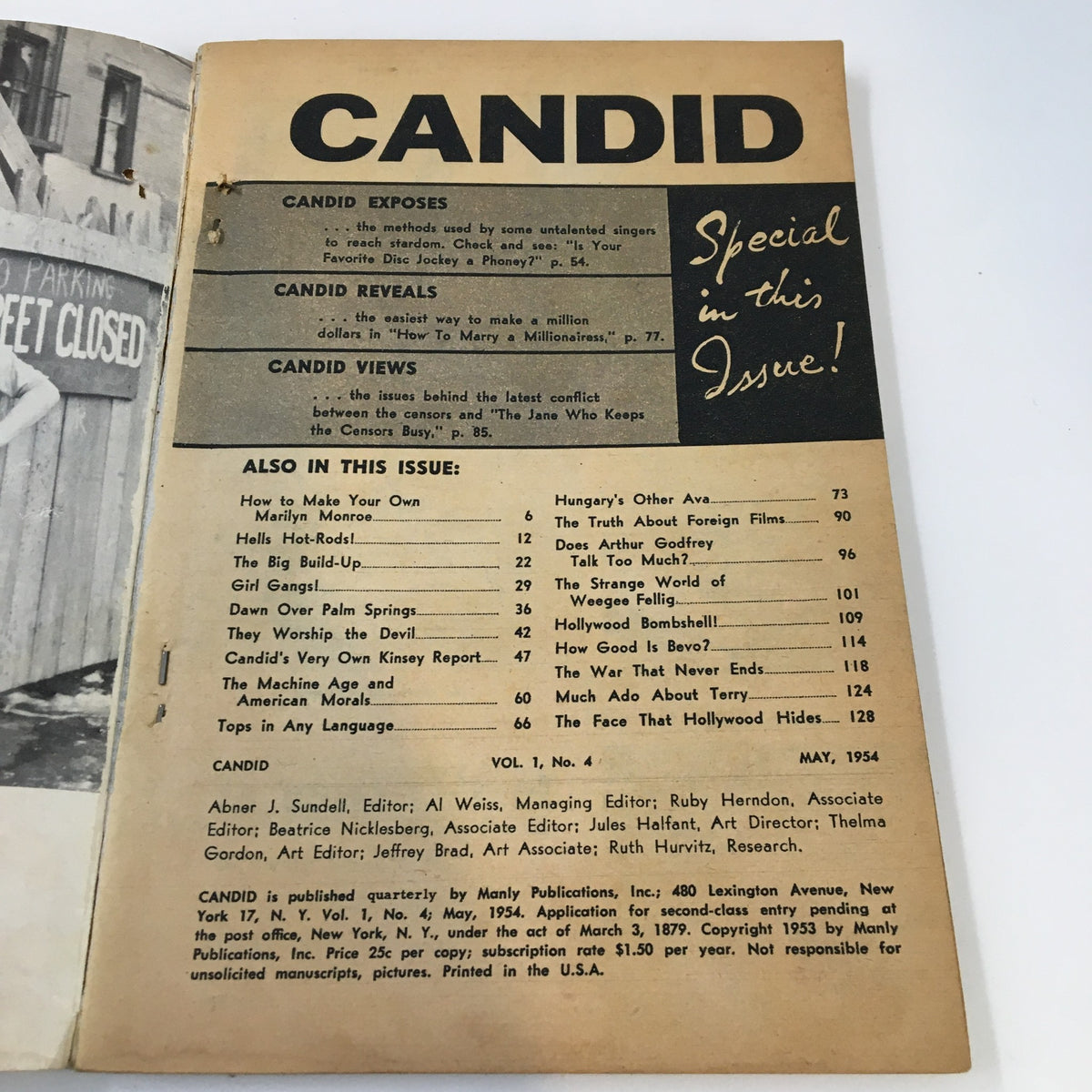
- The cover story "Hell's Hot Rod," reflecting the sensational, attention-grabbing titling common to entertainment magazines of this category. Such titles were designed primarily for newsstand impact. Its pairing with the Gaynor feature reflects the genre's typical blend of glamour and sensationalism.
- Photography and layout consistent with mid-1950s entertainment magazine production standards. Star photography was central to this genre's newsstand appeal. Specific photographers or additional visual credits for this issue are not detailed in available records.
- Additional entertainment-industry content likely present, consistent with the standard format of magazines in this category. Issues typically combined multiple celebrity or sensational features per edition. Specific additional article titles beyond the two noted here are unconfirmed.
- Advertising content reflecting the magazine's general newsstand readership, consistent with genre norms of the period. Specific advertisers appearing in this issue are not detailed in available records. Period advertising of this kind remains a useful secondary research resource for genre historians.
Condition & Rarity
This issue is described as being in good condition overall, a grade reflecting a periodical with visible age and handling but no major structural failures. At this grade, collectors can typically expect minor wear, some surface marks, and handling consistent with a magazine that has survived seven decades since its original newsstand distribution. None of these characteristics are unusual for a periodical of this vintage and category. It is a newsstand copy sold without a label, a variant collectors often value for its cleaner, unobstructed cover presentation, since the absence of a mailing label or subscription marking typically allows the full cover to be viewed without interruption. General-interest entertainment magazines from this category are generally scarce in well-preserved condition, as these disposable newsstand publications were rarely archived with intentional care by their original readers. That scarcity is often compounded for lesser-documented titles within this crowded genre, where surviving quantities and publishing records are less comprehensive than those of more established entertainment magazines. A plastic protective covering, when present, functions as a stabilizing measure intended to preserve a copy's current condition rather than a factor that changes its underlying grade. Collectors evaluating any surviving copy of this issue should examine the binding and cover integrity closely, since these are typically the first points of wear in periodicals of this age and paper stock. Overall, a good-grade, label-free newsstand copy represents a realistic and honestly-described example of what collectors can expect to find for an entertainment magazine of this vintage and category.
Looking for More Issues Like This?
Issues of mid-century entertainment magazines featuring recognizable Hollywood names like Mitzi Gaynor are increasingly hard to track down in well-preserved condition, given how disposable and heavily circulated these newsstand titles were during their original run. Magazines from this crowded, competitive genre also tend to be less comprehensively documented than more established entertainment publications, adding to the challenge of tracing specific issues and titles. For collectors drawn to this particular issue, our 1954 magazines collection is a great place to continue exploring, since it gathers a wide range of titles published during the same year across multiple genres. Browsing by year often surfaces material well beyond a single title or category, offering useful context for the broader publishing landscape surrounding any specific issue. That kind of cross-genre browsing can be especially valuable for collectors interested in mid-century Hollywood coverage more broadly rather than one particular magazine. Readers with a specific interest in Mitzi Gaynor or the wider entertainment press of this period may find related material scattered throughout that same collection. Given how quickly notable celebrity-featured issues from this era tend to be found once discovered, we'd encourage anyone interested in this period to browse broadly rather than searching for a single specific title. The 1954 collection offers a useful starting point for that kind of exploration. There is always more of this history available than a single issue can represent on its own. We hope the broader collection helps round out whatever corner of mid-century entertainment publishing you're most drawn to.