

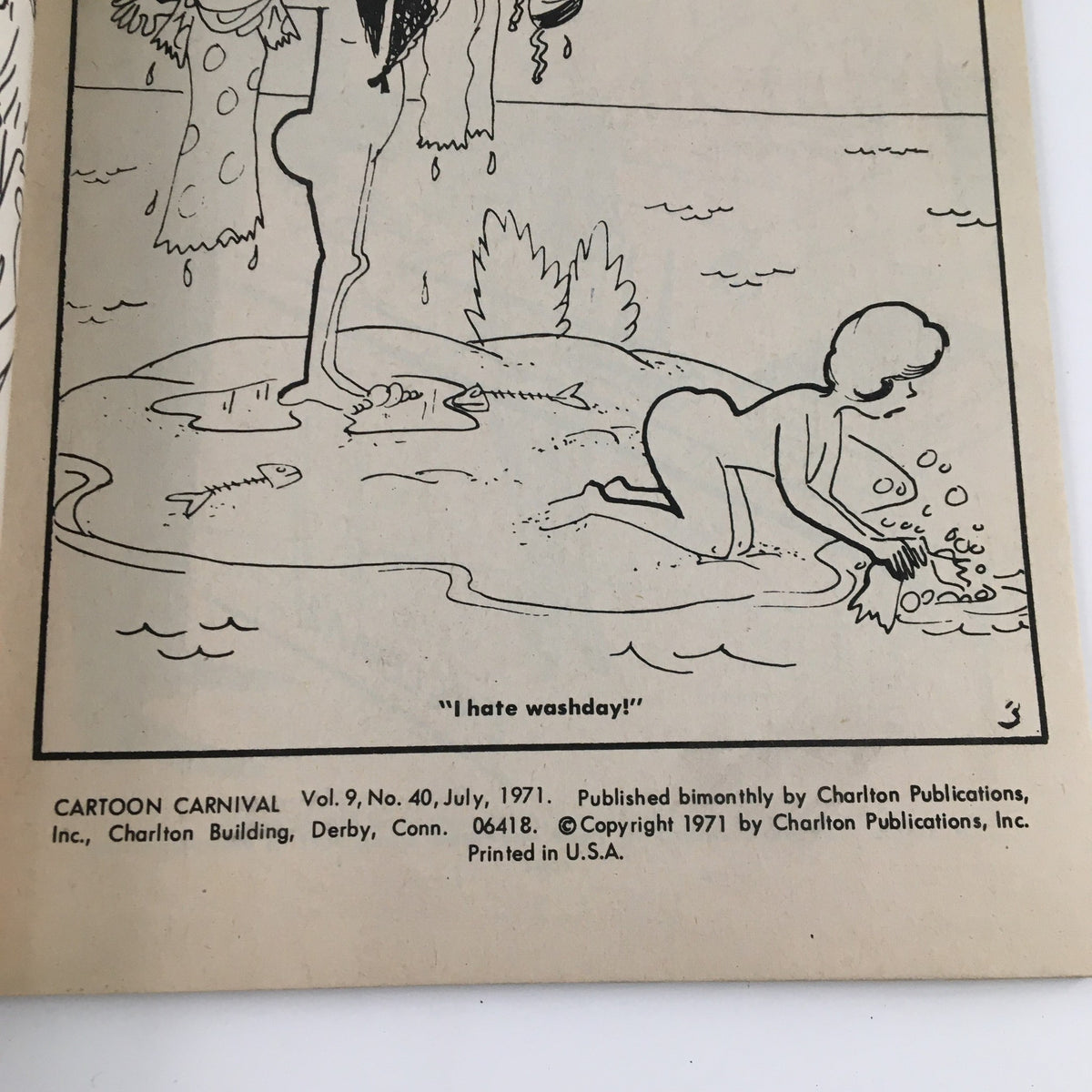


Description
Collector's Note – Why This Issue Matters
This July 1971 issue of Cartoon Carnival, identified as Volume 9, Number 4, belongs to a long-running adult humor and cartoon magazine published by Charlton Publishing between 1962 and 1984, a title built specifically around risqué, double-entendre gag cartoons aimed at an adult male readership rather than the family-friendly humor its generic title might suggest to modern readers. Charlton occupied a distinctive position within American comics and magazine publishing, known throughout the mid-twentieth century for producing low-budget but prolific output across genres including superhero comics, horror titles, and adult humor magazines like this one, often relying on a stable of dependable, journeyman cartoonists rather than the more celebrated names associated with larger publishers. By 1971, men's humor magazines built around single-panel cartoon gags occupied a well-established niche within American newsstand publishing, drawing on a visual gag tradition that stretched back decades through titles addressing similar risqué subject matter with broad comic archetypes: traveling salesmen, desert-island castaways, henpecked husbands, and glamorous but unattainable women. This July 1971 issue, reaching Volume 9 by this point in its run, reflects a magazine with substantial staying power within this specific publishing niche, having maintained regular production for nearly a decade by the time of this issue's release.
Charlton's adult cartoon magazines like Cartoon Carnival relied on a recurring stable of contributing artists who specialized in this particular style of visual humor, producing single-panel gags built around innuendo and comic misunderstanding rather than the more narrative or topical satire found in magazines like Mad or, later, National Lampoon. This format distinguished titles like Cartoon Carnival from general-interest humor publications, positioning it within a specific tradition of adult gag-cartoon magazines that occupied newsstand racks alongside other men's interest publications throughout the 1960s and 1970s. The magazine's combination of color and black-and-white cartoon content, along with its relatively high page count for a publication in this category, reflects Charlton's effort to deliver substantial value within a competitive and crowded segment of adult humor publishing. For collectors today, Charlton's adult cartoon line offers a window into a particular strand of mid-century American humor publishing that has received considerably less scholarly and collector attention than either mainstream comic books or more literary humor magazines, despite its substantial newsstand presence throughout this period.
For collectors, this issue offers a representative artifact of Charlton's long-running Cartoon Carnival line at a point of real maturity in its publishing history, reaching its ninth volume by 1971. That sustained run, within a specific and somewhat under-documented corner of adult cartoon magazine publishing, gives this issue genuine interest within the broader landscape of 1971 magazine collecting, particularly for collectors focused on Charlton Publishing's output or the broader history of mid-century American gag cartoon magazines.
About the Publication
Cartoon Carnival was published by Charlton Publishing from 1962 to 1984, positioned within the category of adult gag-cartoon magazines that delivered risqué, double-entendre humor through single-panel cartoons aimed at a male readership. Charlton itself was a notably prolific and famously low-budget publisher, known throughout the mid-twentieth century for producing a wide range of comics and magazines across genres while relying heavily on in-house production efficiency rather than the larger budgets and more prominent talent rosters of competitors like DC or Marvel. The magazine's format combined dozens of individual cartoon gags per issue, contributed by a recurring roster of journeyman cartoonists who specialized in this particular visual humor style, typically built around comic misunderstandings, innuendo, and broadly drawn stock characters and scenarios. This combination of high cartoon volume and consistently risqué subject matter distinguished Cartoon Carnival within the broader landscape of mid-century American humor publishing, which ranged from family-oriented comic strips to more pointed satirical magazines, with adult gag-cartoon titles like this one occupying their own distinct niche. The magazine's lengthy run, spanning more than two decades, suggests a stable and dedicated newsstand readership for this particular brand of cartoon humor throughout the 1960s, 1970s, and into the early 1980s.
Key Highlights Inside
- A collection of single-panel gag cartoons characteristic of Charlton's adult humor magazine line. These cartoons typically relied on innuendo, comic misunderstanding, and broadly drawn stock characters and scenarios. This format was the defining structural feature of Cartoon Carnival throughout its more than two-decade publishing run.
- Contributions from Charlton's recurring stable of gag cartoonists, artists who specialized in this specific style of risqué visual humor across multiple issues and years. These contributors often worked across several of Charlton's humor titles simultaneously. Their consistent presence helped define the visual and comedic identity of the Cartoon Carnival line.
- A mix of color and black-and-white cartoon content, reflecting Charlton's typical production approach for magazines in this category. This combination allowed the publisher to deliver a substantial page count while managing production costs. The specific balance of color versus black-and-white content for this issue is best confirmed by examining the magazine directly.
- Volume 9, Number 4 numbering, indicating the magazine's substantial maturity within its publishing run by mid-1971. This places the issue within an established, ongoing periodical rather than an early or experimental phase of the title. Sustained numbering of this kind reflects Cartoon Carnival's consistent newsstand presence throughout this period.
Condition & Rarity
Surviving copies of this issue are generally evaluated using the same standards collectors apply across vintage adult humor and cartoon magazines: cover and spine integrity, completeness of interior pages, and overall condition free of significant tears, foxing, or moisture damage. A copy described as being in good condition, with minor wear typical of its age, would be considered a reasonable survivor for a magazine now over fifty years old. The absence of a newsstand label reflects the issue's original point-of-sale distribution rather than a mailed subscription copy, and is generally considered a desirable trait among collectors of magazines in this category. A plastic protective sleeve is a standard and effective safeguard for issues of this vintage, helping prevent further handling wear, UV exposure, and humidity damage, though it has no bearing on the underlying grade of the magazine itself. A stamped mark on the back cover, as noted for this copy, is a common feature found on magazines from this era and is generally regarded by collectors as a minor characteristic of the issue's distribution history rather than a significant detraction from its overall collectibility. Adult cartoon magazines of this period were often read casually and discarded rather than archived, which can make well-preserved surviving copies somewhat less common than their original print runs might suggest. Pages free of brittleness, significant yellowing, or prior tape repairs remain the broader benchmark for a well-preserved copy of any magazine from this era.
Looking for More Issues Like This?
A Cartoon Carnival issue from deep into the title's long publishing run offers a representative piece of Charlton's distinctive adult humor magazine output from the early 1970s. If this particular issue isn't available, it's worth browsing the full range of 1971 magazines for other issues capturing the broader publishing and cultural landscape of that year. That year's magazines, taken together, offer a useful snapshot of the variety found in early-1970s American newsstand publishing, from mainstream news and entertainment titles to specialty publications like this one. Browsing by year can also be a productive way to discover other Charlton titles or related adult humor and cartoon magazines from this same period that might not surface through a narrower search. For collectors specifically focused on Charlton Publishing's output or the broader history of mid-century gag cartoon magazines, this kind of year-based browsing tends to surface other relevant period material as well. Whichever angle appeals most, the 1971 collection is a solid starting point for going deeper into this distinctive corner of American magazine and cartoon history.