



Description
Collector's Note – Why This Issue Matters
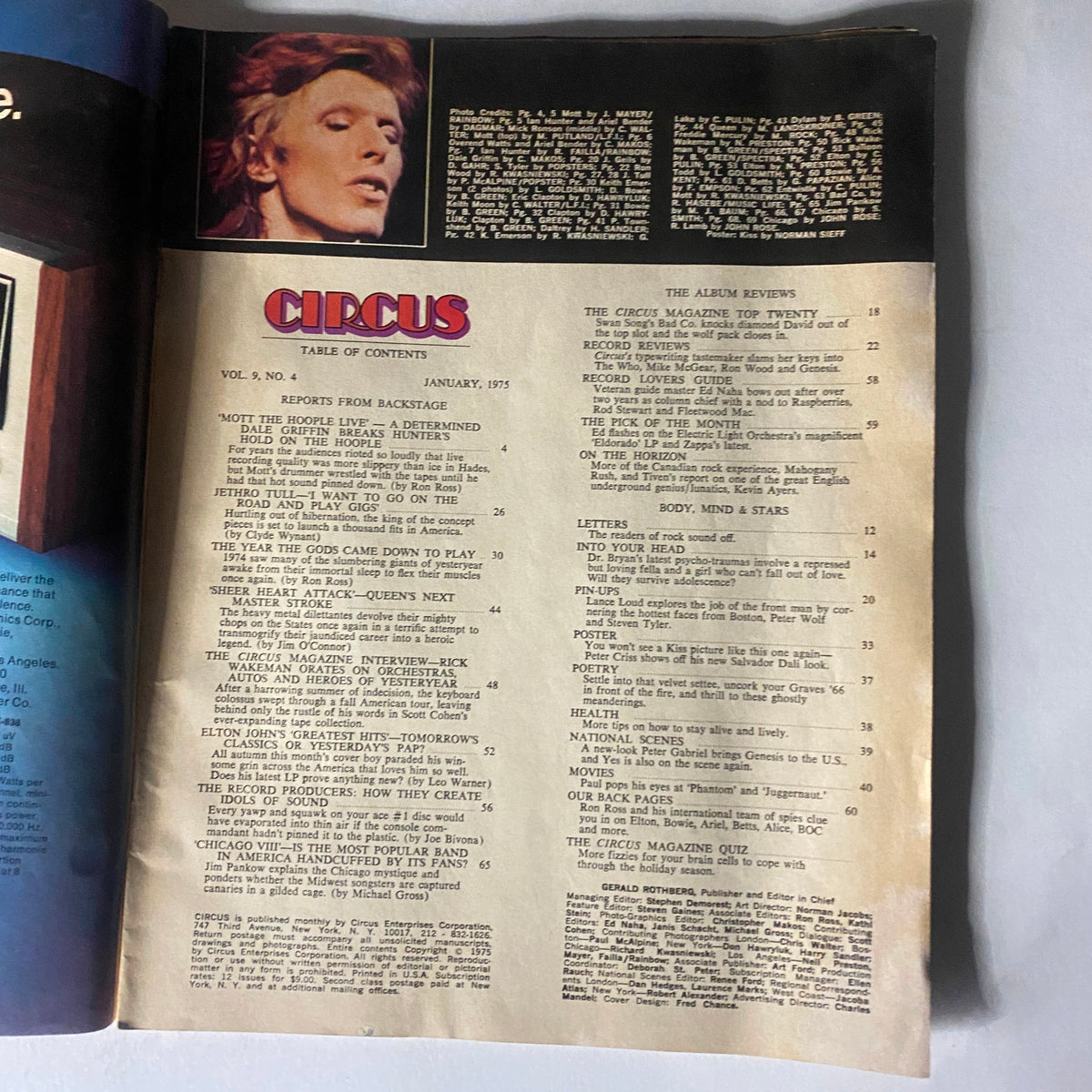
The January 1975 issue of Circus Magazine — Volume 9, Number 4 — featuring Elton John, documents one of the most commercially dominant and culturally omnipresent figures in the history of popular music at the absolute peak of his powers. By January 1975, Elton John had achieved a level of commercial saturation that was genuinely without precedent in rock music history — in 1974 alone he had released two number-one albums (Caribou and Goodbye Yellow Brick Road), scored multiple number-one singles, and sold out stadium after stadium across the United States in tours that were among the highest-grossing in rock history to that point. His partnership with lyricist Bernie Taupin had produced an extraordinary run of creative output from 1970 through 1974 — Tumbleweed Connection, Madman Across the Water, Honky Château, Don't Shoot Me I'm Only the Piano Player, Goodbye Yellow Brick Road, and Caribou constituted one of the most sustained creative and commercial streaks in popular music — and his stage persona, with its elaborate costumes, oversized glasses, and theatrical performance energy, had made him one of the most visually distinctive figures in the glam rock era. A Circus Magazine cover feature on Elton John in January 1975 was therefore not a discovery or an introduction — it was a document of a phenomenon that was dominating American popular music as completely as any artist ever had. For collectors building archives around Elton John's extraordinary magazine cover history, the January 1975 Circus issue is a primary document of his career at its most commercially and creatively intense peak.
The specific context of January 1975 adds historical layers that make this issue more than a routine celebrity cover. Elton John had just launched his own record label, Rocket Records, in 1973, and had signed Kiki Dee and Neil Sedaka among others, demonstrating that his commercial ambitions extended well beyond his own recording career. His relationship with MCA Records in the United States and DJM in the UK was producing extraordinary commercial results even as the creative demands of his prolific output were beginning to generate the kinds of personal and professional pressures that would eventually affect his work in the late 1970s. January 1975 also arrived just months before the release of Captain Fantastic and the Brown Dirt Cowboy in May 1975, which would become the first album in American chart history to enter the Billboard 200 at number one — an achievement that demonstrated the degree to which his commercial momentum was still accelerating rather than plateauing. A Circus Magazine feature from January 1975 captures him at the precise moment of that acceleration, before the creative exhaustion and personal difficulties that would characterize the second half of the decade. Collectors tracking Circus Magazine's coverage of 1970s rock's defining figures will find this issue one of the publication's most historically significant entries from its peak years of rock journalism, and those building archives of the rock music publishing landscape from 1975 will find it a primary document of the year's dominant commercial presence.
The listing's note that no pin-up is included is a meaningful and honest completeness disclosure for a Circus Magazine issue from this era. Circus regularly included pull-out pin-up posters of major rock artists as a standard feature — these inserts were among the most eagerly collected and most frequently removed elements of the publication, and their absence or presence is a significant factor in evaluating any surviving Circus issue's completeness. The transparent disclosure of the missing pin-up in this listing reflects the kind of collector-focused honesty that allows informed acquisition decisions, and it is worth noting for anyone evaluating this issue's documentary completeness versus copies that retain their original inserts.
About the Publication
Circus Magazine was founded in 1966 and developed through the late 1960s and 1970s into one of the most widely read American rock music publications, competing directly with Creem and Hit Parader for a readership of teenage and young adult rock fans who wanted more substantial coverage than the fan magazines provided but in a more accessible format than the more critically oriented Rolling Stone offered. By Volume 9 in January 1975, Circus had refined its editorial formula into a consistent and commercially successful combination of artist profiles, concert reviews, music news, and the pin-up poster inserts that were central to its appeal to a younger demographic. Its coverage of glam rock, hard rock, and the emerging arena rock scene of the mid-1970s was particularly strong, and its access to major acts like Elton John, Led Zeppelin, and Kiss reflected the publication's genuine standing within the rock music industry as a vehicle that could reach the core demographic of committed young rock fans. The January 1975 issue falls within the publication's peak commercial period, when its combination of accessible journalism and collectible visual content was generating its strongest readership and most significant cultural influence within the rock fan community.
Key Highlights Inside
- Elton John is the confirmed cover and feature subject of this issue, documented in January 1975 at the absolute peak of his commercial and creative trajectory — in the wake of the extraordinary 1974 dual-album release of Goodbye Yellow Brick Road and Caribou, and just months before the release of Captain Fantastic and the Brown Dirt Cowboy, which would become the first album to enter the Billboard 200 at number one.
- The listing confirms insightful articles and interviews with artists of the era consistent with Circus Magazine's editorial format — a Circus Elton John feature in January 1975 would have engaged with his career, his creative process, his theatrical stage persona, and the commercial phenomenon that his run of mid-1970s releases had produced, in the accessible but substantive style that distinguished Circus from both fan magazines and more critically oriented competitors.
- The January 1975 publication date places this issue within the glam rock era's most commercially dominant moment in American popular music — Elton John's theatrical aesthetic, his elaborate costumes, and his oversized stage personality were defining visual and cultural references for the genre's mainstream expression, making a Circus feature on him in this period a primary document of how rock journalism was processing and presenting that aesthetic to its readership.
- The confirmed absence of the pin-up poster insert is a meaningful completeness note for collectors — Circus pin-ups were among the publication's most frequently removed elements, and the transparent disclosure of this absence allows accurate assessment of this issue's completeness relative to copies that retain their original inserts.
- Note: Specific article titles, named interviewers, additional featured artists, and detailed interior content beyond the confirmed Elton John cover feature are unconfirmed for this issue. The highlights above are drawn from listing details, the confirmed cover subject, and the publication's documented editorial approach during this period.
Condition & Rarity
Surviving copies of this issue are graded at the Excellent level with light wear — a strong condition designation for a fifty-year-old rock music magazine that indicates minimal aging and careful preservation across half a century. For a Circus Magazine from January 1975, excellent condition with light wear means a copy that retains cover gloss, spine integrity, and interior page quality without the significant tanning, surface scuffing, or structural damage that affects lower-grade copies from the same era. The publication was printed on lightweight coated stock that reproduces color photography with reasonable fidelity but shows handling wear readily and is susceptible to tanning and brittleness over time — making well-preserved copies from this period proportionally less common than the magazine's substantial original circulation would suggest. The confirmed absence of a mailing label indicates newsstand rather than subscriber origin, preserving the cover in its original presentation without adhesive surface disruption — a positive condition attribute for a publication whose cover imagery is the primary visual collector consideration. The plastic protective covering currently housing this copy is appropriate preservation practice, helping to maintain cover surface quality and prevent further spine and edge deterioration during handling and storage. Collectors evaluating surviving copies of this specific issue should note the pin-up absence when comparing to copies that retain their complete original contents, as the insert's presence or absence affects the issue's documentary completeness regardless of its physical condition grade.
Looking for More Issues Like This?
Circus Magazine issues featuring Elton John from his mid-1970s commercial peak are among the most consistently sought-after entries in the publication's archive for both Elton John collectors and serious 1970s rock music magazine enthusiasts, and the January 1975 Volume 9 cover — documenting him at the precise moment of his greatest commercial dominance — is one of the more historically specific and visually significant examples from that era. The Elton John magazine collection at OriginalMagazines.com is the most focused place to explore his cover history across multiple titles and years, documenting one of the most extensively covered careers in popular music history. The Circus Magazine collection offers the broadest view of the publication's rock journalism archive, and the 1975 magazines collection provides a wide cross-section of American music publishing from one of the decade's most commercially energetic years in rock.