



Description
Collector's Note – Why This Issue Matters
The April 22, 1950 issue of Collier’s Magazine is identified as Volume 125, Number 16. Its painted cover by Earl M. Scott depicts a fisherman standing in a fast-moving rocky stream while casting toward the water. The outdoor scene is closely related to Raymond R. Camp’s interior article “If You Want to Catch Trout.” A separate cover line promotes the more controversial feature with the wording “The Right to Kill? A Famous Doctor Speaks Up.” That phrase is not the complete title of the article, which appears inside as “Euthanasia: To Be or Not To Be.” The juxtaposition of peaceful recreational artwork and an ethically disturbing medical debate demonstrates the varied editorial character of a large mid-century weekly. The issue should therefore be cataloged through both its Earl M. Scott fishing cover and its prominent Foster Kennedy article.
Foster Kennedy was an influential neurologist whose name remains associated with the neurological condition known as Foster Kennedy syndrome. His article did not merely discuss voluntary decisions by terminally ill adults, which are central to many modern debates about assisted dying. Instead, Kennedy promoted state-sanctioned death for certain children he classified as profoundly intellectually disabled and incapable of improvement. The essay had first appeared in Collier’s in 1939 and was republished in the April 1950 issue. Its claims belonged to a broader eugenic tradition that attempted to rank human lives according to disability, social utility, heredity, and the perceived financial burden of care. Such ideas had already produced coercive sterilization laws and had acquired even more disturbing meaning after the exposure of Nazi medical crimes. The article is historically important precisely because it reveals how discriminatory medical arguments could still be presented to a mainstream American family readership after the Second World War.
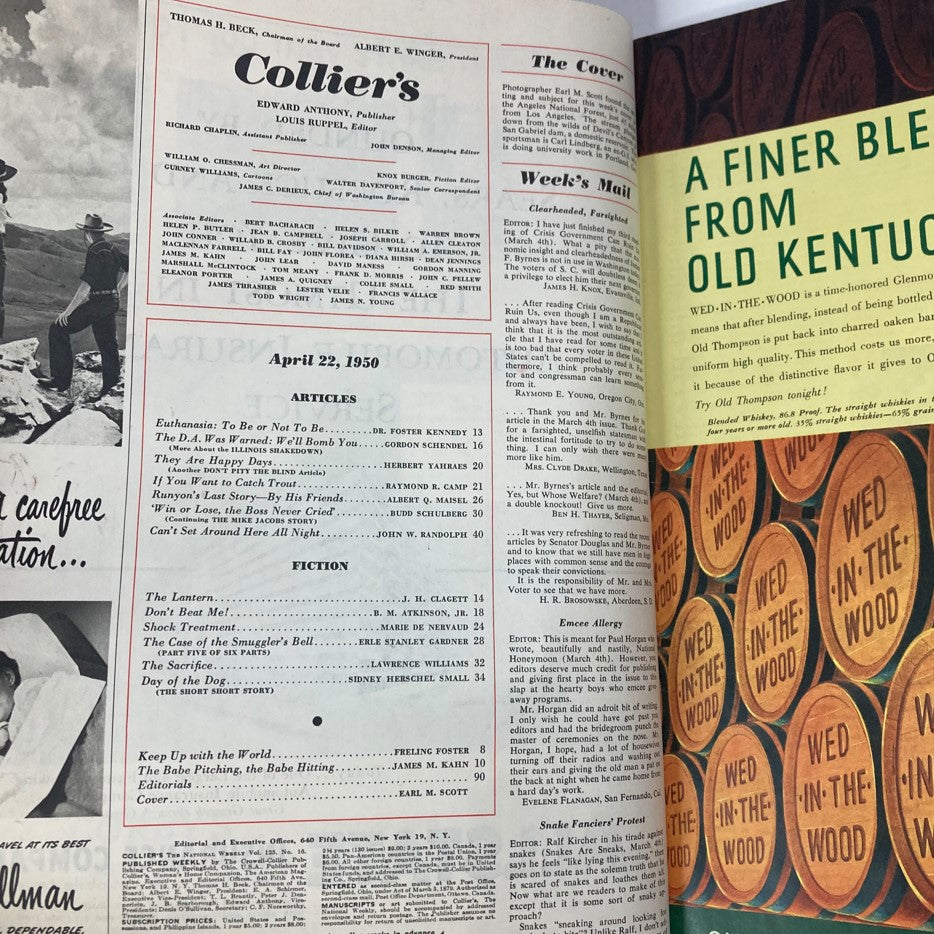
The magazine’s significance extends beyond that controversial feature through its combination of journalism, social reporting, sports, crime history, and fiction. Gordon Schendel concludes his investigation of political and gambling corruption in Illinois with “The D.A. Was Warned: We’ll Bomb You.” Herbert Yahraes completes Collier’s series about blind Americans with “They Are Happy Days,” while Albert Q. Maisel reconstructs Damon Runyon’s unfinished final project through the recollections of his friends. Budd Schulberg continues his serialized biography of boxing promoter Mike Jacobs with “Win or Lose, the Boss Never Cried.” Erle Stanley Gardner contributes the fifth installment of “The Case of the Smuggler’s Bell,” later associated with the Perry Mason novel The Case of the Musical Cow. Short fiction by J. H. Claygett, B. M. Atkinson Jr., Marie de Nervaud, Lawrence Williams, and Sidney Herschel Small further broadens the literary content. Related journalism and fiction can be explored through other vintage issues of Collier’s Magazine and through additional magazines published in 1950.
About the Publication
Collier’s was an American general-interest magazine founded by Peter Fenelon Collier in 1888. It began under the title Collier’s Once a Week and later became widely known as Collier’s: The National Weekly. The publication combined investigative journalism, political commentary, fiction, humor, illustration, photography, and extensive advertising. Its reported articles addressed government, business, labor, medicine, crime, science, war, education, transportation, entertainment, and everyday American life. Collier’s became particularly respected for reform-oriented journalism that exposed corruption, unsafe products, poor working conditions, and failures of public administration. Fiction remained equally important, with short stories and serialized novels appearing beside factual reporting. Established writers shared its pages with authors who were still developing their national reputations. Illustrated covers could be connected with an interior feature, represent a seasonal activity, or function as independent works of popular art. In 1950, the magazine was edited by Louis Ruppel and published by the Crowell-Collier Publishing Company. It continued as a weekly until 1953 and then adopted a biweekly schedule before ending publication in January 1957. Surviving issues now provide a broad record of American journalism, literature, illustration, advertising, and social attitudes during the first half of the twentieth century.
Key Highlights Inside
- “Euthanasia: To Be or Not To Be” by Dr. Foster Kennedy is promoted on the cover as “The Right to Kill? A Famous Doctor Speaks Up.” The article advocates the non-voluntary death of certain severely disabled children rather than limiting its argument to voluntary end-of-life decisions by competent adults. It should be studied critically within the history of eugenics, disability discrimination, medical authority, and twentieth-century bioethics.
- Gordon Schendel’s “The D.A. Was Warned: We’ll Bomb You” concludes the magazine’s two-part investigation of corruption and illegal gambling in Illinois. The report examines intimidation directed toward officials attempting to challenge an entrenched political and criminal system. Its allegations, individuals, and legal outcomes should be evaluated through the complete article and supporting public records.
- Herbert Yahraes’s “They Are Happy Days” is the concluding installment of Collier’s “Don’t Pity the Blind” series. The article presents blind people through education, work, independence, and community participation rather than treating disability solely through tragedy. Its language and assumptions remain products of 1950 and should be compared with later disability-rights scholarship and testimony from blind individuals.
- Albert Q. Maisel’s “Runyon’s Last Story—By His Friends” concerns writer Damon Runyon, while Budd Schulberg’s “Win or Lose, the Boss Never Cried” continues the serialized story of boxing promoter Mike Jacobs. These features connect literary remembrance with the business, personalities, and controversies of professional boxing. The issue also contains James M. Kain’s sports feature “The Babe Pitching, the Babe Hitting.”
- Erle Stanley Gardner’s “The Case of the Smuggler’s Bell” appears as the fifth of six serialized installments. Additional fiction includes “The Lantern,” “Don’t Beat Me!,” “Shock Treatment,” “The Sacrifice,” “Day of the Dog,” and Part Three of William R. Scott’s “When You Come Home.” Together, these works demonstrate how Collier’s placed mystery, drama, short fiction, and continuing narratives beside investigative and service journalism.
Condition & Rarity
The April 22, 1950 issue is described as being in excellent overall condition with light wear appropriate to its age. Such wording suggests an attractive and structurally sound magazine but should not replace direct examination of the supplied photographs. The listing states that the photographed magazine is the exact physical issue represented. Minor age-related wear may include slight edge rubbing, softened corners, shallow creases, surface impressions, or modest stress near the stapled spine. The written description does not clearly confirm whether a mailing or address label is present. That characteristic should therefore be established from the photographs rather than inferred from another surviving example. A plastic protective covering accompanies the magazine and may reduce further exposure to dust, fingerprints, and surface abrasion. The covering does not verify page completeness, firm staples, secure cover attachment, or the condition of the paper inside. Particular attention should be given to the Earl M. Scott cover, the Foster Kennedy article, and the serialized Erle Stanley Gardner pages. Inspection should also check for clipping, writing, staining, moisture exposure, brittleness, fading, loose leaves, tape, and previous repairs. The controversial medical article and notable contributors create clear historical interest, but rarity and final grade depend upon documented availability and the preservation of the individual magazine.
Looking for More Issues Like This?
Exact Collier’s issues can require patience to identify when research is centered on a particular article, cover artist, serial installment, or publication date. The April 22, 1950 edition is especially relevant to readers studying Foster Kennedy, medical ethics, American eugenics, disability history, and postwar popular journalism. Its literary contents also make it useful for research involving Erle Stanley Gardner, Budd Schulberg, Damon Runyon, and mid-century magazine fiction. Related investigative features, serialized stories, illustrations, and social commentary can be explored through the broader collection of vintage Collier’s magazines. Neighboring issues help reconstruct continuing series involving Illinois corruption, blind Americans, Mike Jacobs, and “The Case of the Smuggler’s Bell.” They also show how Collier’s balanced serious public questions with recreation, sports, humor, crime reporting, and fiction. The collection of original magazines from 1950 provides a wider view of the year in which the article was republished. Publications from that year preserve debates about health, politics, science, disability, crime, literature, advertising, and postwar American life. Comparing several titles helps distinguish Collier’s mixture of investigative journalism and popular fiction from the photographic or news-summary formats used by competing magazines. Together, the Collier’s and 1950 collections provide a useful foundation for continued research into American publishing and medical controversy at mid-century.