



Description
Collector's Note – Why This Issue Matters
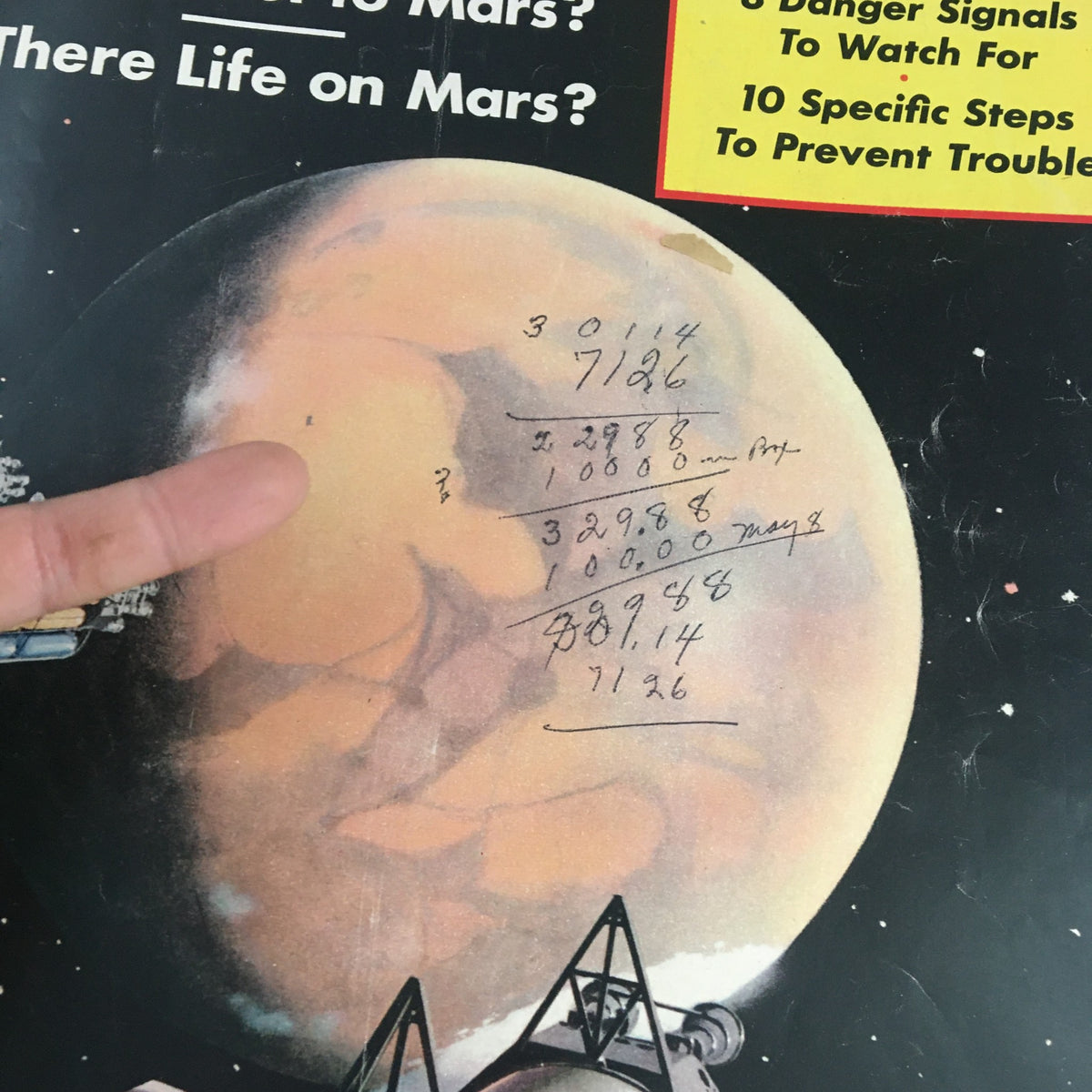
The April 30, 1954 issue of Collier's Magazine is one of the most historically significant single issues in the publication's long run — and one of the most important American magazine documents in the entire history of space exploration advocacy. The cover, painted by Chesley Bonestell, depicts a winged rocket preparing to descend to the Martian surface from orbit, with cargo ships waiting above. Bonestell was the defining space artist of the twentieth century, whose paintings shaped the visual imagination of the Space Age before the Space Age had officially begun, and his work for Collier's across the early 1950s is now recognized as foundational to the public's conception of what space travel would look like. A Bonestell Mars cover from 1954 is a primary artifact of that visual tradition at its most ambitious.
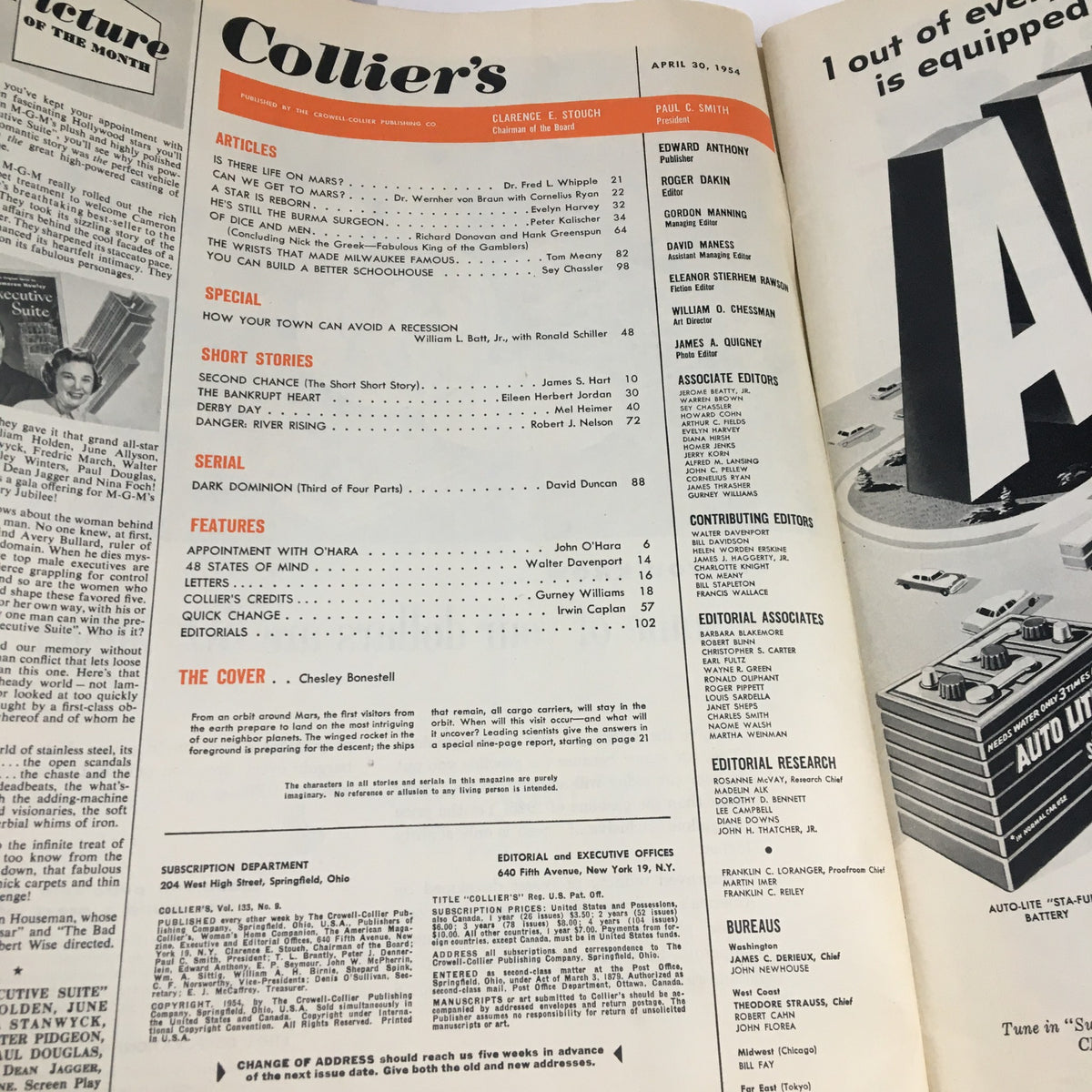
The contributors inside this issue represent the absolute summit of mid-century space science and science communication. Dr. Wernher von Braun — the German-born rocket engineer who had led Nazi Germany's V-2 program and would go on to direct NASA's Saturn V development — contributes a piece on space travel. Dr. Fred L. Whipple, the Harvard astronomer who had coined the "dirty snowball" theory of comets and was one of the most respected planetary scientists in America, addresses the question of life on Mars. Dr. Cornelius Ryan — later famous as the author of The Longest Day — writes on the possibility of reaching Mars. This is not speculative popular science writing by generalists; it is serious scientists and communicators making the case for human space exploration to a mass American readership at the precise moment when such exploration was beginning to seem genuinely achievable. For collectors focused on Collier's Magazine's celebrated space series of the early 1950s, this issue is among the most significant numbers in that landmark editorial project.
The Collier's space series — which ran across multiple issues from 1952 through 1954 — is now credited by historians of the Space Age as one of the primary vehicles through which the American public first developed a coherent and scientifically grounded vision of human space exploration. The series was closely connected to Wernher von Braun's advocacy for a U.S. space program and helped build the public and political constituency that would eventually support NASA's creation in 1958. This April 1954 issue, with its Mars-focused nine-page special report, represents the series at its most visually spectacular and scientifically ambitious. Collectors building archives of American magazine culture in 1954 will find this one of the most culturally consequential single numbers of that year — a document of the moment when the Space Age was being imagined into existence.
About the Publication
Collier's Weekly — published as Collier's: The National Weekly by the early 1950s — was founded in 1888 and by the mid-twentieth century was one of the most widely circulated general interest magazines in America, competing directly with The Saturday Evening Post and Life. Its editorial format combined investigative journalism, fiction, sports reporting, humor, and cultural commentary, and its decision to commission the extended space exploration series of 1952–1954 — bringing together leading scientists, visionary artists, and skilled science communicators — represented one of the most ambitious editorial projects in the magazine's history. Collier's ceased publication in 1957, making its space series issues among the most historically significant items in the publication's legacy and among the most actively collected numbers in its entire run.
Key Highlights Inside
- Cover painting by Chesley Bonestell — depicting a crewed Mars landing from orbit, executed by the most influential space artist of the twentieth century as part of Collier's landmark space exploration series.
- "Is There Life on Mars?" by Dr. Fred L. Whipple — Harvard astronomer and one of the most respected planetary scientists of his generation addressing the question that captivated mid-century American public imagination.
- "Can We Get to Mars?" by Dr. Cornelius Ryan — space advocacy journalism from a writer who would later achieve fame as the definitive chronicler of D-Day, contributing here to the most significant popular science editorial project of the early Space Age.
- "A Star Is Reborn" by Dr. Wernher von Braun with Evelyn Harvey — a contribution from the rocket engineer who would go on to lead NASA's Saturn V program, writing for a mass American audience about the possibilities of space exploration years before NASA existed.
- A nine-page special report on Mars exploration, described on the cover as providing answers from "leading scientists" — one of the most substantive and visually spectacular treatments of human Mars exploration ever published in a general interest American magazine.
- Fiction and features by John O'Hara and other contributors, alongside the full editorial complement of a mid-1954 Collier's issue — providing the complete context of a major American general interest publication at the height of its space advocacy editorial project.
Condition & Rarity
Graded Good, as a newsstand copy — no address label — with minor wear and some writing noted throughout, consistent with a magazine that passed through active use before being preserved. The no-label newsstand designation is the preferred form for display-oriented collectors, preserving the Bonestell cover painting without subscriber label defacement — a meaningful consideration given the cover's status as a significant work of Space Age illustration. Writing throughout indicates previous ownership and active engagement with the content, which does not affect readability but is a factor in strict collector grading. A protective plastic sleeve provides appropriate ongoing preservation for a publication now more than seventy years old. Collier's space series issues attract collectors across vintage magazine history, Space Age ephemera, Chesley Bonestell art collecting, and the history of NASA's origins simultaneously — a broad and active collector base that sustains consistent demand for surviving copies of any honest grade.
Looking for More Issues Like This?
Collier's space series issues are among the most historically significant items in vintage American magazine collecting, and the April 1954 Mars issue — with its Bonestell cover and contributions from von Braun, Whipple, and Ryan — is one of the most celebrated numbers in that series. The full Collier's Magazine collection at OriginalMagazines.com is the best place to explore available issues from the publication's remarkable run. For collectors building a broader archive of mid-1950s American print culture and the early Space Age, the complete 1954 magazine archive offers a wide range of titles from a year that sits at the threshold of one of the most transformative decades in American scientific and political history.