



Description
Collector's Note – Why This Issue Matters
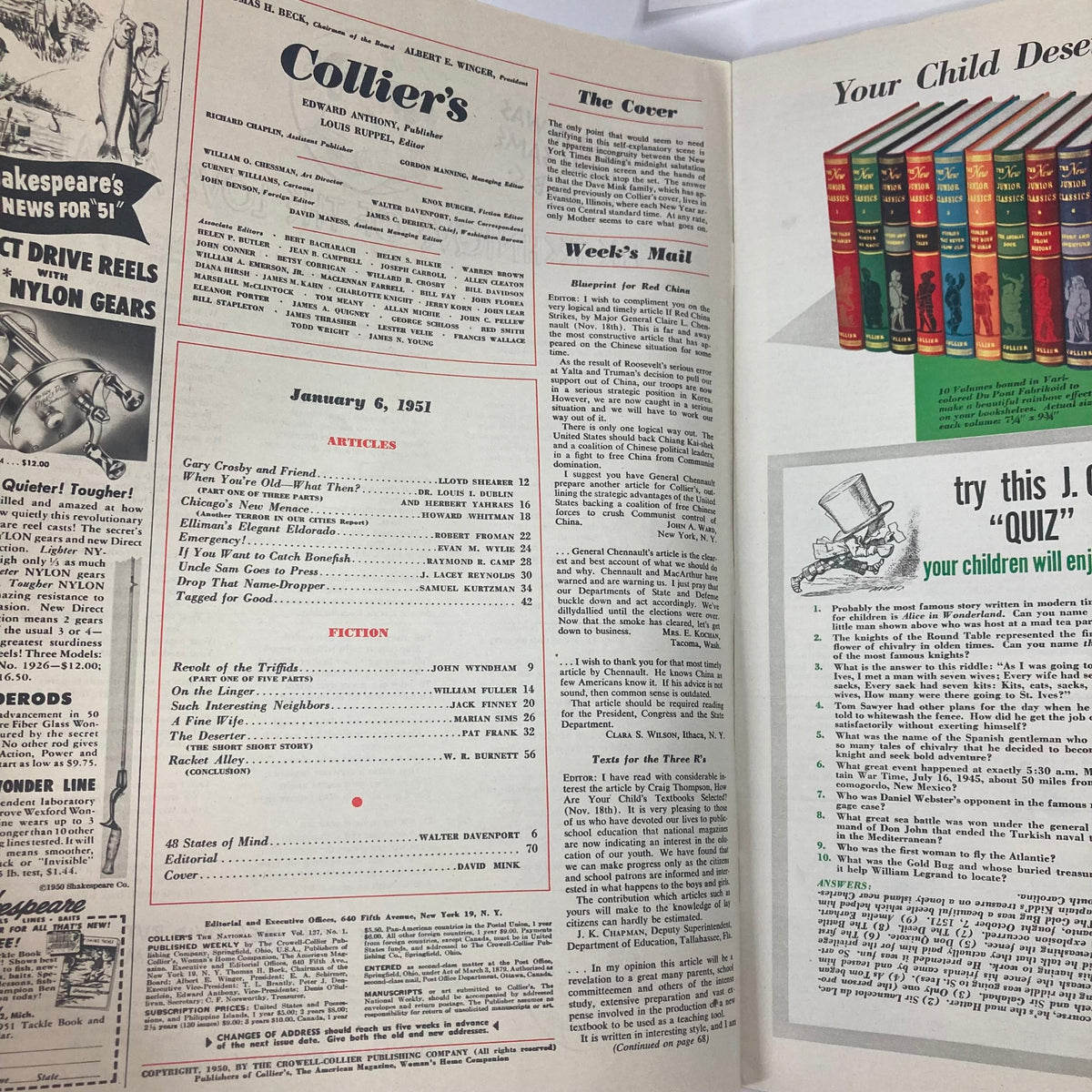
This January 6, 1951 issue of Collier's holds a genuinely significant place in science fiction history, almost entirely independent of its Gary Crosby cover feature. This is the very first installment of "Revolt of the Triffids," the serialized version of what would become The Day of the Triffids, and it marks the first published appearance of the name "John Wyndham" itself, the pen name under which the author would publish all of his major science fiction novels going forward. Published in five consecutive weekly issues running from January 6 through February 3, 1951, this Collier's serialization actually predates the first hardcover book edition by nearly a year, making this specific issue the literal debut of one of the most influential post-war British science fiction novels ever written, a book whose central monster gave an entirely new word to the English language.
The same issue also contains "Such Interesting Neighbors" by Jack Finney, another piece of genuine science fiction history in its own right. Finney was still several years away from the 1955 novel that would make him famous, The Body Snatchers, the basis for Invasion of the Body Snatchers, but this story, with its theme of ordinary suburban life quietly disrupted by something stranger, anticipates the fascination with time travel and uncanny domesticity that would define his later, more celebrated work. Finding two genuinely formative pieces of mid-century American and British science fiction in a single issue, by two authors who would each go on to define entire strands of the genre, is the kind of detail that gives this specific Collier's issue real significance to collectors of pulp and genre fiction history, well beyond its value as a general 1951 magazine.
None of this diminishes the cover feature itself, which centers on Gary Crosby, son of Bing Crosby, in a piece by Lloyd Shearer, a journalist and editor who would go on to a long career in celebrity profile writing. Collier's in this era regularly combined exactly this kind of mix, mainstream celebrity profiles and topical journalism alongside serialized genre fiction that was, at the time, considered disposable entertainment rather than literature destined to endure. That a single weekly issue of a general-interest magazine could house both a Bing Crosby family profile and the literal birth of The Day of the Triffids says a great deal about how casually genre fiction was treated by the mainstream press of the period, even as it was producing work that would go on to be translated into more than a dozen languages and adapted repeatedly for film, television, and radio. This particular Collier's issue is a vivid example of that overlap.
About the Publication
Collier's was one of the major American general-interest weekly magazines of the first half of the 20th century, known for its mix of journalism, celebrity profiles, serialized fiction, and consumer advertising aimed at a broad national readership. By the early 1950s, the magazine was a well-established home for both topical reporting, including investigative series on social issues of the day, and popular fiction, regularly publishing serialized novels and short stories from major American and international writers alongside its news and feature content. The magazine's large physical format and lavish color illustration, including dramatic interior artwork for its serialized fiction, set it apart from many of its newsstand competitors and made it a particularly attractive venue for authors seeking a wide, mainstream audience. Collier's would continue publishing until 1957, and the kind of fiction-and-journalism hybrid format reflected in this issue was characteristic of its identity throughout the postwar period. Specific editorial details unique to this particular issue beyond what's reflected in its table of contents are not independently confirmed here, but the magazine's general format and editorial approach during this era are well documented.
Key Highlights Inside
- "Revolt of the Triffids," Part One of Five, by John Wyndham — the very first published installment of what would become The Day of the Triffids, and the first work ever published under the "John Wyndham" name. This serialization in Collier's predates the novel's first hardcover edition later that same year, making this issue the literal debut appearance of one of the most influential post-apocalyptic novels of the 20th century.
- "Such Interesting Neighbors" by Jack Finney — a short story published several years before Finney's breakout novel The Body Snatchers (1955), which became the basis for Invasion of the Body Snatchers. The story would later be adapted for television twice, including a 1987 episode of Steven Spielberg's Amazing Stories.
- Cover feature "Gary Crosby and Friend" by Lloyd Shearer, profiling Bing Crosby's son. This places the issue within Collier's broader pattern of pairing mainstream celebrity profiles with its fiction and feature content.
- "Racket Alley," the concluding installment of a serialized crime novel by W.R. Burnett, the prolific American crime novelist whose other works include Little Caesar and The Asphalt Jungle, both adapted into landmark films of their respective eras.
- Beyond these specific pieces, the remaining articles and stories listed in the issue's table of contents, including the multi-part "When You're Old—What Then?" series and the "Terror in Our Cities" report on Chicago, reflect Collier's characteristic mix of social journalism and topical reporting for the period. Specific content beyond the listed titles and credited authors is not independently confirmed here.
Condition & Rarity
Issues of this type are generally evaluated by collectors against a few key benchmarks: whether the copy is a newsstand edition or a subscription copy, whether a mailing label is present, and the overall condition of the cover, spine, and interior pages. Because this is the first installment of the original "Revolt of the Triffids" serialization, condition and completeness carry particular weight for collectors specifically pursuing Wyndham or early science fiction material, since this issue represents the literal first printing of a genre landmark rather than simply a vintage periodical of general interest. The creases on the front cover and within the pages noted in this listing, along with occasional age-related marks, are common and expected characteristics for a large-format weekly magazine of this vintage, which was printed on paper stock not intended for long-term archival preservation. Collectors pursuing complete five-issue runs of the original Triffids serialization, spanning January 6 through February 3, 1951, should note that the condition and availability of each individual installment can vary considerably, making a well-preserved first installment like this one a meaningful piece on its own even outside a complete set. Protective plastic sleeving is a common and recommended storage method for vintage periodicals like this one, helping to guard against further handling wear without altering the item itself. Collectors evaluating any surviving copy of this issue should examine the extent of the noted creases and marks closely, along with the overall integrity of the spine and binding, since these factors affect both display quality and long-term value, particularly for an issue of this literary significance.
Looking for More Issues Like This?
A Collier's issue containing the very first installment of "Revolt of the Triffids," the original serialized debut of The Day of the Triffids and the first appearance of the John Wyndham name, is a genuinely significant find for collectors of science fiction history and pulp-era periodicals alike. If you're researching or collecting from this storied publication, our Collier's collection is a strong place to start, including potential opportunities to track down the remaining four installments of this same serialization. Our broader 1951 magazines collection offers a wider view of that year in American print as well. Whether your interest is in the Triffids serialization specifically, in Collier's as a publication, or in 1951 as a year in magazine history, both collections are worth exploring together.