



Description
Collector's Note – Why This Issue Matters
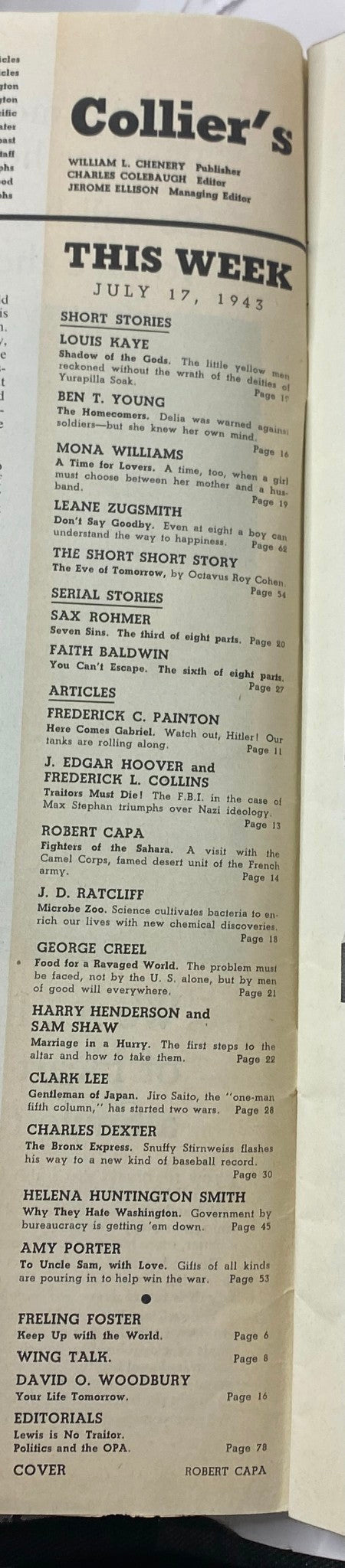
The July 17, 1943 issue of Collier's Magazine is a primary document of exceptional historical significance — and the specific combination of its cover attribution to Robert Capa and its fully documented table of contents makes it one of the more extraordinary single issues in the wartime American magazine archive. Robert Capa was in July 1943 already established as the most celebrated combat photographer in the world, the man who had photographed the Spanish Civil War with a directness and emotional immediacy that had transformed photojournalism's relationship to modern warfare. His D-Day Normandy photographs were still a year away, but his reputation in July 1943 was already formidable — he had covered the Chinese war against Japan, the Spanish Civil War, and the North African campaign, and his presence in Collier's as both a cover photographer and an article contributor for "Fighters of the Sahara" gave this specific issue a dual documentary significance: it is simultaneously a primary document of Capa's wartime photojournalism in its mature phase and a primary document of the North African campaign's final weeks through the eyes of its most important visual witness. The Camel Corps feature Capa contributed — a visit with the French army's desert unit — is a piece of wartime journalism from one of the most accomplished practitioners of the form, produced in the specific final weeks of the North African campaign that had concluded with Allied victory in Tunisia just two months earlier. Collectors building a focused archive of wartime American magazine journalism will find the Collier's magazine collection an essential resource for the publication's coverage of World War II across its most historically significant issues.
The fully documented table of contents of this issue reveals a wartime Collier's operating at the height of its editorial ambition and commercial authority — a publication assembling some of the most significant journalism, fiction, and cultural commentary of the moment into a single weekly package of remarkable breadth. Frederick C. Painton's "Traitors Must Die!" documenting the FBI's case against Nazi agent Max Stephan reflects the domestic security journalism that was a consistent concern of the wartime press. Clark Lee's "Gentleman of Japan" profiling Jiro Saito as a "one-man fifth column" reflects the Pacific War's intelligence and fifth-column dimensions alongside the European theater coverage that dominated the issue. George Creel's "Food for a Ravaged World" engages with the postwar reconstruction challenge that was already being discussed in July 1943 as Allied victory became more conceivable. The serial fiction by Sax Rohmer and Faith Baldwin represents the high-quality popular fiction serialization that gave Collier's its enormous national readership, and the Charles Dexter piece on Snuffy Stirnweiss documents wartime baseball's specific character when many established players were in military service and new figures were emerging. Collectors focused on the wartime period will find that 1943 magazine issues document one of the most historically significant years of the twentieth century with primary source authority across journalism, fiction, photography, and cultural commentary simultaneously.
The specific attribution of this issue's cover to Robert Capa — rather than simply noting a wartime photography subject — is the editorial detail that elevates this Collier's to a genuinely exceptional collector artifact. Capa's cover work for Collier's in this period was not incidental to his biography — it was part of the most productive and historically significant phase of his photojournalism career, and individual issues in which he contributed both cover imagery and interior journalism are among the most complete primary documents of his wartime output available in any single artifact. The "Yank Tank Crew" cover subject reflects the specific visual vocabulary of wartime photojournalism — the American serviceman humanized and individualized within the machinery of industrial warfare — that Capa had pioneered and that this Collier's cover deploys with the authority of one of the form's most accomplished practitioners.
About the Publication
Collier's Weekly was founded in 1888 and had established itself by 1943 as one of the two or three most widely circulated and editorially ambitious general interest weekly magazines in the United States, competing directly with The Saturday Evening Post for the broad middle-class readership that consumed American popular journalism and fiction in the mid-twentieth century. Its wartime editorial program combined serious journalism on the war's military, political, and domestic dimensions with the popular fiction serializations, cultural commentary, and science journalism that gave it its comprehensive weekly appeal. By 1943, Collier's was one of the primary venues for wartime photojournalism in American publishing, and its ability to publish Robert Capa's cover photography and journalism gave individual issues a documentary significance that extended well beyond their immediate entertainment and information value.
Key Highlights Inside
- Robert Capa cover and "Fighters of the Sahara" article — dual contributions from the most celebrated combat photographer of the era, combining cover imagery of an American tank crew with interior journalism about the French Camel Corps in North Africa, produced in the specific final weeks of the North African campaign and representing Capa's wartime photojournalism at a mature and historically significant phase of his career.
- "Traitors Must Die!" by Frederick C. Painton — wartime domestic security journalism documenting the FBI's case against Max Stephan, a Nazi agent whose case was one of the most publicized wartime espionage prosecutions and whose story reflected the specific anxieties about domestic fifth-column activity that defined American home-front security consciousness in 1943.
- "Food for a Ravaged World" by George Creel — early wartime journalism on the postwar reconstruction challenge, reflecting how American publications in July 1943 were already engaging with the question of what a postwar world would require even as the war's outcome remained uncertain.
- Sax Rohmer and Faith Baldwin serial fiction — the third installment of Seven Sins and the sixth installment of You Can't Escape, representing the high-quality popular fiction serialization that gave Collier's its enormous national readership and documenting the specific entertainment culture of the American home front in July 1943.
- "The Bronx Express" by Charles Dexter on Snuffy Stirnweiss — wartime baseball journalism documenting the specific character of the 1943 season when established players were in military service and new figures were emerging in the reconfigured competitive landscape of America's national pastime under wartime conditions.
- "Clark Lee: Gentleman of Japan" on Jiro Saito — Pacific War intelligence journalism reflecting the fifth-column and espionage dimensions of the conflict alongside the European theater coverage that dominated the issue's primary reporting.
Condition & Rarity
The listing directs collectors to the provided photographs for condition assessment without specifying a precise grade, and collectors evaluating this issue should examine those photographs carefully to assess its specific physical state. What can be stated with confidence is that a Collier's from July 17, 1943 is now more than eighty years old, placing it in the category of wartime periodicals where the specific paper quality constraints of wartime production — rationing affected the stock quality of American magazines throughout the conflict — combined with eight decades of storage produce the yellowing, edge wear, and minor physical deterioration that are the expected physical record of authentic wartime artifacts. The documentary and historical significance of this specific issue — Robert Capa's dual contribution, the fully documented table of contents, the wartime journalism of exceptional quality — is fully intact regardless of the physical condition that the photographs reveal. A protective plastic covering indicates deliberate preservation intent appropriate for a publication of this historical significance.
Looking for More Issues Like This?
Collier's issues from July 1943 with Robert Capa cover photography and interior journalism — combining the most celebrated combat photographer of the era with a fully documented table of contents of exceptional wartime journalism quality — are among the most historically significant single issues available in the wartime American magazine collector market. The broader Collier's magazine collection is the most reliable starting point for finding other significant issues from across the publication's history, including other wartime issues that document the publication at its most editorially ambitious and historically consequential. Collectors building a focused archive of 1943 as one of the most historically significant years of the twentieth century will find the complete 1943 magazine collection an invaluable resource for locating other primary documents from this extraordinary year across every publication type and subject area.