



Description
Collector's Note – Why This Issue Matters
May 4, 1946 is a publication date of specific and layered historical significance, and this Collier's issue documents the immediate post-war American moment with a table of contents of unusual depth and range. The war had ended in September 1945 — just eight months before this issue's publication — and the country was navigating the specific and historically consequential transition from wartime mobilization to peacetime reconstruction that would define the late-forties American experience. The "This Was Hitler's Mind" article by Major Cortez A. Enloe Jr. and Hans H. Reese, M.D. is among the most historically significant items in this issue's documented contents: a medical account of Hitler's mental condition as observed by doctors in his final year, published eight months after his death, constitutes a primary source document of the specific early post-war American attempt to understand Nazi psychology from a clinical rather than purely political perspective. The specific credentials of the authors — a military physician and a psychiatrist — and the "bitterest truth story" framing reflect the specific documentary ambition of the American mainstream press in the months immediately following the war's end, when the full dimensions of what the Nazi regime had been were still being processed and the medical and psychological community's evidence was being brought into public discourse for the first time. For collectors building an archive of Collier's Magazine issues from the immediate post-war period, this May 4, 1946 edition is a primary document of that processing at its most clinically direct.
The Edward P. Morgan "They Seek a Promised Land" article on Jewish European migration — "Like their forebears in the days of the Pharaoh, Europe's Jews want to migrate from the countries that persecuted them" — is a primary document of specific and immediate historical consequence. May 1946 was thirteen months after the liberation of the Nazi concentration camps and two years before Israel's declaration of independence in May 1948. The specific question of what would happen to the surviving Jewish population of Europe — the displaced persons camps, the British restrictions on immigration to Palestine, the American Jewish community's advocacy, and the gathering political movement toward a Jewish state — was one of the most actively contested policy questions in international affairs in May 1946. A Collier's feature by Edward P. Morgan engaging this question by name and framing it within the biblical migration narrative is a primary document of how the American mainstream press was engaging the displaced persons crisis and the proto-Zionist movement at their specific late-1946 political moment. The Walter Davenport appraisal of Harold Stassen's chances for the 1948 Republican presidential nomination is a primary document of the specific post-war Republican Party's presidential politics — Stassen was one of the most actively discussed potential 1948 candidates before his ultimate failure to secure the nomination — and the "Our Army Is Undemocratic" article by Joel Westbrook reflects the specific immediate post-war debate about the democratization of American military culture that was one of the central domestic policy conversations of 1946. Collectors researching American magazines from 1946 will find this Collier's issue a primary source document of extraordinary range across post-war politics, medical psychology, and international affairs.
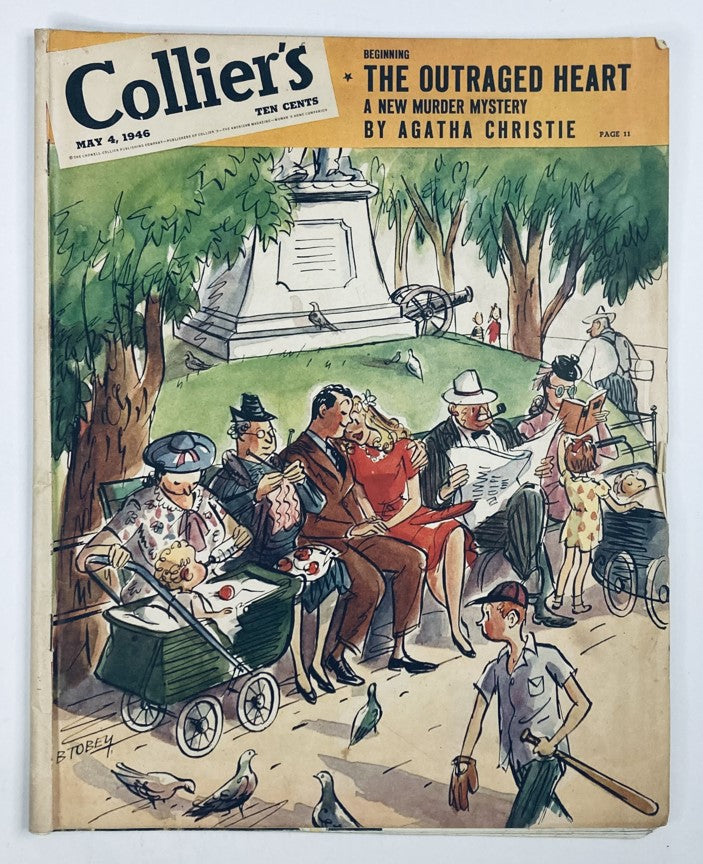
The Agatha Christie serial story "The Outraged Heart" — which gives this issue its cover title — is a historically interesting bibliographic document in its own right. Christie's American magazine presence in the immediate post-war period was substantial, and a Collier's serial installment in May 1946 is a primary bibliographic record of her publication history in the American market at a specific point in her career. The Haiti Voodoo feature with photographs by Leone Greengood-Adams reflects the specific post-war American interest in Caribbean culture and ritual that was generating some of the more unusual ethnographic journalism of the period. The Barney Tobey cover adds a documentary dimension from one of Collier's most accomplished cover artists of the mid-century period, and the no-label newsstand provenance preserves that cover in its complete, unobstructed form.
About the Publication
Collier's Weekly — commonly known simply as Collier's — was founded in 1888 and by May 1946 had been publishing for fifty-eight years as one of the most widely read general-interest magazines in the United States, its combination of fiction serials, investigative journalism, political commentary, and popular science content giving it a broad editorial appeal that addressed an educated, general-interest American readership across a wide range of subjects. By 1946 it was in the immediate post-war phase of its history, navigating the transition from wartime content to the peacetime concerns — demobilization, reconstruction, international politics, and domestic social change — that would define the late-forties American cultural landscape. The magazine ceased publication in 1957, making its complete run a historically specific and now closed archive of American popular journalism from its late-nineteenth through mid-twentieth century peak.
Key Highlights Inside
- "This Was Hitler's Mind" by Major Cortez A. Enloe Jr. and Hans H. Reese, M.D. — a primary source document of the American medical and military psychology community's clinical account of Hitler's mental condition in his final year, published eight months after his death and constituting one of the earliest mainstream American press treatments of Nazi psychological pathology from direct medical observation rather than retrospective analysis.
- "They Seek a Promised Land" by Edward P. Morgan — a primary document of the American mainstream press's engagement with the European Jewish displaced persons crisis and the proto-Zionist migration movement in May 1946, published thirteen months after the liberation of the concentration camps and two years before Israeli independence, at the specific moment of maximum political uncertainty about the displaced survivors' fate.
- Agatha Christie "The Outraged Heart" serial installment — a primary bibliographic record of Christie's American magazine presence in the immediate post-war period, constituting a specifically documented entry in the publication history of one of the twentieth century's most commercially significant mystery writers in the American mass-market serialization format.
- Walter Davenport "Stassen's Political Gamble" — a primary document of the immediate post-war Republican presidential politics, engaging Harold Stassen's 1948 nomination chances at the specific early-1946 moment when he was among the most actively discussed potential Republican nominees, constituting a primary source record of the party's post-war presidential succession debate.
- "Our Army Is Undemocratic" by Joel Westbrook — a primary document of the immediate post-war American debate about military democratization and officer privilege, reflecting the specific domestic policy conversation about the relationship between wartime military culture and peacetime democratic values that was one of the most actively discussed questions of 1946.
- Barney Tobey cover, Haiti Voodoo rituals feature with photographs, Christie fictional serial alongside four additional fiction pieces, and Collier's standard departments — the full editorial architecture of a May 4, 1946 Collier's documented with the attribution specificity that makes this table of contents an unusually complete primary source of American popular journalism at its immediate post-war moment.
Condition & Rarity
Collier's issues from May 1946 are approaching their eightieth year of existence, and the condition landscape for surviving copies from this immediate post-war period reflects both the general attrition of that age and the specific characteristics of a weekly general-interest magazine produced on paper stock not designed for archival longevity. The listing directs collectors to the photographs as the primary condition reference — the standard practice for a publication of this age — and the absence of a mailing label is a meaningful condition positive that preserves the Barney Tobey cover in its complete, unobstructed form, identifying this as a newsstand copy and distinguishing it from subscriber examples in a publication whose large subscription base made newsstand copies a meaningful minority of surviving examples. Collier's staple-bound weekly format was susceptible to cover separation and page stress over eight decades of storage, and surviving copies that retain structural integrity with complete editorial content represent meaningful survivors from the immediate post-war print run. The plastic protective sleeve provides ongoing archival protection. Collectors evaluating surviving examples should prioritize the cover image integrity and the completeness of the Hitler mental history and displaced persons journalism as primary condition criteria for a publication of this age and historical significance.
Looking for More Issues Like This?
A label-free copy of Collier's from May 4, 1946 with the Hitler mental history by military and medical authors, the European Jewish displaced persons crisis journalism, the Stassen 1948 presidential politics, and the Agatha Christie serial installment is among the more specifically historically documented single issues in the publication's immediate post-war archive — the convergence of Nazi psychological primary source material, proto-Zionist migration journalism, and Republican presidential politics in a single May 1946 issue gives this edition a research profile extending across multiple scholarly disciplines simultaneously. If this issue is no longer available, the full Collier's Magazine collection at OriginalMagazines.com is the most comprehensive place to browse surviving issues from across the publication's history and locate other immediate post-war political features, fiction serials, or significant issues from the magazine's final decade of publication. The 1946 magazine collection brings together issues from across that year's major publications for collectors working to document the full breadth of American print journalism during the most consequential year of the post-war transition.