



Description
Collector's Note – Why This Issue Matters
The April 1940 issue of Cosmopolitan Magazine featuring "Lily Comes Home At Last" by Mary Roberts Rinehart is a primary document of American popular fiction publishing at a specific and historically charged moment — the seven months between the German invasion of Poland in September 1939 and America's still-distant entry into the war, when the country was simultaneously watching the collapse of Europe and maintaining its official neutrality. Mary Roberts Rinehart was in April 1940 one of the most commercially successful and widely read authors in the United States, a figure whose magazine serializations and novels commanded enormous readerships across the popular fiction market. Her mystery novels — particularly The Circular Staircase (1908) and its many successors — had made her the most popular mystery writer in America before Agatha Christie's international ascendancy, and her serializations in Cosmopolitan and other major magazines were among the most eagerly anticipated fiction events in the popular publishing calendar. A Rinehart story in the April 1940 Cosmopolitan is therefore not simply a fiction feature — it is a primary document of the specific relationship between one of America's most beloved popular writers and one of its most widely circulated general interest magazines, produced at the precise moment when that relationship was still operating at maximum commercial authority before the war's disruptions would reshape American publishing and reading habits. Collectors building a focused archive of Cosmopolitan's literary and editorial history from its pre-Gurley-Brown general interest era will find the Cosmopolitan magazine collection the most comprehensive resource for the publication's coverage of American popular culture and fiction across this period.
The April 1940 date gives this issue a specific and historically poignant quality that the fiction and fashion content within it does not explicitly address. The Phoney War — the months of relative military inactivity following the fall of Poland — had ended with Germany's invasion of Denmark and Norway just days before this issue's likely publication date, and the catastrophic fall of France was weeks away. American readers picking up the April 1940 Cosmopolitan were doing so in a world that was changing faster than any magazine's production schedule could track, and the specific combination of escapist fiction, fashion, and cultural content within an April 1940 issue carries the historical resonance of a cultural moment that was unknowingly approaching its end. The America documented in the April 1940 Cosmopolitan — its specific consumer culture, its fashion priorities, its literary tastes, its advertising landscape — is the America of the final months before the war's shadow fell definitively over every aspect of daily life, and that transitional quality gives primary sources from this specific window a documentary weight that issues from either side of it do not quite share. Collectors focused on the pre-war and early war period will find that 1940 magazine issues document this pivotal year with the primary source immediacy that no retrospective account can replicate.
The pre-Gurley-Brown Cosmopolitan deserves recognition as a significantly different publication from the one that the name currently evokes, and collectors who approach the April 1940 issue with expectations shaped by the post-1965 Cosmopolitan will find a genuinely different editorial object. The 1940 Cosmopolitan was a general interest magazine with a strong popular fiction program — its pages contained the kind of ambitious serialized and short fiction by major popular writers that made it one of the primary venues for commercial literary fiction in the American magazine market. The Rinehart story in this issue is entirely consistent with that editorial identity, and it represents a chapter of the publication's history that is as historically interesting as its later transformation into the frank women's service magazine that Helen Gurley Brown created.
About the Publication
Cosmopolitan Magazine was founded in 1886 and had developed by 1940 into one of the most widely circulated general interest magazines in the United States, combining popular fiction serializations, cultural journalism, articles on current events, and the fashion and lifestyle content that gave it broad appeal across an educated, middle-class readership. In this pre-Gurley-Brown era, the publication was known primarily for its ambitious fiction program, which regularly featured work by major commercial authors including Mary Roberts Rinehart, and its editorial format reflected the general interest magazine tradition rather than the women's service positioning that would define its later identity. By April 1940, Cosmopolitan was operating as one of the primary venues for popular fiction serialization in American magazine publishing, and individual issues from this period are primary documents of the commercial literary culture of the pre-war era.
Key Highlights Inside
- "Lily Comes Home At Last" by Mary Roberts Rinehart — a fiction feature by one of the most commercially successful and widely read American popular authors of the twentieth century, whose mystery novels and magazine serializations commanded enormous readerships and whose Cosmopolitan appearances were among the most significant fiction events in the pre-war popular publishing calendar.
- April 1940 publication date — placing this issue in the specific window between the end of the Phoney War and the fall of France, when America was watching Europe's collapse from official neutrality and when the specific consumer culture, fashion, and literary life documented in the magazine's pages were approaching the last months of their pre-war character.
- Pre-Gurley-Brown Cosmopolitan's general interest and fiction format — a primary document of the publication in its earlier editorial identity as a major venue for commercial popular fiction serialization, reflecting a chapter of its history that is as historically significant as the later transformation that made it primarily known as a women's service magazine.
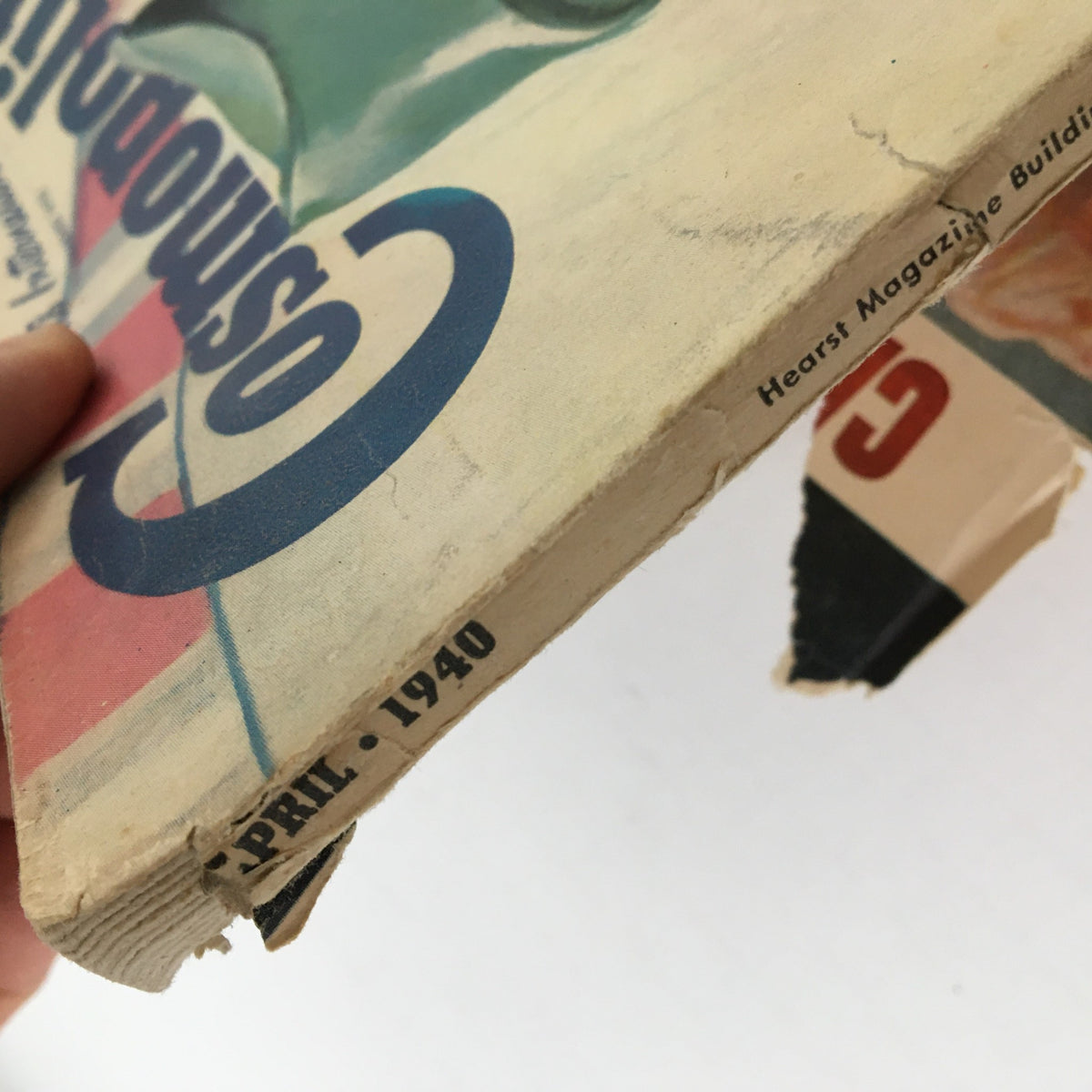
- Address label on the front cover and detached back page — condition details addressed in the condition section below, which require specific evaluation from the provided photographs to assess their impact on the issue's research and display utility.
- Note: Specific additional article titles, fashion content, advertising, and other editorial details beyond what is indicated by the Rinehart story and listing description are unconfirmed for this issue. The above reflects what is verifiable from the publication, featured story, date, and the documented literary and historical context of April 1940.
Condition & Rarity
Good condition with an address label on the front cover, minor wear throughout, and a detached back page requires honest and specific assessment for collector purposes. The address label documents the issue's original subscription delivery history and affects the visual presentation of the cover at the label's location — its impact should be evaluated from the provided photographs. The detached back page is the most significant structural condition issue, as it represents a physical separation from the main publication body rather than simply surface wear; its specific location and whether it retains all printed content are relevant to evaluating the issue's completeness as an archival document. Good overall condition with these specific, disclosed imperfections accurately describes a publication that retains the majority of its content and character as a primary source of pre-war American popular culture and fiction despite the noted physical issues. A protective plastic covering indicates preservation intent appropriate for a publication being maintained as a collectible artifact of the pre-war American magazine landscape.
Looking for More Issues Like This?
Pre-war Cosmopolitan issues from April 1940 featuring Mary Roberts Rinehart fiction in the general interest format that defined the publication before its famous mid-century transformation are among the more specifically interesting finds for collectors working at the intersection of American popular fiction history, the pre-war magazine landscape, and the specific transitional moment that early 1940 represented. The broader Cosmopolitan magazine collection is the most reliable starting point for finding other significant issues from across the publication's long history, including other pre-Gurley-Brown issues that document the magazine in its earlier general interest and fiction-focused editorial identity. Collectors building a focused archive of 1940 as a pivotal pre-war year will find the complete 1940 magazine collection a valuable resource for locating other titles and issues that document this extraordinary transitional year from the multiple perspectives that serious historical research requires.