




Description
Collector's Note – Why This Issue Matters
By July 1950, American motorcycling had two undisputed proving grounds, and this issue of Cycle Magazine arrived squarely at the intersection of both. The Catalina Grand Prix, run on Santa Catalina Island off the coast of California, had by this point become the premier off-road and road-racing test in the United States. It was a brutal, dusty affair that separated serious competitors from weekend riders, run over terrain that punished machines and men in equal measure. Manufacturers watched Catalina closely, because a strong showing there carried real weight with the buying public. Riders who performed well often became genuine celebrities within the sport, their names carried from race report to race report for years afterward. The event itself had only recently taken on its now-legendary status, having been revived in the late 1940s after a wartime hiatus. Coverage of Catalina in a contemporary 1950 issue captures that event while it was still being defined, rather than after its reputation had fully solidified.
On the other side of the Atlantic, the Isle of Man TT held the equivalent status in Europe, a road-racing circuit so demanding that a rider's performance there could make or break a career and a manufacturer's reputation in a single afternoon. The Mountain Course, with its narrow lanes and unforgiving stone walls, had already claimed a reputation as the toughest test in motorcycle racing well before 1950. British and European manufacturers treated a strong TT result as essential marketing, often building entire advertising campaigns around a single race outcome. American readers of Cycle Magazine relied on domestic coverage like this to stay current with a competition most of them would never see in person. That dependence on the printed page made publications such as this one a vital link between the American racing scene and its European counterpart. The TT's mythology, much like Catalina's, was still being actively written in this period rather than looked back upon as settled history.
A 1950 issue built around both events captures a pivotal moment in motorcycling history: the years immediately following World War II, when the sport was rapidly professionalizing. Manufacturers were racing to prove their machines on the world stage, using race results as a substitute for the advertising budgets many couldn't yet afford in the lean postwar economy. Enthusiast publications like Cycle Magazine were the primary way American riders learned what was happening overseas, long before television coverage or easy international travel existed. Coverage that placed Catalina and the Isle of Man side by side reflected a growing awareness among American riders that motorcycle racing was becoming a genuinely international pursuit. It also reflected the editorial instincts of a publication trying to serve readers who were increasingly curious about the sport beyond their own borders. That dual focus is part of what makes an issue like this a useful artifact for understanding how American motorcycle culture absorbed international influence. It stands as a marker of a sport in transition, moving from a scattered, regional pastime toward something resembling a unified international competition.
For anyone researching the postwar racing scene, an issue timed to these two events offers a snapshot of how the sport's mythology was being written in real time. Neither Catalina nor the Isle of Man TT had yet settled into the legendary status they'd eventually hold in motorcycling lore, which makes contemporary coverage especially valuable to historians and collectors alike. Readers picking up this issue in the summer of 1950 were witnessing history as it happened, not reading a retrospective. That immediacy is difficult to replicate in later writing about the same events, however well-researched. It's part of why period periodicals remain sought after by serious students of motorsport history. The specific framing, tone, and priorities of a 1950 motorcycle magazine reveal as much about the era's readership as they do about the races themselves. Taken together, those qualities are what elevate an issue like this from a simple back-issue to a genuine historical document.
About the Publication
Cycle Magazine was one of the standard-bearers of American motorcycle journalism in the mid-20th century, serving an audience of riders, racers, and mechanically-minded enthusiasts. Like most periodicals of its type and era, it followed a newsstand monthly format mixing race coverage, new-model reporting, technical features, and advertising from the manufacturers and aftermarket suppliers of the day. Its readership would have included active competitors following results from major events, casual riders keeping up with new machinery, and dealers tracking industry trends. The magazine's advertising pages alone offer a useful record of which manufacturers and parts suppliers were courting American riders at a given moment. Technical features typically walked the line between practical maintenance advice and enthusiast-level interest in performance and engineering. Race coverage was often the anchor of any given issue, since competition results carried real commercial weight for the manufacturers whose machines had competed. Because the sport was still relatively niche in the United States compared to Europe, publications like this played an outsized role in shaping how American riders understood motorcycling as a broader culture. That combination of trade-press utility and enthusiast appeal is part of what makes surviving issues valuable time capsules of both the sport and the industry that supported it. Few motorcycle-specific publications from this era have survived in large numbers, which adds to the documentary value of any complete issue found today.
Key Highlights Inside
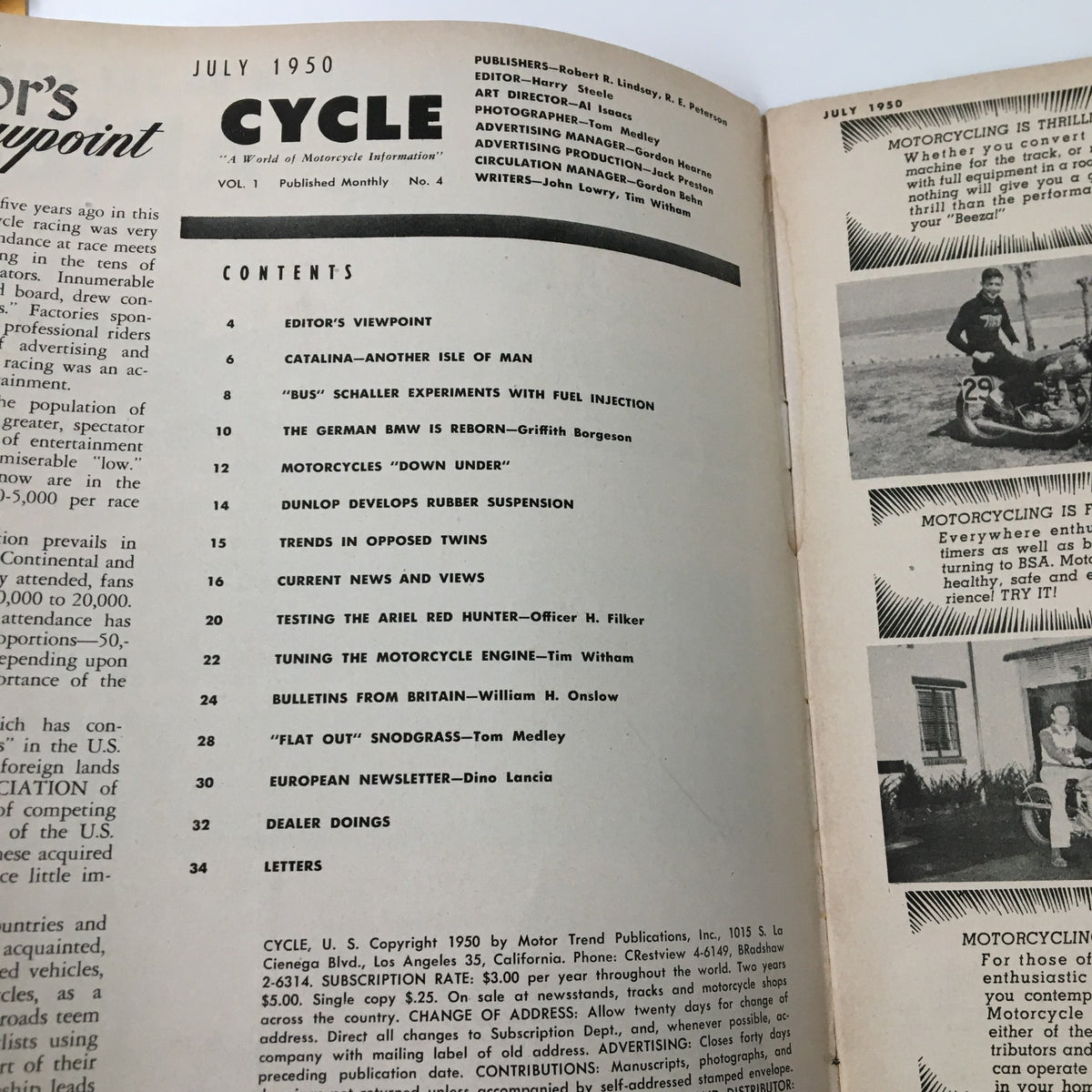
- Coverage centered on the Catalina motorcycle races, a defining event in postwar American racing. The Catalina Grand Prix was among the most closely watched competitions of the era. Its inclusion here reflects the event's growing national profile in 1950.
- Coverage of the Isle of Man TT, the era's premier international road-racing event. The TT's reputation for difficulty made it a natural subject for American readers curious about European racing. Its pairing with Catalina coverage underscores the international scope this issue offered.
- Period advertising typical of Cycle Magazine's 1950 run. Advertising sections of this era commonly featured motorcycle manufacturers, parts suppliers, and accessory makers. These pages remain useful today as a record of the industry's postwar landscape.
- Photography consistent with the trade-press style common to motorcycle magazines of the period. Race and product photography served both editorial and promotional purposes in issues like this. Such imagery is often a key draw for collectors researching the visual culture of the sport.
- General editorial content reflecting the postwar motorcycle enthusiast press. Issues from this period typically balanced racing news with practical and technical material. This issue's structure appears consistent with that broader pattern.
- Specific interior articles and bylines for this issue are unconfirmed beyond the Catalina and Isle of Man coverage noted on the cover and in the listing. Collectors should treat any additional interior content as unverified until examined directly. This is common for vintage periodicals lacking a detailed table of contents in the surviving record.
Condition & Rarity
This issue is graded acceptable, the standard collector-market designation for a periodical showing honest wear consistent with over seven decades of age. Common characteristics at this grade include binding wear, softened corners, minor creasing, and general handling marks accumulated over decades of storage and circulation. None of these attributes are unusual for a magazine of this vintage, and most surviving copies of comparable age show similar signs of use. It is a newsstand copy issued without the original subscriber label, a variant collectors often value for its cleaner cover presentation. Label-free newsstand copies typically lack the mailing label, address stamp, or subscription crease found on copies distributed by mail, which many collectors consider a more visually appealing presentation of the original cover art. Surviving copies of Cycle Magazine from 1950 are generally scarce in high grade, as vintage motorcycle periodicals saw heavy handling and low survival rates compared to more broadly collected genres like comics or general-interest magazines. Motorcycle enthusiast publications were often read repeatedly, passed between riders, or stored in garages and workshops rather than preserved with archival care, which further reduced the pool of well-preserved survivors. A plastic protective covering, when present, is a standard archival measure intended to stabilize a copy's current condition rather than a factor that changes its underlying grade. Collectors evaluating any surviving copy of this issue should examine the binding closely, since spine and staple integrity are often the first areas to show age-related stress. Overall, an acceptable-grade newsstand copy of this kind represents a realistic, honestly-described example of what collectors can expect to find for a motorcycle periodical of this age.
Looking for More Issues Like This?
Issues of Cycle Magazine spotlighting events like Catalina and the Isle of Man TT are genuinely hard to come by, and this one in particular reflects a great deal of the American racing scene at a formative moment. Motorcycle periodicals from this era simply weren't preserved in the numbers that other collectible categories were, which makes any given issue a meaningful find for a dedicated collector. If you're building out a collection around this era, our Cycle Magazine collection is a good place to keep browsing, since it gathers other surviving issues from across the publication's run. Readers interested in the broader postwar racing scene may also find related motorsport titles worth exploring alongside Cycle Magazine. Beyond the publication itself, our 1950 magazines collection covers the broader publishing landscape of the same year for collectors interested in the period more generally. That collection includes titles well outside the motorcycle world, offering useful context for what else was being published and read at the time. Many collectors find that browsing by year, rather than by title alone, turns up unexpected pieces that round out a themed collection. Whether your focus is motorcycling specifically or the postwar era more broadly, both collections offer a wider set of material to explore. We'd encourage anyone drawn to this issue to look through both collections at their own pace. There's always more of this history to uncover than a single issue can hold.