




Description
Collector's Note – Why This Issue Matters
The January 1967 issue of Ebony magazine — Volume 22, Number 3 — featuring Nichelle Nichols on its cover documents a genuinely historic intersection of television, race, and American culture. Star Trek had premiered on NBC on September 8, 1966, just four months before this issue went to press, and Nichols's portrayal of Lieutenant Nyota Uhura was already registering as something unprecedented in American television. Uhura was not a servant, not a comic figure, not a background presence — she was a senior officer on the bridge of a starship, presented as a peer among the crew in a future where race had ceased to be a barrier to achievement or authority. For Ebony's readership, the significance of that image was immediate and profound. The magazine had spent more than two decades documenting Black American achievement against the backdrop of systemic exclusion, and here was a Black woman occupying a position of dignity and competence on one of the most-watched programs on American television, at the precise moment the Civil Rights Movement was forcing a national reckoning with exactly these questions of representation and equality. Collectors building archives at the intersection of Black American media history and science fiction television history will find the Nichelle Nichols magazine collection at OriginalMagazines.com an essential resource for mapping her presence across publications throughout her career.
The cultural weight of this cover extends well beyond the television context. January 1967 falls in the immediate aftermath of one of the most turbulent years in the Civil Rights Movement — the Voting Rights Act had passed in 1965, but 1966 had brought urban rebellions, the rise of the Black Power movement, and an increasingly fractured national conversation about the pace and direction of racial progress. Ebony's decision to feature Nichols on its January cover — the first issue of the new year, traditionally the most prominent slot in any magazine's annual publishing calendar — was an editorial statement about what Black achievement in America looked like at that moment. The fact that the achievement being celebrated was a fictional future made it no less meaningful; if anything, Uhura's existence in Gene Roddenberry's hopeful vision of the twenty-third century was precisely the kind of affirmative image that Ebony had always understood its mission to champion. Collectors interested in the broader cultural landscape of this pivotal year can explore the 1967 magazine archive at OriginalMagazines.com for parallel primary sources across multiple publications. The full run of Ebony's coverage of Black entertainment and achievement is archived in the Ebony magazine collection at OriginalMagazines.com, which provides essential context for this issue's place in the publication's editorial history.
It is also worth noting the specific historical footnote that makes Nichols's continued presence on Star Trek so significant to later generations: she has spoken publicly about her intention to leave the show after the first season, and her decision to stay — influenced by a conversation with Martin Luther King Jr., who personally urged her to remain in the role because of what Uhura represented to Black Americans and particularly to young Black girls — is now one of the most cited stories in the history of American television. The January 1967 Ebony cover predates that decision point and captures Nichols in the earliest weeks of a role that would come to carry a weight she could not yet fully anticipate.
About the Publication
Ebony was founded in Chicago in November 1945 by John H. Johnson of Johnson Publishing Company, modeled in format on Life magazine but conceived explicitly to document, celebrate, and advocate for Black American life at a time when mainstream publications largely excluded or caricatured it. By January 1967 it was the most widely circulated Black-owned publication in the United States, with a readership spanning the full range of Black American social and economic life. Its editorial mission balanced celebration of Black achievement with unflinching engagement with the political and social conditions that shaped Black American experience, and its cover subjects were chosen with deliberate care as statements about who and what mattered. A Nichelle Nichols cover in January 1967 was not a casual editorial choice — it was a considered declaration about the significance of what she was doing on American television.
Key Highlights Inside
- Nichelle Nichols featured on the cover — one of her earliest major magazine appearances in her role as Lieutenant Uhura, published within the first season of Star Trek's original NBC run and capturing her at the very beginning of what would become a historically significant television career.
- Coverage consistent with Ebony's editorial approach to Black entertainment figures, which typically combined biographical profile, career context, and broader cultural commentary on the significance of the subject's work and visibility.
- Editorial content representative of Ebony's January 1967 format, addressing the full range of Black American life — political, cultural, social, and personal — at a moment of acute historical intensity in the Civil Rights era.
- Period advertising pages throughout, representing the Black consumer market as addressed by American brands in the mid-1960s — a primary-source document of considerable interest to historians of American advertising, commerce, and the economics of Black media.
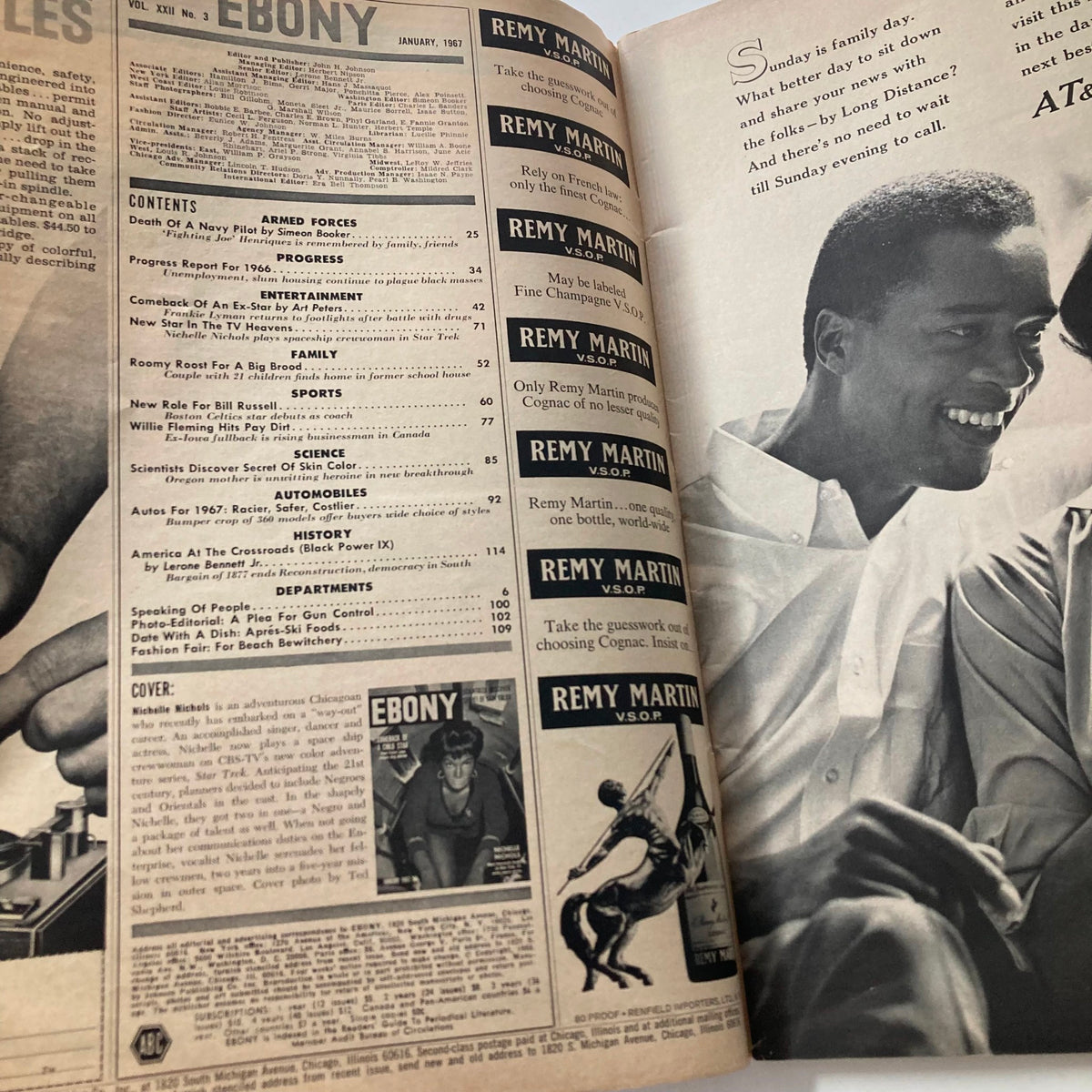
- Note: Specific article titles, additional features, and interior content beyond what is documented above are not confirmed in available listing details. The above reflects what is verifiable from the cover subject, volume and issue number, publication date, and the well-documented editorial format of the publication during this period.
Condition & Rarity
The listing does not specify a detailed condition grade beyond noting plastic protective covering, which indicates intentional storage care at some point in the issue's history. Plastic protective storage provides meaningful preservation advantages for cover gloss, color retention, and interior page quality in a magazine of this age. For a nearly sixty-year-old monthly publication, collectors examining any surviving copy of this issue should assess the standard condition variables: cover surface integrity and color retention of the Nichols portrait, binding stability, completeness of the interior page block, and the presence or absence of a subscriber label on the cover. The particular collector significance of this issue — driven by the intersection of Star Trek fandom, Nichelle Nichols's historical stature, Ebony's cultural legacy, and Civil Rights-era media history — creates demand across multiple collector communities simultaneously, which applies consistent upward pressure on the availability of well-preserved copies in any condition grade.
Looking for More Issues Like This?
A January 1967 Ebony with Nichelle Nichols on the cover sits at such a specific and celebrated intersection of television history and Black American media heritage that collectors from several different communities actively seek it out — and it doesn't surface often. If this issue is currently unavailable, the Nichelle Nichols magazine collection at OriginalMagazines.com is the most focused place to search for her other significant print appearances across her career. The Ebony magazine archive is equally worth exploring for other landmark covers from the publication's Civil Rights-era run, and the 1967 magazine archive offers a broader view of American print culture during one of the most consequential years of the twentieth century.