



Description
Collector's Note – Why This Issue Matters
The November 1962 issue of Ebony Magazine — Volume 18, Number 1 — arrives at one of the most consequential and dangerous moments in the American civil rights movement. In the months immediately preceding this issue, James Meredith had integrated the University of Mississippi under federal marshal protection, triggering riots that left two people dead. The Albany Movement in Georgia, in which Dr. Martin Luther King Jr. had been centrally involved, had just concluded its difficult and ambiguous campaign against segregation. The Birmingham campaign, which would become one of the defining confrontations of the entire movement, was still months away. King in November 1962 was a figure operating under enormous pressure — his strategy being questioned by allies, his safety under constant threat, and the federal government's commitment to civil rights still deeply uncertain. An Ebony cover featuring King at this precise moment is not background noise. It is a document of how the movement's most visible leader was being presented to Black America during one of the most tactically and morally complex periods of his public life. Collectors building a serious archive of Martin Luther King Jr. magazine appearances will find that 1962 represents an underrepresented and historically critical window in his print legacy.
Ebony's role in this moment cannot be overstated. The magazine was the primary national print forum through which Black Americans processed, debated, and documented the civil rights struggle — not as outside observers, but as participants and stakeholders. Coverage of King in Ebony carried a different weight than coverage in mainstream white-owned publications: it was addressed to the community most directly affected, in a voice that assumed shared investment rather than explaining the movement to skeptical outsiders. A November 1962 issue is also notable for its volume designation — Vol. 18, No. 1 marks the opening of a new annual volume, often an occasion for editorial reflection and forward-looking content. For collectors documenting the intersection of African American publishing history and the civil rights era, the full run of Ebony Magazine issues from the early 1960s represents some of the most historically irreplaceable material in American periodical history. The broader landscape of 1962 magazine publishing makes plain just how few other mainstream publications were engaging with these subjects with anything approaching comparable seriousness or authenticity.
About the Publication
Ebony Magazine was founded in Chicago in November 1945 by John H. Johnson of Johnson Publishing Company, explicitly modeled on the format of Life magazine but addressed to a Black American readership that mainstream publications had long ignored or caricatured. It grew rapidly to become the most widely read Black-owned publication in the United States, reaching circulation figures in the millions by the 1960s. Its editorial approach combined celebrity profiles, fashion, culture, and lifestyle content with substantive political and social journalism — a mix that reflected Johnson's conviction that Black readers deserved the full range of content that white-owned publications offered their audiences. During the civil rights era, Ebony occupied a unique position: popular enough to reach ordinary households across the country, authoritative enough to be taken seriously as a record of the movement, and trusted enough by its readership to function as a genuine community forum. Issues from the early 1960s are among the most historically significant in the magazine's nearly eight-decade run.
Key Highlights Inside
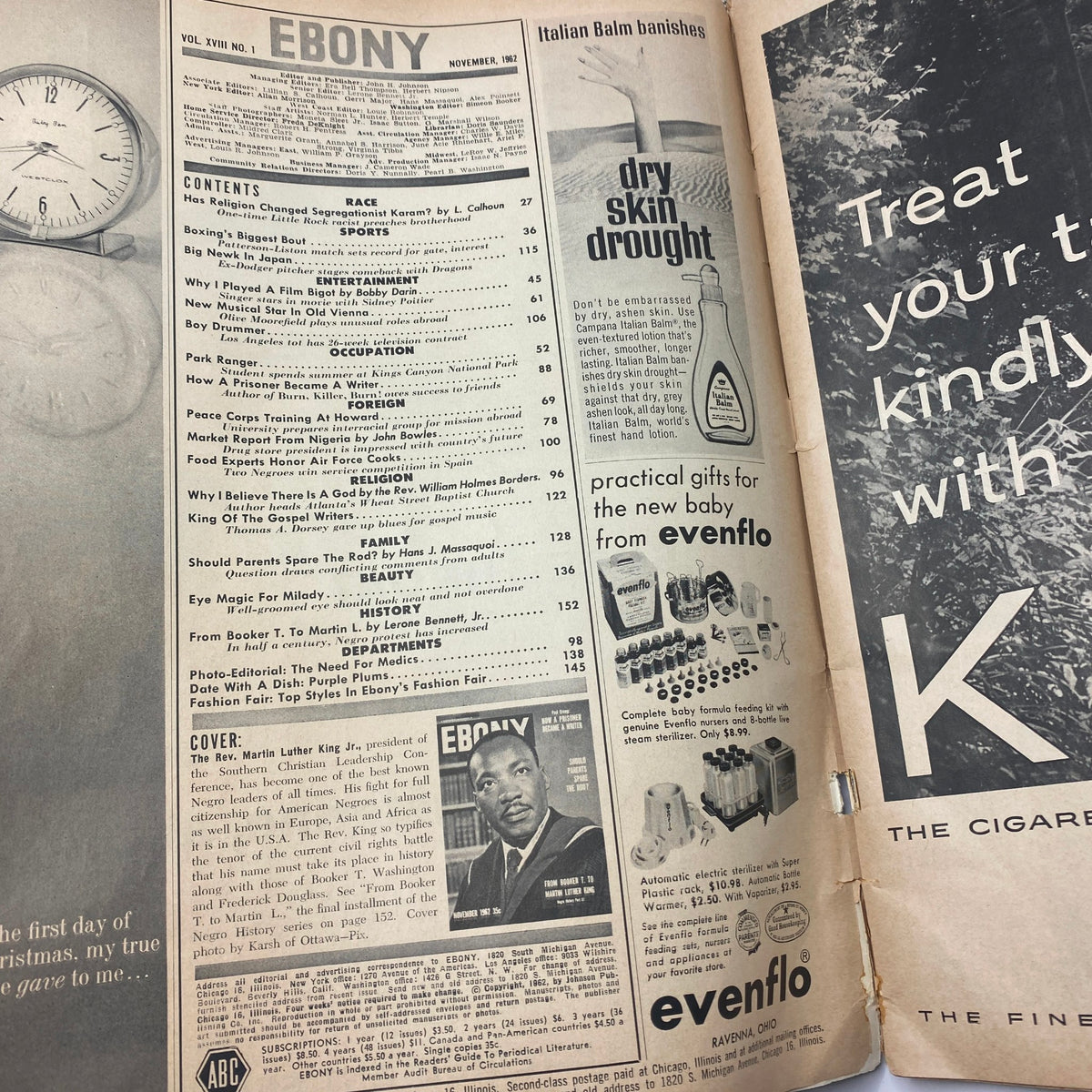
- Dr. Martin Luther King Jr. feature: King is the named subject of this issue's cover, placing it in the fall of 1962 — a period of intense strategic activity within the civil rights movement and one of the more underexamined phases of King's public career relative to the more heavily documented events of 1963 and 1965.
- Volume 18, Number 1: The designation as the opening issue of a new annual volume suggests this edition may have carried editorial content reflecting on Ebony's own history and mission alongside its civil rights coverage — though specific additional interior content beyond what is stated in the listing is unconfirmed.
- Good interior page condition: The listing specifically notes the interior pages as well-preserved with clear, legible print and no missing pages — a meaningful distinction for a sixty-plus-year-old magazine on the paper stock Ebony used in this era, which is prone to brittleness and tanning.
Condition & Rarity
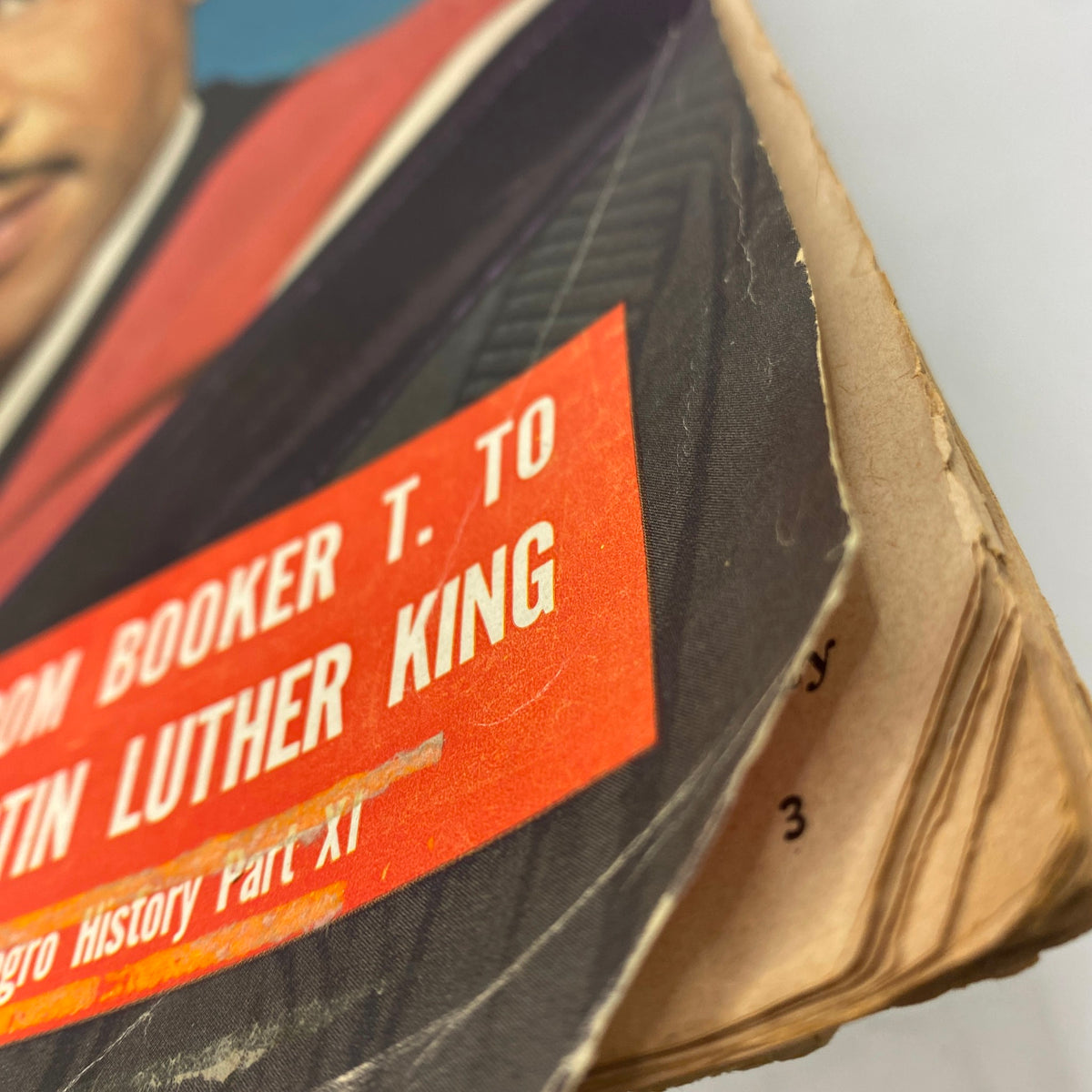
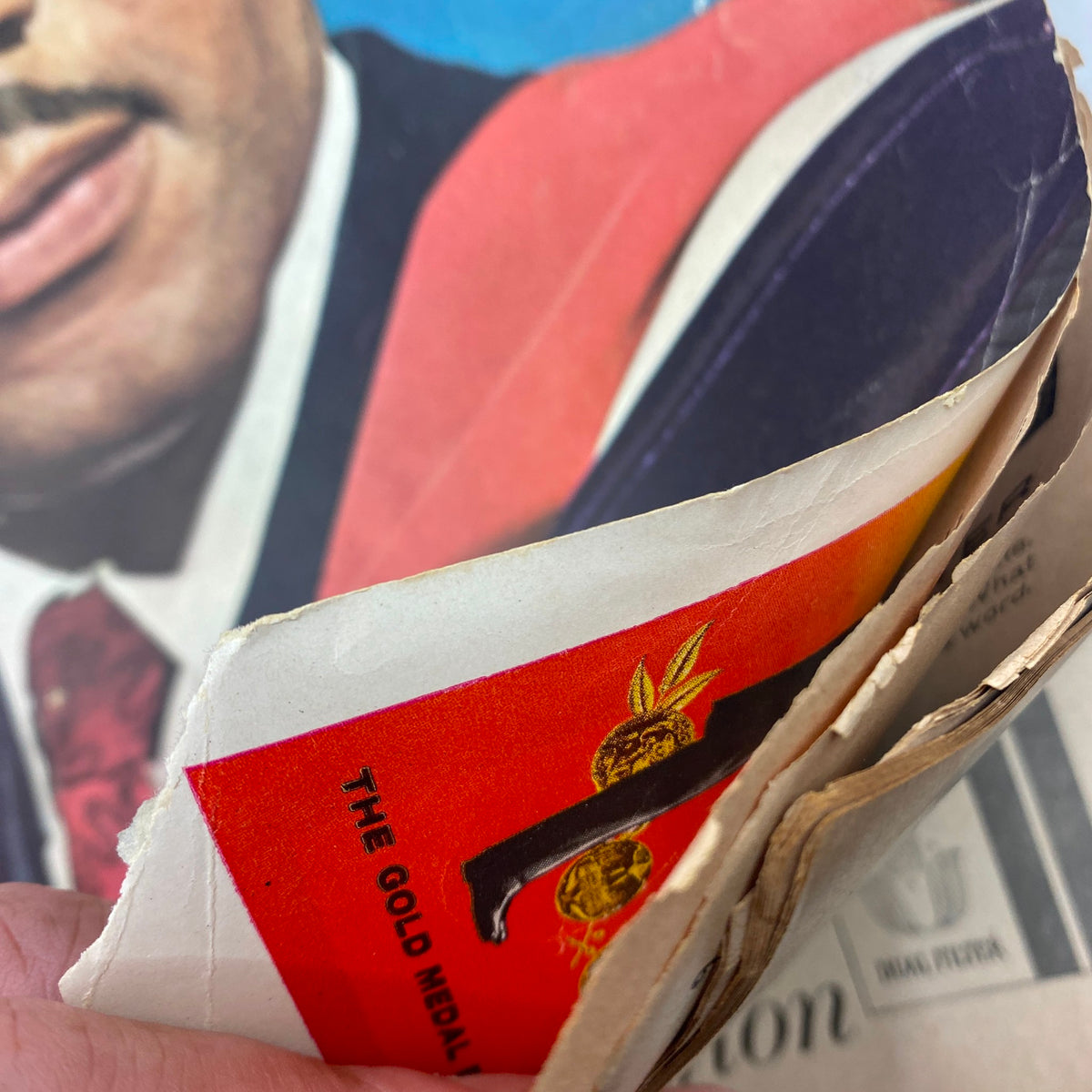
Early 1960s issues of Ebony present a specific condition profile that collectors should understand when evaluating surviving copies. The magazine was printed on uncoated and lightly coated paper stocks that age more visibly than the heavy coated pages used by contemporaries like Life or Vogue, making interior preservation in genuinely good, legible condition a more meaningful grading achievement than it might appear at first. The cover wear and ripped address label on this issue are honest and common attributes for a subscriber copy of this vintage — the label damage indicates this was a mailed subscription copy rather than a newsstand example, and ripped rather than cleanly removed labels are the norm for issues of this age. The cover presentation is consequently compromised relative to a clean newsstand copy, but the interior integrity noted in the listing is the more important attribute for research and archival purposes. The protective plastic covering indicates deliberate preservation at some point in the issue's history. When evaluating any surviving copy of this issue, interior page stability and completeness are the primary grading variables, with cover condition as a secondary but visually significant factor.
Looking for More Issues Like This?
Early-1960s Ebony issues featuring Dr. King in good interior condition are primary historical documents, and they are meaningfully harder to find than their original print runs might suggest — decades of casual storage have not been kind to the paper stock. If this issue has already found a home, the archive of Martin Luther King Jr. magazine coverage is the best place to look for other significant appearances across his career, and the full Ebony Magazine collection covers the breadth of the publication's remarkable run through the civil rights era and beyond. The 1962 magazine archive is also worth exploring for anyone building a comprehensive picture of that pivotal year in American history.