
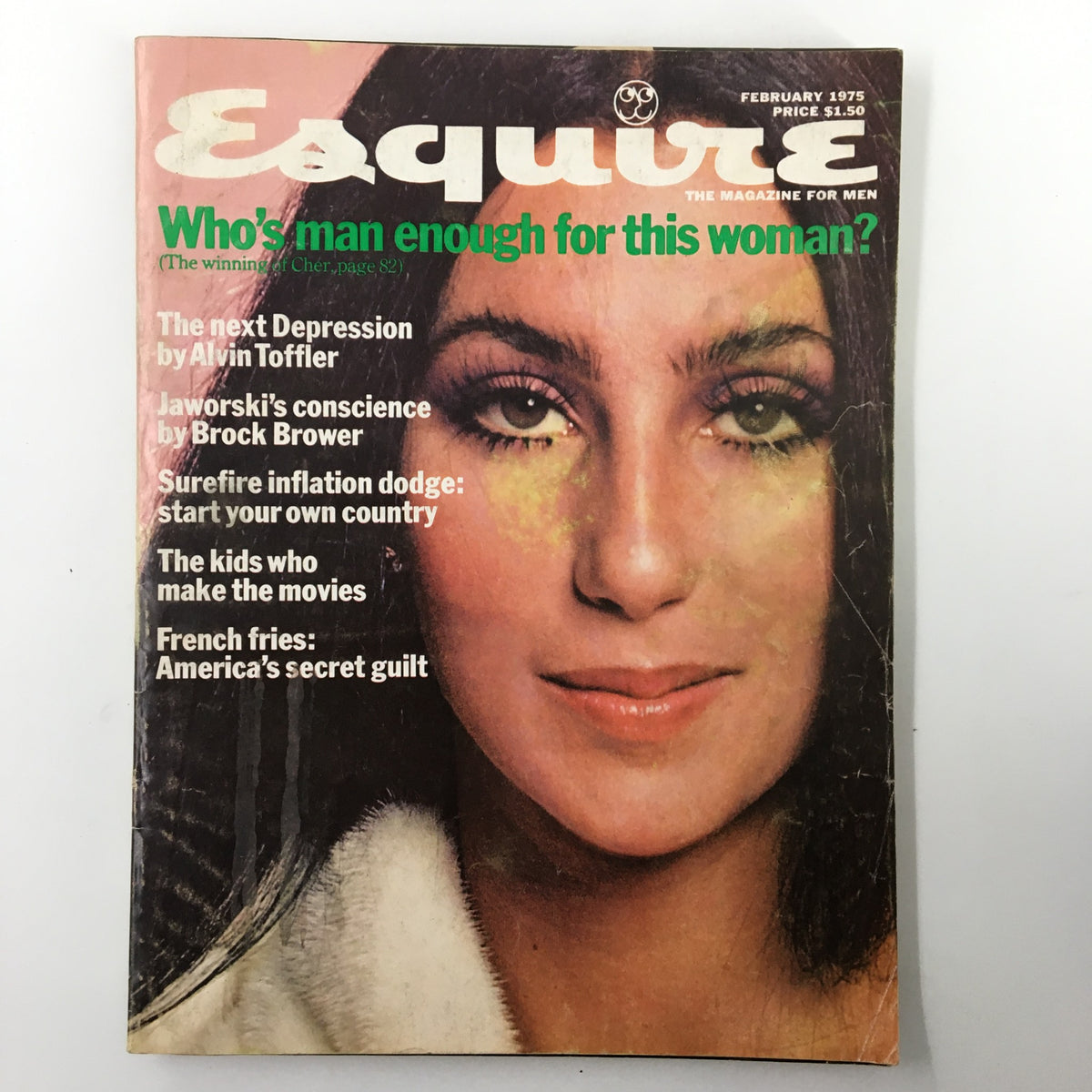


Description
Collector's Note – Why This Issue Matters
This February 1975 issue of Esquire, built around the cover line "Who's Man Enough For This Woman?" featuring Cher, lands at an extraordinarily precise moment in her career and personal life. Just days after this issue would have reached newsstands, on February 12, 1975, Cher debuted her solo CBS variety show, simply titled Cher, having spent the previous several years extricating herself from both her professional and marital partnership with Sonny Bono. The timing here is genuinely tight: Cher and Sonny's divorce, after roughly two years of public wrangling over finances and custody of their son Chaz, would not be finalized until June 26, 1975, meaning this February issue arrived while that very public separation was still legally unresolved, even as Cher's solo television career was simultaneously launching. A Cher magazine cover from this exact window captures her squarely between those two chapters, no longer half of "Sonny and Cher" but not yet the divorced, remarried solo star she'd become by the end of that same year.
The cover line's framing, posing the question of who might be "man enough" for Cher, takes on a particular resonance set against what was actually happening in her life at the time. She had been involved with record executive David Geffen since 1973, a relationship she ended that same year due to his possessiveness, and by January 1975 she had begun seeing Allman Brothers Band co-founder Gregg Allman, whom she would marry just four days after her divorce from Sonny was finalized that June. The Esquire cover's framing of Cher as a woman whose romantic life posed a kind of public question mirrors the way the press of the period was genuinely fixated on exactly that aspect of her life, even as she was simultaneously reestablishing herself as a solo recording artist and the host of her own network television show.
This issue also arrives at a transitional and genuinely difficult moment for Esquire itself as a publication. Longtime editor Harold Hayes, the architect of the magazine's celebrated New Journalism era throughout the 1960s, had departed in 1973 amid disagreements with management, and the years immediately following his exit saw the magazine experience real declines in both readership and advertising revenue, well before Clay Felker's 1977 acquisition attempted a turnaround. A Esquire issue from this specific stretch of the mid-1970s is therefore a useful artifact of the magazine navigating its post-Hayes identity, still capable of landing a culturally resonant cover subject in Cher even as the publication's broader institutional fortunes were genuinely uncertain. This 1975 magazine sits at the intersection of those two stories, one about a single iconic performer's transitional year and one about a storied magazine finding its footing after the departure of its defining editor.
About the Publication
Esquire has been published continuously since 1933, building its reputation through several distinct editorial eras, most notably under editor Harold Hayes from 1961 to 1973, when the magazine became a pioneering home for New Journalism, publishing writers like Norman Mailer, Tom Wolfe, and Gay Talese alongside its traditionally more lifestyle-oriented men's content. By the time of this February 1975 issue, the magazine was navigating the aftermath of Hayes's departure, a period generally marked by declining circulation and advertising revenue compared to the publication's peak circulation of roughly 1.25 million in the early 1970s. The magazine had also recently shifted to a more conventional page size in 1971, moving away from the oversized format that had defined its visual identity for decades. Specific editorial details unique to this particular issue beyond its cover story are not independently confirmed here, but the magazine's general institutional situation during this period is well documented.
Key Highlights Inside
- Cover story "Who's Man Enough For This Woman?" featuring Cher, published in the narrow window between her February 12, 1975 solo CBS show debut and the June 1975 finalization of her divorce from Sonny Bono. This places the issue at an unusually precise and well-documented turning point in her personal and professional life.
- Arrives just before Cher's relationship with Gregg Allman, whom she began dating in January 1975 and would marry that June, became fully public, giving the cover's romantic framing a notably direct relationship to events unfolding in her life at the time.
- Published during a genuinely transitional period for Esquire itself, roughly two years after the departure of longtime editor Harold Hayes and several years before Clay Felker's 1977 acquisition attempted to reposition the magazine. This institutional context is a useful backdrop for understanding the publishing environment this issue emerged from.
- Beyond the cover story itself, the specific content of the Cher feature, including its actual interview material, framing, and any accompanying photography, along with the rest of the issue's articles and features, is not confirmed here. Collectors interested in the complete contents should plan to verify them directly against the physical issue.
Condition & Rarity
Issues of this type are generally evaluated by collectors against a few key benchmarks: whether the copy is a newsstand edition or a subscription copy, whether a mailing label is present on the cover, and the overall condition of the cover, spine, and interior pages. A newsstand edition without a label is typically considered more desirable than a labeled subscription copy, since the unmarked cover preserves the original cover photography and design exactly as it appeared on the rack, a meaningful factor for an issue whose cover subject and headline are central to its collectible appeal. A grade of "good" with minor, age-appropriate wear and a few visible marks reflects a presentable copy that falls short of pristine condition, which is typical and expected for a periodical that has survived roughly five decades since its original printing. Magazines from the mid-1970s were generally produced on standard newsstand paper stock not intended for long-term archival preservation, making cover gloss retention, spine integrity, and any discoloration or marking the primary factors collectors weigh when assessing a copy's overall condition. Protective plastic sleeving is a common and recommended storage method for vintage periodicals like this one, helping to guard against further handling wear without altering the item itself. Collectors evaluating any surviving copy of this issue should examine the noted marks and the overall sharpness of the cover photography and headline closely, along with the integrity of the spine and binding, since these are the factors most likely to affect both display quality and long-term value.
Looking for More Issues Like This?
An Esquire issue capturing Cher at this exact, narrowly defined turning point, between her solo television debut and her divorce and remarriage that same year, is a genuinely specific piece of 1970s pop culture history. If you're researching or collecting Cher-related ephemera, our Cher magazines collection is a strong place to start, alongside our broader Esquire collection for more from this storied publication and our 1975 magazines collection for a wider view of that transitional year in print. Whether your focus is on Cher specifically, on Esquire's mid-1970s era, or on 1975 as a year in American magazine publishing, all three collections are worth exploring together.