
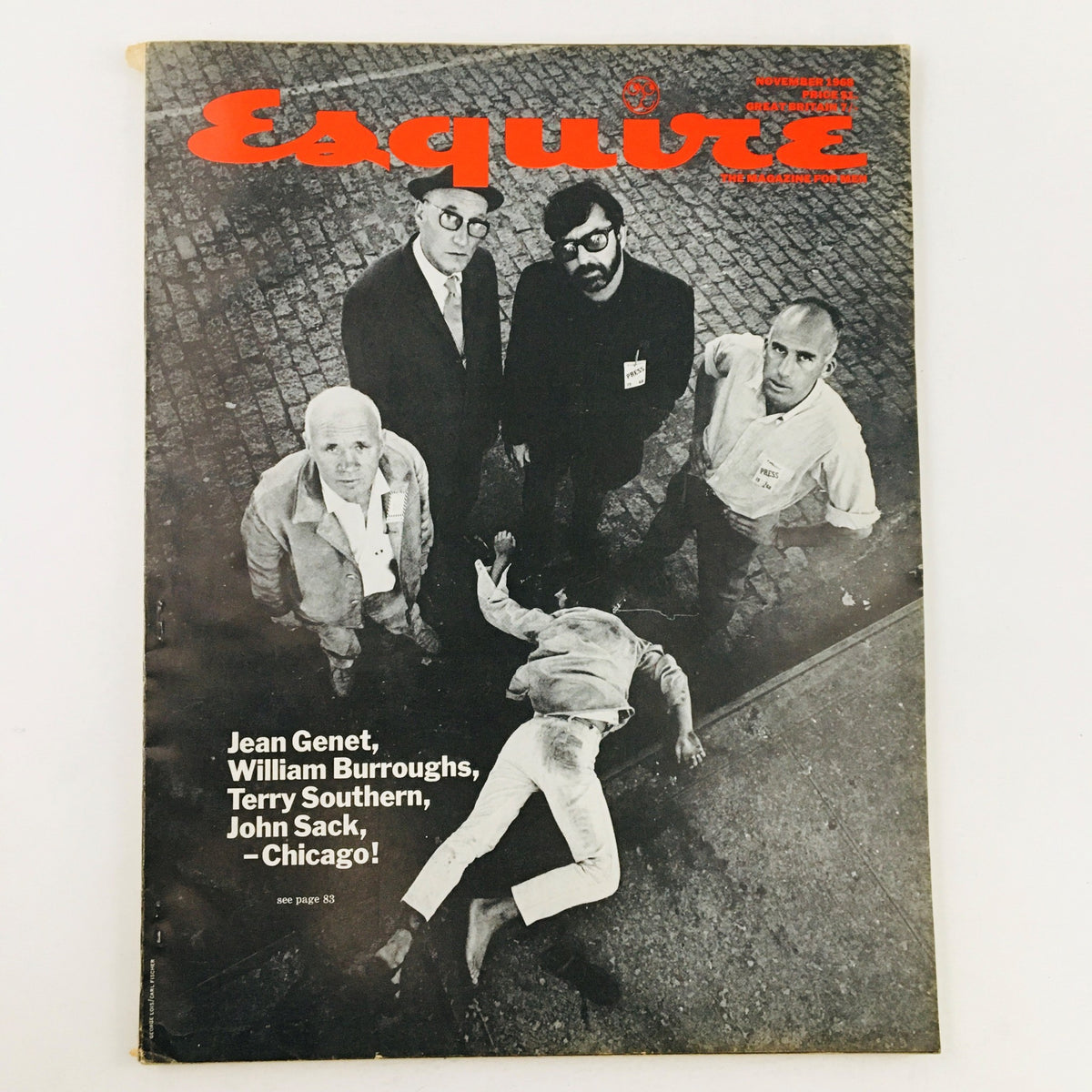


Description
Collector's Note – Why This Issue Matters
The November 1968 issue of Esquire magazine belongs to one of the most volatile cultural moments of the twentieth century. By late 1968, American print culture was absorbing the aftershocks of political violence, protest, censorship fights, and rapidly changing ideas about literature and public life. An issue associated with Jean Genet and William S. Burroughs immediately signals a magazine willing to engage writers who stood outside the comfortable mainstream. For collectors, that matters because Esquire was not a fringe little magazine. It was a major American publication, and when it brought figures like Genet and Burroughs into its orbit, it documented the point where avant-garde literature and mass-circulation journalism were intersecting in unusually visible ways.
Jean Genet and William S. Burroughs each carried a very different kind of literary charge in 1968. Genet was already known internationally for work that challenged moral convention and for the political radicalization that became more visible around the upheavals of 1968. Burroughs, by contrast, had become one of the defining countercultural writers of the postwar era, closely tied to Beat literature and to experiments in form, language, and social provocation. Bringing those two names together gives this issue a strong intellectual identity, even without claiming any article-level specifics beyond the listing. It marks the magazine as part of a wider late-1960s conversation about transgression, literary authority, and the place of difficult writers in mainstream American media.
Seen alongside other 1968 magazines, this issue also reflects how much the tone of sophisticated American magazines had changed by the end of the decade. November 1968 was no longer the world of tidy postwar consensus. It was a period when magazines were increasingly expected to register tension, conflict, and cultural experimentation. That is what gives this issue enduring appeal for serious collectors of literary and cultural periodicals. It is not simply an issue with famous names attached. It is a printed artifact from the moment when literary modernism, counterculture, and upscale magazine journalism were colliding in public.
About the Publication
Esquire was one of the defining American magazines of the twentieth century, aimed at readers interested in style, politics, literature, journalism, and modern cultural life. By the 1960s it had developed a reputation for ambitious editorial work that could place major fiction writers, cultural critics, and provocative public subjects beside sophisticated visual design and commentary. That editorial range is central to why back issues remain collectible. A late-1960s issue of Esquire was not simply lifestyle publishing; it was part of the broader American magazine world that shaped how intellectual and cultural seriousness reached a large readership.
Key Highlights Inside
- November 1968 issue of Esquire.
- The listing identifies Jean Genet and William S. Burroughs as the key literary figures associated with this issue.
- The issue has strong relevance to collectors of late-1960s avant-garde and countercultural literary culture because both writers were major nonconformist figures of the period.
- Its broader interest lies in how a major American magazine engaged serious literary and cultural subjects during one of the most turbulent years of the decade.
- Specific article titles and the full interior contents are unconfirmed from the available listing and should be verified from the table of contents or interior pages before being cited in detail.
Condition & Rarity
The listing describes surviving examples of this issue as being in good condition, with some minor wear and visible wear on the binding, while also noting a no-label presentation and protective plastic storage. In collector terms, the absence of a label is an important plus for a title like Esquire, where cover design and typography are a major part of the issue’s visual appeal. The plastic covering is a modern preservation measure rather than an original feature, but it reflects exactly the sort of storage collectors want for a substantial mid-century magazine. When evaluating any surviving copy of this November 1968 issue, the main points remain cover appearance, binding stability, page completeness, and whether the age-related wear remains within the expected range for a heavily read literary-cultural magazine of the period.
Looking for More Issues Like This?
Readers who arrived here through the Genet and Burroughs connection usually get the best context by spending time with the broader run of vintage Esquire magazines. A single issue becomes much more revealing when it is seen within the magazine’s larger history of publishing ambitious writers and shaping cultural conversation.
It is also worth exploring the wider group of 1968 magazines. That larger year-based view helps place this issue within the unsettled, intellectually charged print culture of one of the most consequential years of the twentieth century.