
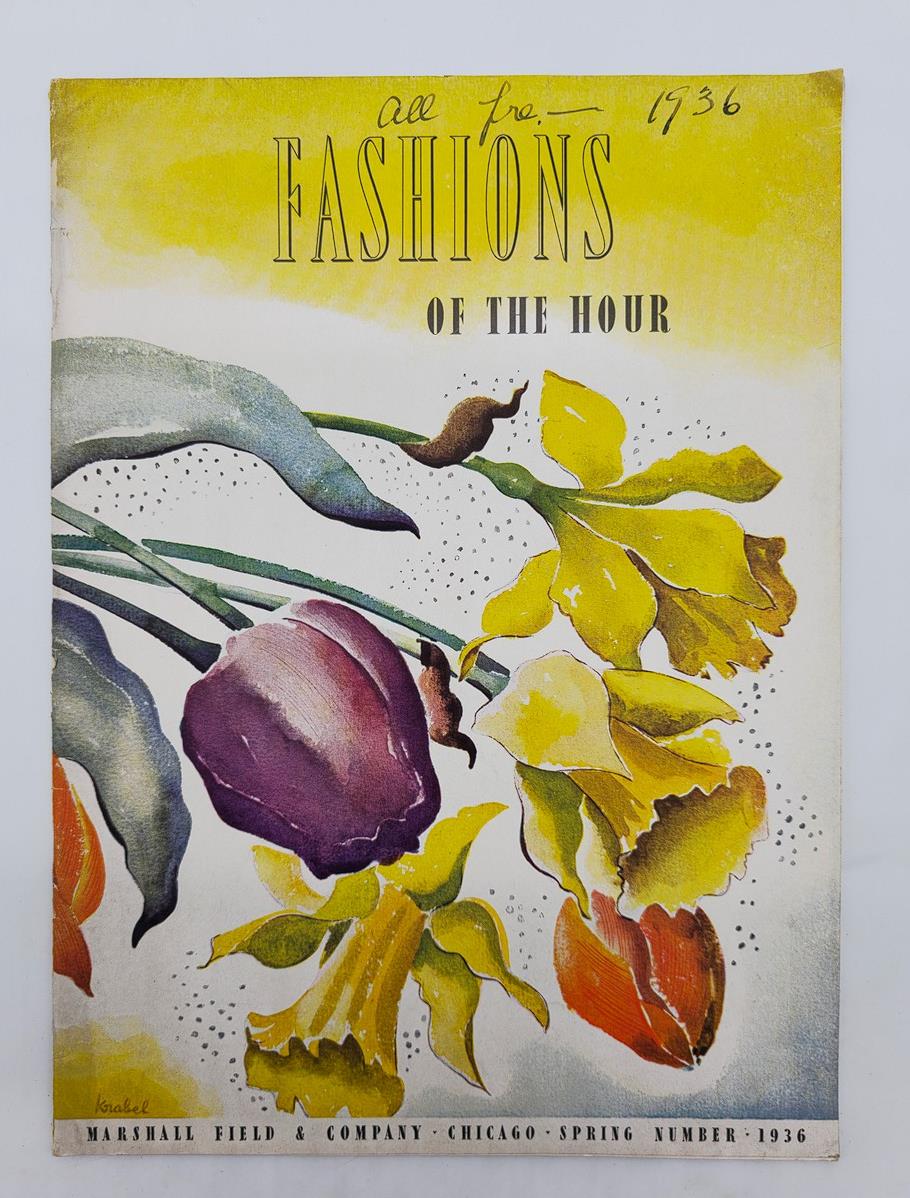



Description
Collector's Note – Why This Issue Matters
The Spring 1936 issue of Fashions of the Hour, dedicated to the Paris Collection, is a primary document of haute couture at one of the most consequential and historically specific moments in the history of twentieth-century fashion — the final spring season before the disruptions of the late 1930s began their irreversible alteration of the conditions that had made Paris the uncontested center of the world's fashion system for more than a century. Spring 1936 falls in the precise mid-decade window between the Depression's worst years and the approaching European crisis, a moment in which Parisian couture had survived the economic catastrophe of the early 1930s — which had devastated the American client base that sustained the major houses — and had reconstituted itself around a somewhat smaller but still operationally intact system of ateliers, press, and international buyers. The houses presenting in spring 1936 included the full roster of the interwar couture establishment: Chanel, Schiaparelli, Mainbocher, Molyneux, Vionnet, Lanvin, and Balenciaga, who had opened his Paris house in 1937 but whose Spanish origins were already influencing the broader conversation. A publication documenting the Paris Collection in spring 1936 is therefore a primary record of the interwar couture system operating in what would prove to be, in retrospect, its final years of uninterrupted dominance before the German occupation of 1940 closed the houses, scattered the clients, and fundamentally restructured the global fashion system in ways that were still being resolved when Paris reopened after the Liberation. For collectors building archives of magazines from 1936 as documents of the decade's cultural and aesthetic life, a Paris Collection issue from this specific spring sits at the intersection of fashion history, Depression-era publishing, and the last confident expression of interwar European cultural authority before the decade's final catastrophe.
Fashions of the Hour was the fashion publication produced by Marshall Field and Company, the Chicago department store, as a vehicle for presenting the season's most significant Paris and American designs to its clientele — a publication category that occupied a specific and important position in the interwar American fashion media landscape. Department store fashion magazines of this type functioned simultaneously as editorial publications and as commercial vehicles, presenting Paris Collection designs to American consumers who could not attend the shows themselves and who relied on publications like Fashions of the Hour to translate the season's Parisian direction into the accessible, purchasable terms of American retail. The spring 1936 Paris Collection issue therefore documents not only what the Paris houses were producing but how those productions were being received, interpreted, and made commercially available to the American market at a specific and revealing moment in the transatlantic fashion system's operation. The relationship between Paris couture and American retail that publications like this one mediated was one of the defining structures of twentieth-century fashion's commercial organization, and a Spring 1936 issue from the peak of that system's interwar operation is a primary document of that relationship at its most fully developed and historically significant expression. The visual content — the haute couture designs, the fashion illustration or photography, the specific garments selected for American retail presentation — constitutes a record of the aesthetic priorities and commercial judgments that shaped what American consumers understood "Paris fashion" to mean in 1936.
The broader context of spring 1936 European culture gives this issue a further historical dimension that collectors approaching it as a period document should understand. The Spanish Civil War began in July 1936, just months after this spring issue's publication. Germany had remilitarized the Rhineland in March 1936 — weeks before this issue reached its readers — in open violation of the Versailles Treaty and without effective Allied response. The Popular Front government in France, elected in May 1936, was producing the political tensions that would complicate French cultural life through the late 1930s. The 1936 Berlin Olympics were months away. Paris in spring 1936 was a city whose cultural vitality and creative productivity — in fashion, in art, in literature, in film — was extraordinary by any historical measure, and simultaneously a city whose political and social foundations were under pressures that contemporary observers could perceive but whose ultimate consequences they could not yet see. A Paris Collection fashion document from this specific spring captures the aesthetic confidence and creative ambition of interwar Parisian culture at the precise moment when that confidence was most visibly coexisting with the approaching conditions that would end it, giving the issue a historical poignancy and documentary significance that purely aesthetic analysis cannot fully capture.
About the Publication
Fashions of the Hour was the seasonal fashion magazine published by Marshall Field and Company, the prominent Chicago department store, beginning in the early twentieth century and continuing through the mid-twentieth century. It served as the store's primary vehicle for presenting the season's most significant Paris and American fashion to its clientele — a sophisticated, relatively affluent readership of Marshall Field customers and fashion-engaged consumers in the Chicago metropolitan area and beyond. The publication occupied a specific and important niche in the interwar American fashion media landscape: distinct from the major national fashion magazines like Vogue and Harper's Bazaar in its direct retail connection, but sharing their commitment to presenting Paris couture as the authoritative source of seasonal fashion direction. Department store fashion publications of this type are among the more specialized and historically significant collecting categories within the broader vintage magazine market, valued both for their visual content — which often included high-quality fashion illustration and photography — and for their documentary value as records of how Paris fashion was translated and presented to American retail consumers during the interwar period's most active years of transatlantic fashion commerce.
Key Highlights Inside
- Spring 1936 Paris Collection — confirmed primary editorial content — Documentation of the spring 1936 haute couture presentations from the Paris houses at the specific mid-decade moment when the interwar couture system was operating in what would prove to be its final years of uninterrupted dominance — a primary visual record of the garments, silhouettes, and aesthetic priorities that defined Parisian fashion authority in the last confident spring season before the late-1930s European crisis began its disruption of the conditions that sustained it.
- Transatlantic fashion translation — confirmed publication function — Editorial content reflecting Fashions of the Hour's specific role as a mediating publication between Paris couture production and American retail consumption, documenting both the designs themselves and the commercial and aesthetic judgments involved in presenting the Paris Collection to a Chicago department store clientele — a primary record of the transatlantic fashion system's most active and consequential interwar operating mode.
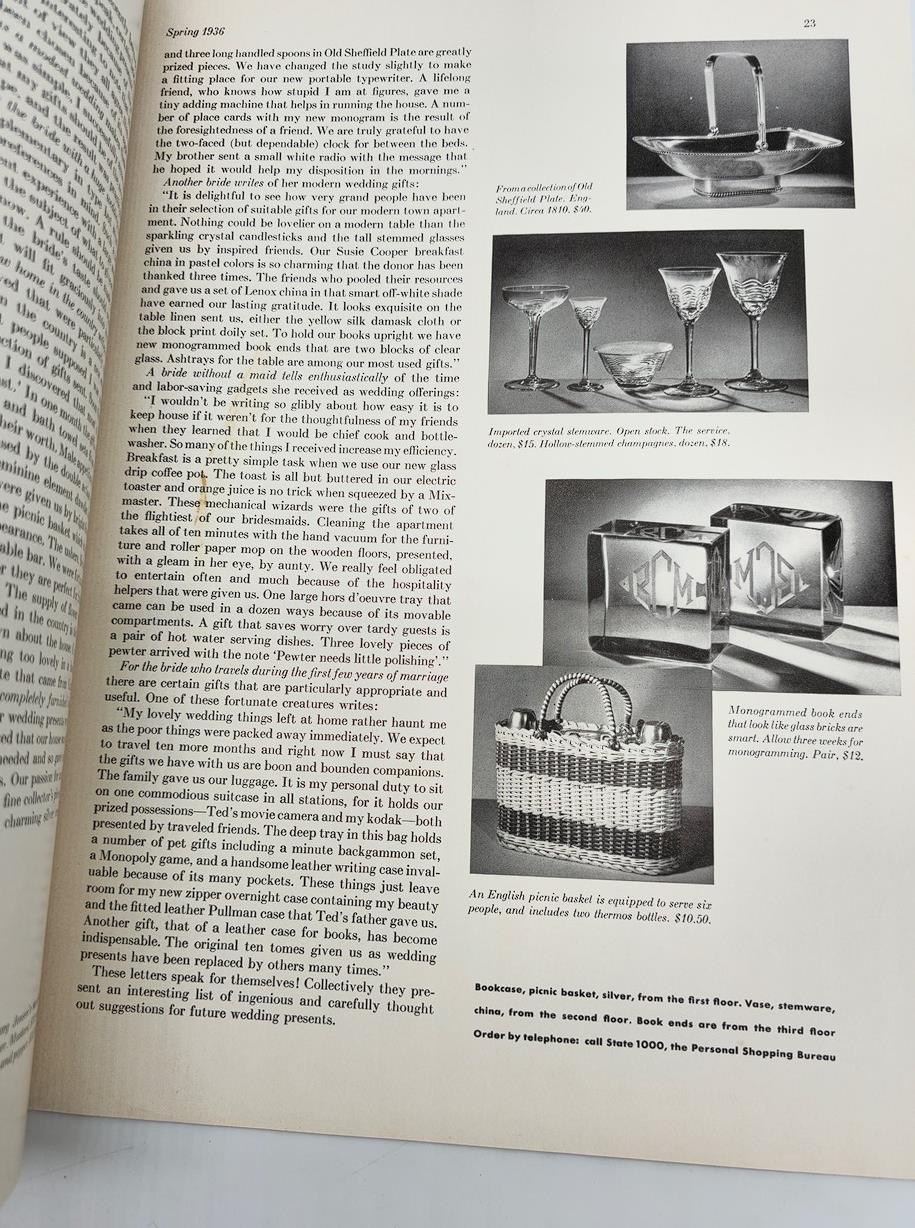
- Spring 1936 fashion illustration and photography — confirmed visual content — Original visual content representative of the illustration and photography standards applied to upscale American retail fashion publishing in the mid-1930s, documenting both the specific garments of the spring 1936 Paris Collection and the visual language through which fashion authority was communicated to American consumers during the interwar period's most productive years of Paris-America fashion exchange.
- Mid-1930s haute couture aesthetic — confirmed historical context — Design content reflecting the specific aesthetic moment of spring 1936 Parisian fashion, when the bias-cut fluidity associated with Vionnet, the surrealist wit of Schiaparelli, and the structured elegance of Mainbocher and Molyneux were all simultaneously active and visible expressions of the extraordinary creative diversity that made interwar Paris couture one of the most artistically consequential periods in the history of Western dress.
- Note: Specific house names, designer attributions, garment descriptions, and additional confirmed content beyond the Paris Collection theme have not been independently verified for this issue. The above reflects the confirmed publication identity and editorial function alongside the known context of spring 1936 Paris fashion rather than specific table-of-contents information.
Condition & Rarity
The listing directs collectors to available photographs as the primary condition reference for this issue, without specifying a named condition grade or detailing particular wear characteristics beyond the general expectation that a nearly ninety-year-old publication will show age-appropriate evidence of its survival across that span. For a publication of this type and vintage, the condition variables that collectors of interwar department store fashion magazines specifically assess are: cover integrity and the preservation of any cover illustration or design, interior page completeness without missing or separated leaves, the condition of any fashion plates or full-page illustrations that constitute the primary visual content of the issue, and the structural integrity of the binding — which in publications of this era is particularly susceptible to adhesive deterioration that can produce separated signatures even when individual pages remain intact. A protective plastic covering applied during preservation indicates deliberate archival handling at some point in the issue's history. Department store fashion publications like Fashions of the Hour were typically produced on better paper stock than mass-market newsstand magazines of the same era — the retail context demanded a quality of presentation that newsprint could not provide — which means that surviving copies generally show better color retention and less brittleness than equivalent-age consumer magazines, making condition assessment from available photographs a reliable guide to the specific survivorship characteristics of any given copy.
Looking for More Issues Like This?
Fashions of the Hour issues from the mid-1930s Paris Collection seasons represent one of the more specialized and purposeful collecting categories within the vintage fashion magazine market — publications whose specific retail-couture mediation function gives them a documentary significance that neither the major national fashion magazines nor purely commercial retail catalogues of the same period fully replicate, and whose survival in any condition across nearly nine decades is meaningfully less common than their original institutional context might suggest. For collectors building a broader picture of American publishing culture, fashion history, and the visual aesthetics of the Depression decade, the full 1936 magazine archive at OriginalMagazines.com covers the range of publications from a year that sits at a specific and historically resonant mid-point of the 1930s — confident enough in its cultural productivity to produce extraordinary work, close enough to the decade's approaching catastrophe to give that work a poignancy that only retrospective distance reveals fully.