

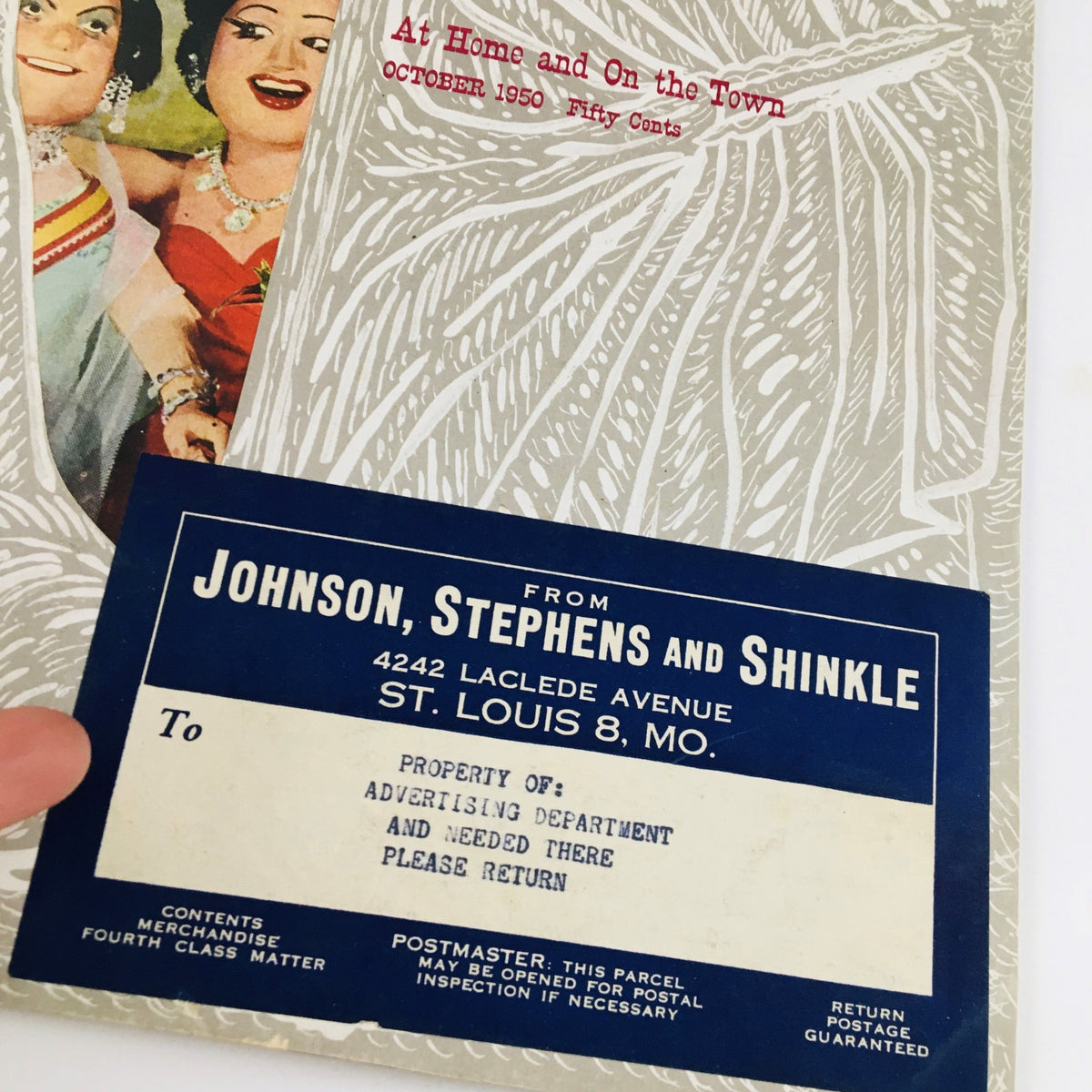


Description
Collector's Note – Why This Issue Matters
The October 1950 issue of Flair magazine — Volume 1, Number 9, themed "At Home and On The Town" — is a primary document of one of the most extraordinary and most ambitious publishing experiments in the history of American magazine design, a publication whose specific visual and editorial ambition was so exceptional that it remains one of the most discussed and most actively collected American magazines of the twentieth century. Flair was created and edited by Fleur Cowles and published by Cowles Communications beginning in February 1950, and it occupied a position in the American magazine landscape that was genuinely without precedent: a monthly publication that treated each issue as an art object rather than simply a periodical, deploying die-cut covers, unusual paper stocks, tipped-in illustrations, fold-out sections, and the contributions of the most significant European and American artists, writers, and designers of the era in a format that challenged every conventional assumption about what a mass-market magazine could be. The October 1950 "At Home and On The Town" theme is primary documentation of the publication's specific editorial voice at a specific mid-run phase: Volume 1, Number 9 was the ninth issue of a publication that would only produce twelve issues before ceasing publication in January 1951, making the October 1950 edition one of the final third of an extraordinarily brief but extraordinarily influential publishing run. For collectors building a serious archive of mid-century American publishing history and design culture, this issue is a primary artifact of a publication that is consistently cited as one of the most visually remarkable and most editorially ambitious monthly magazines ever produced in the United States, and the full range of 1950 magazines and publications from this specific year documents the broader American publishing and cultural landscape in which Flair's extraordinary experiment was occurring.
The specific historical significance of Flair as a publication gives every surviving issue a primary source value that extends well beyond the contents of any individual edition. The magazine's combination of contributors — Salvador Dalí, Jean Cocteau, Colette, W.H. Auden, Tennessee Williams, Isak Dinesen, e.e. cummings, and many others from the most significant roster of European and American creative talent assembled by any American magazine of the era — with Fleur Cowles's own extraordinary editorial vision produced a publication that was simultaneously an art object, a literary journal, a fashion magazine, a travel publication, and a design manifesto. The October 1950 "At Home and On The Town" theme engaged these specific contributors and this specific production ambition in the specific domestic and social leisure context that the early-1950s American affluent upper-class cultural world most characteristically inhabited — the intersection of sophisticated home design and urban social entertainment that defined the specific aspirational lifestyle the publication most directly addressed. The no-label newsstand condition confirmed in the listing is a meaningful positive: Flair's extraordinary die-cut covers and specialized paper stocks make the subscription label bonding particularly consequential for cover integrity, and a newsstand edition preserving the full original cover presentation is a more complete primary artifact of the publication's specific visual ambition than labeled subscription examples. The small sticker noted on the front cover should be assessed from the accompanying photographs relative to its placement on the cover's primary visual elements. The plastic protective covering indicates deliberate preservation care for a publication whose specific production qualities make physical protection particularly meaningful.
The brevity of Flair's publishing run — twelve issues from February 1950 through January 1951 — gives each surviving issue an additional scarcity dimension that the general magazine collecting community immediately recognizes. The publication ceased after one year primarily because its extraordinary production costs made it commercially unsustainable despite its critical admiration and its loyal sophisticated readership, and the total archive of primary source Flair issues is therefore the smallest of any major American magazine of its era. An October 1950 Volume 1, Number 9 "At Home and On The Town" edition in good condition with no label and plastic protective covering is a primary physical artifact of one of the most discussed and most admired brief publishing experiments in American magazine history.
About the Publication
Flair magazine was conceived and edited by Fleur Cowles and published by Cowles Communications from February 1950 through January 1951, producing only twelve issues before its extraordinary production costs ended its run. Its specific production ambitions — die-cut covers, multiple paper stocks, tipped-in illustrations, unusual physical formats, and the most significant roster of European and American creative contributors assembled by any American magazine of the era — made it the most visually distinctive and most editorially ambitious monthly publication in the history of American magazine publishing, and its twelve-issue archive is among the most actively sought and most institutionally significant in American magazine collecting.
Key Highlights Inside
- "At Home and On The Town" theme — Flair's domestic and social leisure editorial vision at mid-run phase documented — The confirmed October 1950 "At Home and On The Town" theme is primary documentation of Flair's specific editorial intelligence engaging with the intersection of sophisticated home life and urban social entertainment at the mid-run phase of one of the most ambitious brief publishing experiments in American magazine history, in Volume 1, Number 9 — the ninth of only twelve issues ever produced.
- No-label newsstand edition — Flair's die-cut cover and specialized production fully preserved — The confirmed no-label newsstand condition is particularly meaningful for a publication whose extraordinary die-cut covers and specialized paper stocks make the subscription label's impact on cover integrity especially consequential, preserving the full original visual presentation of one of the most deliberately designed cover objects in American magazine publishing history.
- Volume 1, Number 9 — penultimate third of twelve-issue total run documented — The confirmed Volume 1, Number 9 designation places this issue in the final third of Flair's complete publishing run of twelve issues, making it one of the rarer entries in an already extraordinarily brief archive and primary documentation of the publication's editorial vision at its mature late-run expression.
- October 1950 early postwar affluent American cultural world — design and lifestyle journalism documented — An October 1950 Flair preserves primary documentation of the specific affluent American cultural world — its home design aspirations, its urban social rituals, its specific intersection of European modernist aesthetics and American postwar prosperity — that the publication was most directly and most ambitiously serving in the specific format of the most visually remarkable monthly magazine of its era.
- Note: The specific contributors, artists, writers, and complete editorial contents of this October 1950 issue beyond the confirmed "At Home and On The Town" theme have not been independently verified beyond the listing description. A small sticker is confirmed on the front cover and should be assessed from the accompanying photographs. The highlights above reflect what is documentable from the listing and the well-established historical context of Flair magazine's extraordinary publishing history.
Condition & Rarity
This issue is described as being in good condition with minor wear, no label, a small sticker on the front cover, and a plastic protective covering — a condition profile that requires careful assessment for a publication whose specific production qualities make condition attributes particularly consequential. The small sticker on the front cover should be evaluated from the accompanying photographs relative to its placement on the die-cut cover's primary visual elements, as Flair's elaborate cover design makes sticker placement on primary visual areas a more meaningful condition variable than it would be for conventional magazine covers. The no-label newsstand status is the most significant positive condition attribute, preserving the cover in complete original presentation. The plastic protective covering indicates deliberate preservation care that is particularly appropriate for a publication whose specialized paper stocks and die-cut production qualities are more vulnerable to environmental exposure than conventional magazine formats. Good condition with minor wear for a publication from this era in this specific production format represents a meaningful preservation achievement. Flair issues in any condition are among the most actively sought and most institutionally significant in American magazine collecting, recognized by design historians, publishing historians, and mid-century American culture researchers as primary artifacts of the most visually remarkable brief publishing experiment in the history of American magazines.
Looking for More Issues Like This?
Flair magazine issues are among the most actively sought and most institutionally significant in the entire history of American magazine collecting — only twelve issues were ever produced, making every surviving example a primary artifact of a publishing experiment that design historians and magazine collectors universally recognize as one of the most ambitious and most visually extraordinary ever attempted. If this October 1950 "At Home and On The Town" edition is no longer available, exploring the broader range of mid-century American publishing history is the most productive path for collectors building context around this extraordinary publication. The 1950 magazines collection at OriginalMagazines.com brings together a wide range of primary source material from the specific year in which Flair's entire extraordinary publishing life occurred, providing the broader cultural and publishing context within which this remarkable experiment took place.