
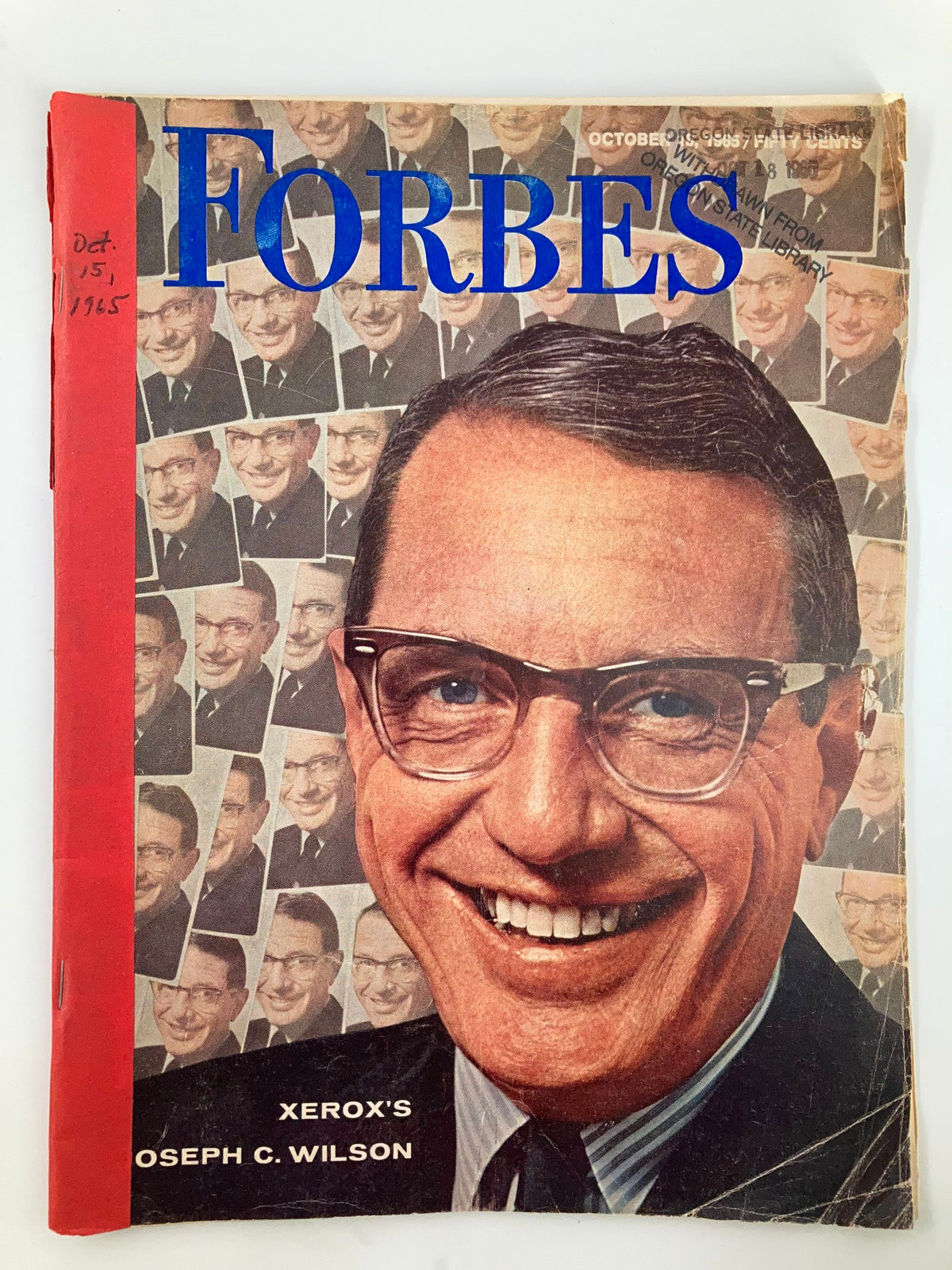


Description
Collector's Note – Why This Issue Matters
The October 15, 1965 issue of Forbes arrived at a remarkable inflection point in American business history. Xerox Corporation, founded as the Haloid Company in Rochester, New York, had only commercialized its landmark 914 plain-paper copier in 1959 — and by the mid-1960s, it had become one of the most stunning corporate success stories of the postwar era. Joseph C. Wilson, the chief executive who steered that transformation, was widely regarded as one of the most visionary business leaders of his generation. A Forbes cover or feature on Wilson in 1965 captured a man and a company at the absolute peak of their cultural moment, before the competitive pressures and legal battles of the 1970s reshaped the xerography landscape entirely. For anyone researching the early history of the document technology industry, this issue is a primary source.
Wilson's leadership of Xerox is a case study still taught in business schools decades later. He championed the licensing agreement with Battelle Memorial Institute and the investment in Chester Carlson's electrophotography patents when virtually no one else saw commercial promise in the technology. By 1965, Xerox revenues had grown from a few million dollars to well over half a billion annually — a trajectory that made Wilson a symbol of what disciplined, long-view corporate strategy could achieve. Forbes was precisely the publication that took that kind of story seriously, and an issue devoted to examining Wilson and Xerox in this period represents the business journalism of the era at its most consequential. Collectors of vintage Forbes magazines will recognize immediately why a 1965 issue anchored by this subject stands apart from routine back-issue fare.
Nineteen sixty-five itself was a pivotal year for American capitalism more broadly. The postwar economic expansion was still running at full force, the Dow was pushing record levels, and the business press was brimming with confidence about the transformative power of technology companies. Xerox was the era's defining example of that thesis. An issue documenting Wilson's stewardship of the company in that specific moment — before the Xerox PARC years, before the antitrust proceedings, before the personal computer rendered the office copier a supporting player rather than a star — belongs in any serious archive of 1965 American business periodicals. It is a document of optimism, ambition, and a particular faith in corporate innovation that defined that decade.
About the Publication
Forbes, founded in 1917 by Bertie Charles Forbes, had by the 1960s established itself as one of the three pillars of American business journalism alongside Fortune and BusinessWeek. Published on a biweekly schedule throughout this era, it targeted executives, investors, and serious students of commerce with in-depth profiles of corporate leaders, analysis of industry trends, and pointed commentary on markets and management. Its editorial voice was characteristically direct — more personality-driven than Fortune, more analytical than a daily financial newspaper — and its cover subjects were chosen to reflect who and what was genuinely shaping the American economy. By 1965 the magazine had developed a loyal readership among the business establishment, and its long-form profiles carried real weight in how corporate reputations were formed and debated.
Key Highlights Inside
- Joseph C. Wilson and Xerox: The issue's central subject is Wilson's leadership of Xerox Corporation, documenting one of the most extraordinary corporate growth stories in American business history at its mid-decade apex.
- Mid-1960s corporate landscape: As with all Forbes issues of this period, surrounding features and editorial content would have addressed the broader investment and management climate of a booming postwar economy — context that makes the issue valuable as a period document beyond its lead story.
- Interior content unconfirmed: Specific articles, departments, and additional features beyond the Wilson and Xerox coverage have not been verified for this issue. The above reflects only what is documented from the cover and known editorial focus.
Condition & Rarity
Surviving copies of this issue present with condition profiles consistent with institutional or personal subscription copies that have passed through six decades of storage. The presence of a front label indicates this was a mailed subscription copy rather than a newsstand edition — a distinction that matters in the periodical collector market, as subscription copies often received less handling in their early life but carry the label as a permanent cosmetic attribute. The stamped mark and additional marks on the cover are characteristic of library or office circulation copies of the era and are common on business magazines from this period. Binding wear and cover creases are expected on any unrestored 1965 magazine and do not typically affect legibility or structural integrity when the wear is described as minor. The plastic protective covering on examined copies suggests prior owner awareness of the issue's collectibility. When evaluating any surviving copy, collectors should prioritize page completeness and interior legibility over cover cosmetics, as the editorial content — not the cover surface — carries the primary research and historical value for an issue of this significance.
Looking for More Issues Like This?
A 1965 Forbes centered on Joseph Wilson and Xerox is genuinely difficult to track down in any condition, and examples in presentable shape surface infrequently. If this particular issue is unavailable, the broader Forbes vintage magazine collection at OriginalMagazines.com covers a wide span of issues and is worth browsing for other landmark editions from the publication's history. For collectors focused specifically on the era rather than the title, the full 1965 magazine archive brings together business, news, culture, and entertainment publications from across that pivotal year — an excellent resource for anyone building a mid-decade reference collection.