


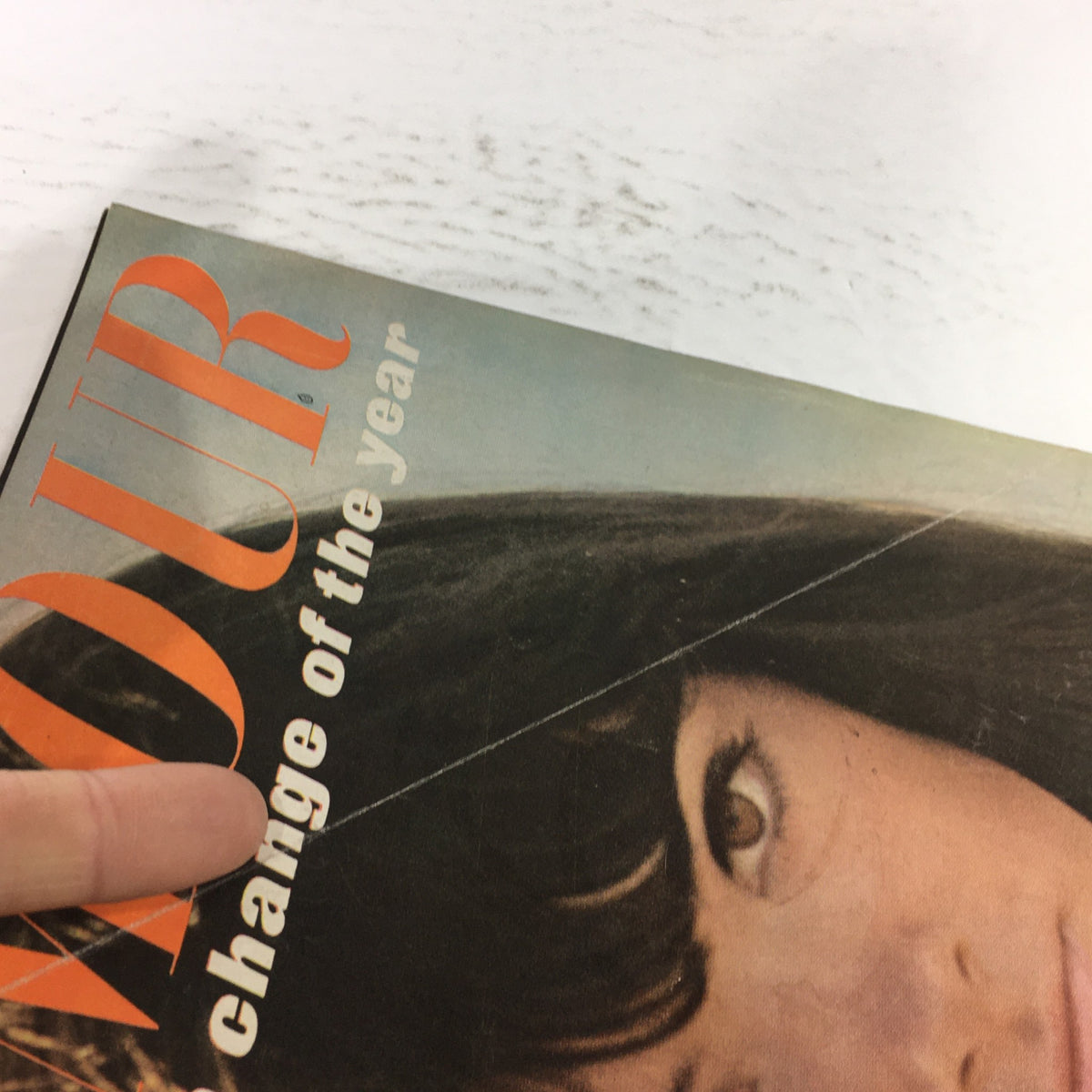


Description
Collector's Note – Why This Issue Matters
The April 1965 issue of Glamour magazine featuring Kathy Carpenter on the cover and themed around "The Year of Make-Up" is a primary document of one of the most significant transitions in American beauty culture of the twentieth century. By April 1965, the beauty industry was in the middle of a genuine revolution: the mid-sixties were producing a radical expansion of the makeup palette available to and used by young American women, the mod aesthetic emerging from British fashion was bringing bold eye makeup, pale lips, and geometric graphic color applications into the mainstream, and the specific concept of makeup as an artistic and expressive practice rather than merely a grooming routine was being articulated in fashion media with a clarity it had not previously achieved. A Glamour cover story designating 1965 "The Year of Make-Up" was an explicit editorial statement that something historically significant was happening in beauty culture — a declaration that the magazine was documenting a genuine turning point rather than merely covering seasonal trends. The April 1965 publication date is itself significant: spring was the season when the year's new beauty directions were most actively being launched by cosmetics companies and promoted by fashion media, and an April issue dedicating itself to the year's makeup revolution was engaging with that moment at its most commercially and editorially energetic. The full arc of the magazine's beauty coverage and editorial evolution across this pivotal decade is traceable through the Glamour magazine collection.
The mid-sixties makeup revolution that this issue documents was driven by a confluence of forces that make April 1965 a particularly interesting moment to capture. Mary Quant's cosmetics line was being developed in Britain and would launch commercially within the year. Revlon and Estée Lauder were competing aggressively for the young American market with new product lines designed for the mod aesthetic. The specific visual influence of Jean Shrimpton, Twiggy, and the London model scene was being absorbed into American mainstream beauty culture in real time, and the question of what American women — specifically the college-educated young professionals who formed Glamour's core readership — were going to do with all of this was genuinely active and unresolved. A dedicated "Year of Make-Up" issue in April 1965 constitutes a primary source of real value for researchers working on the history of the cosmetics industry, the history of beauty standards, and the specific cultural mechanisms through which the British mod aesthetic reached and transformed mainstream American women's culture. The broader context of the mid-sixties cultural transformation is documented across the 1965 magazine collection.
The condition details of this issue warrant specific collector attention. The address label on the front cover identifies it as a subscription copy, and the additional noted attributes — bent crease on the front cover, possible small rips, edge wear, marks, and writing — constitute a condition profile that places this issue in the authentic, aged-artifact category rather than the display-quality category. The writing noted on the magazine adds an unusual provenance detail: handwritten content on vintage magazines is sometimes collector-relevant (inscriptions, dates, personal notes) and sometimes merely wear, and the provided photographs are the appropriate reference for assessing what the writing consists of and where it appears relative to the cover image and interior pages.
About the Publication
Glamour magazine was founded in 1939 by Condé Nast as a fashion and beauty publication aimed at the younger, more budget-conscious end of the women's magazine market — positioned below Vogue and Harper's Bazaar in the fashion hierarchy but above purely mass-market titles in its editorial ambition and visual quality. By April 1965 it had been publishing for twenty-six years and had developed a loyal readership among college students, recent graduates, and young working women who sought fashion and beauty authority that was more accessible and practically oriented than the major couture-focused titles. Its beauty editorial tradition was particularly strong — the magazine had always treated makeup, skincare, and the practical dimensions of beauty culture with a seriousness that its competitors did not always match — making a dedicated "Year of Make-Up" issue a natural expression of its deepest editorial commitments.
Key Highlights Inside
- "The Year of Make-Up" cover theme with Kathy Carpenter — a dedicated annual beauty statement published in April 1965 at the precise moment when the mid-sixties makeup revolution was most actively transforming American beauty culture, capturing in real time the specific products, techniques, and cultural arguments that were making 1965 genuinely distinctive in the history of cosmetics.
- Mid-sixties beauty editorial content — the specific makeup approaches, color palettes, application techniques, and beauty philosophy being presented to young American women in the spring of a year when the mod aesthetic's influence on mainstream American beauty was at its most actively contested and most commercially energetic.
- Spring 1965 fashion and lifestyle content consistent with Glamour's April format — the seasonal fashion directions, career features, and practical lifestyle content that accompanied the beauty editorial and addressed the specific concerns and aspirations of the young college-educated American woman in the mid-sixties.
- Period cosmetics advertising pages — a makeup-themed issue would have carried concentrated advertising from the cosmetics industry in the spring of 1965, providing a primary document of the specific brands, products, and marketing language being used to sell the mid-sixties beauty revolution to a mass female audience.
- Note: Specific article titles, bylines, featured beauty professionals, and additional named interior features beyond those indicated in the listing have not been confirmed from available sources. The highlights above reflect what is documented in the listing and Glamour's well-established beauty editorial format for this period.
Condition & Rarity
Surviving copies of the April 1965 Glamour "Year of Make-Up" issue carry a condition profile that the listing describes with commendable honesty: good overall with the expected collection of authentic-age attributes. The address label on the front cover identifies this as a subscription copy, partially obscuring the Kathy Carpenter cover image in ways that affect display quality and are consistently reflected in how the market prices subscription versus newsstand copies. The bent cover crease, edge wear, possible small rips, marks, and writing are the accumulated attributes of a magazine that has passed through sixty years of existence without preservation care — they authenticate the artifact while affecting its display value. The writing noted on the magazine is an unusual attribute that the photographs are the appropriate reference for evaluating: its location, content, and extent will determine its significance for potential collectors. The protective plastic sleeve is the correct conservation measure for a publication of this age and paper stock.
Looking for More Issues Like This?
An April 1965 Glamour declaring "The Year of Make-Up" with Kathy Carpenter on the cover is a primary document of one of the most significant transitions in twentieth-century American beauty culture, and copies in any condition from this specific themed issue reward research attention from beauty historians and sixties culture collectors. If this particular issue is no longer available, the full Glamour magazine collection at OriginalMagazines.com is the most comprehensive source for exploring other issues across the title's long and editorially rich publishing history, with strong representation in the sixties decades that beauty and fashion historians prioritize most highly. For anyone building a broader archive of the mid-sixties cultural and aesthetic moment, the complete 1965 magazine collection brings together titles from a year whose significance in American fashion, beauty, and cultural history rewards sustained collector attention.