

Description
Collector's Note – Why This Issue Matters
The November 1965 issue of Glamour Magazine, featuring Katherine Carpenter on the cover, is a primary document of American women's fashion publishing at a specific and culturally interesting moment in the mid-1960s. November 1965 falls within one of the most aesthetically dynamic periods in postwar American fashion history — the mod revolution was accelerating from its London origins into mainstream American culture, the British invasion's influence on youth aesthetics was reshaping what women's magazines considered aspirational, and the fashion industry was navigating the transition from the early-decade's more conservative silhouettes toward the increasingly bold and youth-centered aesthetic that would define the decade's most iconic visual identity by 1966 and 1967. A November Glamour cover from this specific year captures the fashion world at exactly this hinge point — not yet at the full expression of the mod moment, but clearly moving toward it. The November position in Glamour's annual publishing calendar also carries specific editorial significance: fall fashion was in full swing, the holiday season's commercial momentum was beginning to shape editorial choices, and the combination of fashion authority and gift-guide aspirationalism that characterized November issues gave them a specific commercial and cultural weight within the publication's year. For collectors building archives around Glamour Magazine's fashion publishing history, November issues from the mid-1960s represent the publication navigating one of the most consequential aesthetic transitions in the history of American women's fashion.
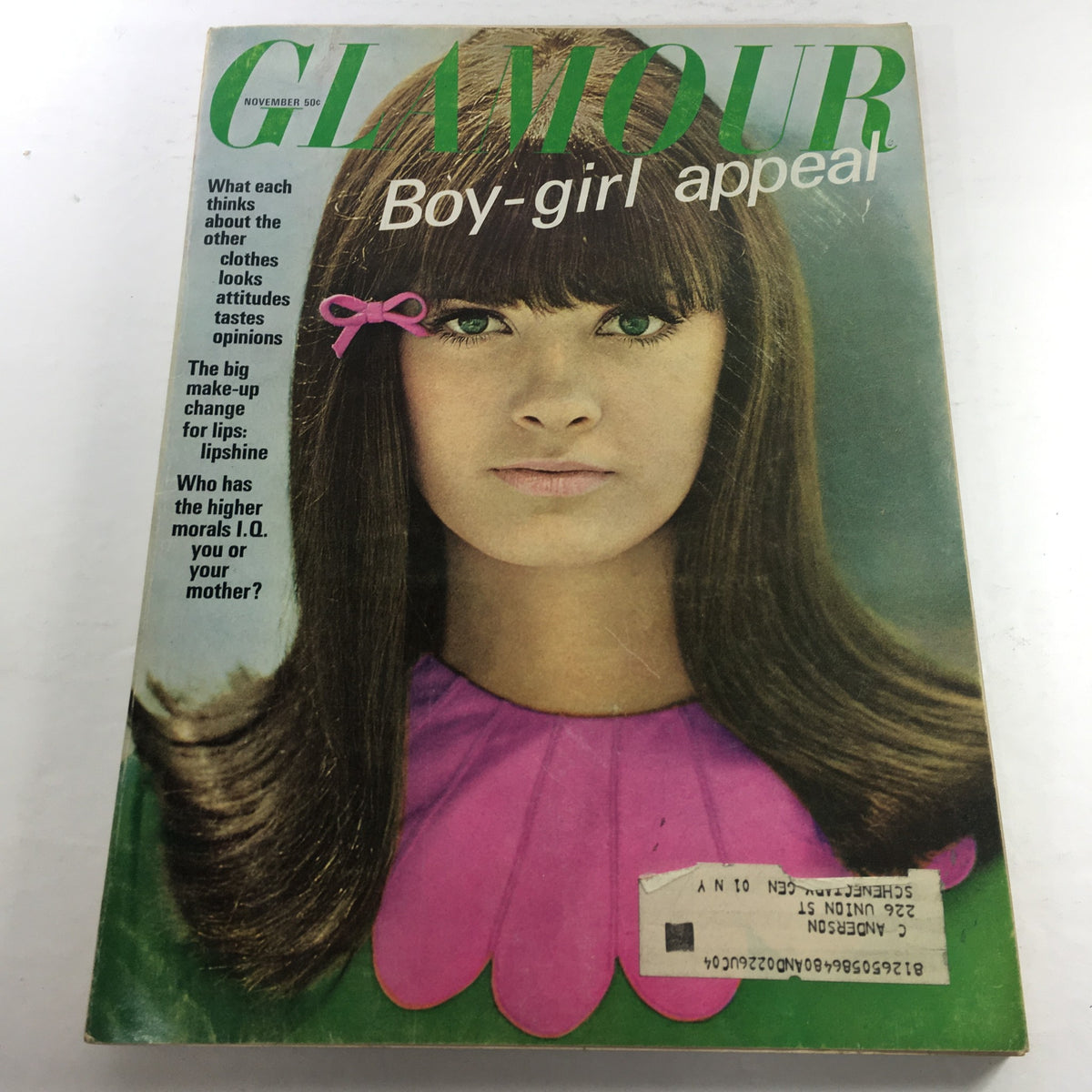
Katherine Carpenter as the November 1965 cover subject places this issue within the specific ecosystem of mid-1960s American fashion modeling — a period when the industry was beginning the transition from the relatively anonymous model-as-clothes-hanger convention toward the named, recognizable model identity that would eventually produce the supermodel culture of the 1980s. A Glamour cover appearance in November 1965 was a significant professional milestone within that ecosystem, representing the kind of mainstream American fashion magazine placement that defined a mid-decade modeling career's trajectory. The broader cultural context of November 1965 also adds historical weight to this issue's specific date: the Vietnam War was escalating rapidly, civil rights legislation was reshaping American law and society, and the generational transformation that the counterculture would make fully visible by 1967 was already well underway in the background of a mainstream fashion magazine that was primarily engaging with its readership through the language of clothes, beauty, and lifestyle aspiration. That tension between the fashion magazine's editorial world and the larger political reality surrounding it is itself historically revealing as a document of how mainstream women's publishing was engaging — or deliberately not engaging — with its historical moment. Collectors researching American women's publishing and cultural life from 1965 will find this issue a useful primary document of that specific tension.
About the Publication
Glamour Magazine was founded by Condé Nast in 1939, initially titled Glamour of Hollywood before evolving into the broader fashion, beauty, and lifestyle publication that became one of the most widely read women's magazines in the United States. By November 1965, Glamour had established itself as a central title in the Condé Nast portfolio, serving a readership of young professional and college-aged American women whose fashion and lifestyle aspirations were grounded in accessibility and practicality alongside genuine glamour. The magazine's November issues were among its more commercially significant of the year — the combination of fall fashion authority and approaching holiday season advertising investment gave November editions a specific commercial and editorial weight. The mid-1960s were a period of significant aesthetic change for Glamour and its contemporaries, with the mod revolution beginning to influence editorial choices and cover selections in ways that were reshaping what the publication considered aspirational for its core demographic of young American women.
Key Highlights Inside
- Katherine Carpenter appears on the November 1965 cover, documented here within the specific mid-1960s American modeling ecosystem that was navigating the transition from anonymous fashion photography toward the named-model culture that would consolidate through the late 1960s and 1970s — a cover placement that represents a significant professional milestone within that specific industry moment.
- The November 1965 publication date places this issue within one of the most aesthetically dynamic years in postwar American fashion — the mod revolution was accelerating from British origins into the American mainstream, and Glamour's November editorial choices document that transition as it was actively occurring rather than in retrospect.
- As a November issue, this Glamour would have combined fall fashion authority with the beginning of holiday season editorial content — a combination that gave November editions a specific commercial and aspirational character distinct from other months in the publication's annual calendar.
- The confirmed address label on the front identifies this as a subscriber copy — the standard surviving format for Glamour from the mid-1960s, as the magazine's subscription-based distribution model meant that labeled copies represent the majority of surviving issues from this period.
- Note: Specific article titles, named contributors, additional featured models, and detailed interior content beyond the confirmed Katherine Carpenter cover are unconfirmed for this issue. The highlights above are drawn from listing details and well-documented public knowledge about Glamour Magazine and the fashion industry in November 1965.
Condition & Rarity
Surviving copies of this issue present in Good condition with minor edge wear, possible small rips or marks, and a confirmed address label on the front — a condition profile that collectors should evaluate carefully against the provided photographs to understand the specific nature and location of the edge wear and any marks relative to the Carpenter cover imagery. For a sixty-year-old women's fashion magazine, Good condition with these attributes represents honest survival aging that is workable for research and collection purposes, though display-oriented collectors should assess the photographs for the specific degree of cover surface integrity before acquisition. The address label is a subscriber delivery marking consistent with Glamour's distribution model of the era — the standard surviving format for mid-1960s issues of the publication rather than a condition deficiency. The confirmed ease of page turning noted in the listing is a positive preservation detail, indicating that interior pages remain supple and undamaged by brittleness despite the publication's age. The plastic protective covering provides appropriate stabilization for a fragile mid-1960s periodical, helping to prevent further cover surface deterioration and spine damage during handling and storage. Mid-1960s Glamour issues documenting the transitional aesthetic moment before the full mod revolution's American mainstream expression are collected both by Glamour archivists building complete runs and by fashion historians whose research centers on the specific editorial choices of this pivotal transitional period.
Looking for More Issues Like This?
Glamour Magazine issues from the mid-1960s transitional aesthetic moment — the years immediately before the mod revolution fully reshaped American women's fashion publishing — are among the more historically interesting entries in the publication's long archive, and November 1965 is a well-situated example of the publication navigating that transition in real time. The Glamour Magazine collection at OriginalMagazines.com is the most comprehensive place to browse available issues across the publication's decades of fashion publishing history, with representation from the mid-1960s period when the decade's most distinctive aesthetic was taking shape. For collectors building a broader picture of American women's publishing and fashion culture in 1965, the 1965 magazines collection offers a wide cross-section of titles that together capture the full range of that year's American print and fashion culture at a genuinely consequential moment of mid-decade transition.