

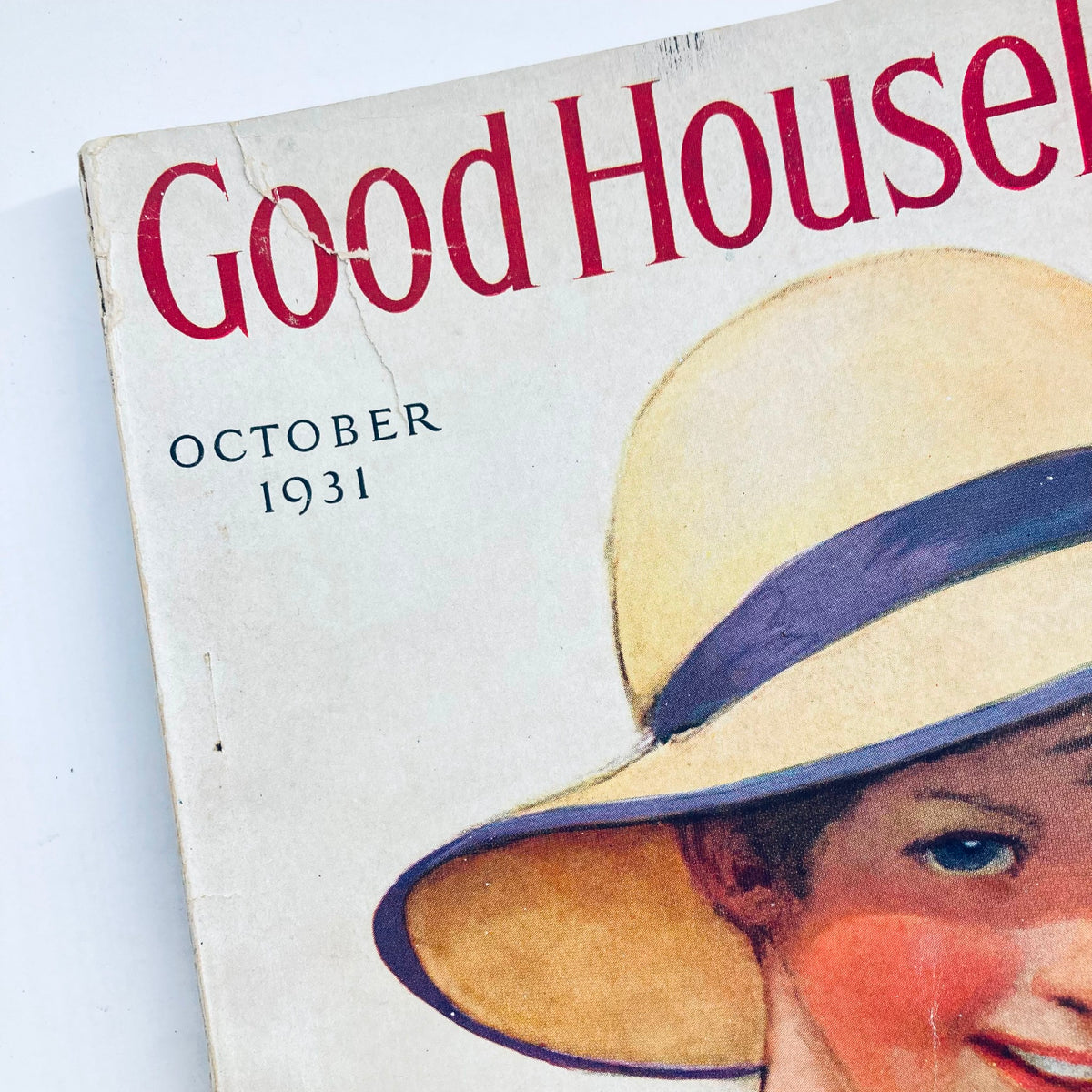


Description
Collector's Note – Why This Issue Matters
The October 1931 issue of Good Housekeeping — themed around "The First French Fashions" — arrives at one of the most culturally and economically contradictory moments in twentieth-century American life. The Great Depression was in its second year, unemployment was rising toward its catastrophic peak, and the economic conditions that would define the decade were tightening their grip on ordinary American households. And yet the American fashion press, and the women's magazines that had built their advertising models on aspirational consumer culture, continued to report on French couture with the same reverent attention they had given it throughout the prosperous 1920s. That combination — French fashion at the height of its authority, documented in a major women's service magazine during the depths of the Depression — gives this issue a particular historical tension that makes it a more interesting cultural artifact than a straightforward fashion document would be. For collectors who focus on vintage Good Housekeeping issues from the early twentieth century, an October 1931 French fashion feature represents a precise document of how American women's media navigated the dissonance between aspirational style culture and economic devastation.
French fashion in October 1931 occupied an absolute cultural authority in the world of women's dress that is difficult to fully appreciate from a contemporary vantage point. Paris — and specifically the houses of Coco Chanel, Madeleine Vionnet, Elsa Schiaparelli, and Jean Patou, among others — was the unquestioned center of the global fashion universe, and the seasonal collections produced by these designers set the terms within which American fashion at every price point operated. The fall collections shown in Paris each year were the subject of extensive coverage in American women's magazines, and the phrase "the first French fashions" — referring to the earliest American reporting on the Parisian fall season — was a recognized editorial category that readers of publications like Good Housekeeping understood as a signal of genuine news value. The 1931 collections were taking place against the backdrop of an international economic crisis that was affecting the couture houses themselves — client numbers were shrinking, prices were under pressure, and the houses were adapting their designs and their business models in ways that would have been visible in the collections that this issue was covering. Collectors building archives around the magazines of 1931 will find this issue a document of French fashion at a specific and historically pressured moment, filtered through the particular editorial lens of American women's service journalism.
The broader significance of this issue lies in what it reveals about Good Housekeeping's editorial strategy during the Depression years. The magazine had built its reputation and its enormous readership on a combination of practical household guidance, consumer advocacy, and aspirational lifestyle content — a formula that required careful calibration in economic conditions as severe as those of 1931. A French fashion feature in October 1931 is an editorial bet that its readership, however economically stressed, still valued the cultural authority and aesthetic pleasure that Parisian couture represented, and that engaging with that world — even vicariously, even in circumstances that made actual acquisition of French fashions impossible for most readers — remained a meaningful part of the magazine's value proposition. That bet, and the editorial judgment it reflects, makes this issue a document not just of fashion history but of the psychology of aspiration and the role that women's magazines played in sustaining it through one of the most difficult periods in American economic history.
About the Publication
Good Housekeeping, founded in 1885 and one of the most widely circulated women's service magazines in the United States throughout the early twentieth century, had by 1931 developed an editorial identity built around a distinctive combination of practical household guidance, consumer product evaluation, fashion and beauty coverage, fiction, and the aspirational lifestyle content that formed the core of its appeal to the educated American housewife. The magazine was particularly well known for its Good Housekeeping Institute and its product testing and endorsement program, which gave it a consumer advocacy authority that distinguished it from pure fashion or entertainment publications and built deep reader trust across a broad demographic range. Its fashion coverage in the early 1930s reflected the magazine's characteristic approach of making high-style aspirational content accessible and relevant to readers whose actual purchasing power varied enormously — translating the authority of French couture into practical guidance for American women navigating the difficult terrain of Depression-era domestic life with dignity and style.
Key Highlights Inside
- A lead fashion feature on the first French fashions of the season — reporting on the Paris fall collections with the authority and detail that Good Housekeeping's fashion coverage was known for, presenting the season's key silhouettes, fabrics, and design directions from the Parisian couture houses at a moment when those houses were adapting to the economic pressures of the global Depression while maintaining the aesthetic standards that had made Paris the center of the fashion world.
- Illustrated fashion content almost certainly featuring the kind of high-quality fashion illustration that defined women's magazine visual presentation in the early 1930s — a period when fashion illustration was at the peak of its technical and artistic development, before photography had fully displaced hand-drawn imagery as the dominant format for fashion documentation in American magazines.
- Household management, domestic economy, and practical guidance content consistent with Good Housekeeping's editorial formula in 1931 — content that would have been shaped by the economic conditions of the Depression, addressing readers who were managing reduced household budgets while maintaining the standards of domestic life that the magazine had always championed.
- Fiction, beauty, and lifestyle content reflecting the specific cultural and social atmosphere of October 1931 — a moment of economic anxiety, cultural conservatism, and domestic focus that gave women's service magazine content a particular resonance and relevance for readers whose world had contracted significantly from the relative prosperity of the preceding decade.
- Advertising content representing the consumer landscape of early Depression-era America — the advertisements in an October 1931 Good Housekeeping provide a significant document of which consumer goods companies were maintaining their advertising investment despite economic conditions, and of how American advertising was adapting its messaging to address readers under genuine financial stress.
Note: Specific article titles, fiction contributors, featured designers, and additional editorial details beyond the cover theme are unconfirmed for this issue from available sources. The highlights above reflect verifiable historical context drawn from the cover theme, publication date, and the well-documented editorial character of Good Housekeeping during this period.
Condition & Rarity
This copy is identified as a no-label edition — a meaningful provenance attribute for a magazine of this era, as it indicates the copy entered circulation through newsstand retail rather than subscription fulfillment, arriving without the address label adhesive damage and postal handling wear that characterize mailed copies. On a magazine now approaching one hundred years old, the absence of a label is a substantive condition attribute that distinguishes surviving newsstand examples from the more commonly encountered subscription-processed copies, and is particularly significant given the fragility of paper stock from the early 1930s — a period when American magazine paper quality varied considerably and the acid content of the paper used for interior pages makes careful storage history an important factor in the condition of surviving copies. The listing notes the magazine is in good condition and that photographs accurately represent the exact item — collectors are strongly advised to examine those photographs carefully, as a ninety-plus-year-old women's service magazine will typically show the full range of paper aging characteristics including toning, brittleness at the edges, and potential foxing that are inevitable at this age regardless of storage conditions. The plastic protective sleeve indicates preservation-conscious storage and provides ongoing protection against light exposure and humidity. For a Good Housekeeping issue from 1931 with a French fashion cover theme, a no-label newsstand copy in good condition represents a meaningful survival from one of the more vulnerable decades in American magazine publishing history.
Looking for More Issues Like This?
A no-label October 1931 Good Housekeeping with a French fashion theme is a genuinely specific find from one of the more challenging decades to source in good condition — Depression-era women's magazines of this age surface with diminishing frequency as the years continue to thin the surviving pool of well-preserved examples. If this issue has already found a home, the broader vintage Good Housekeeping collection at OriginalMagazines.com is an excellent resource for other significant issues from the magazine's remarkable early-twentieth-century run, spanning the years when American domestic culture and women's consumer identity were being shaped in ways whose influence is still felt today. Collectors focused on the fashion, domestic culture, and social atmosphere of the early Depression years will also find it well worth exploring the full 1931 magazine archive, which brings together publications from one of the most historically consequential and emotionally charged years of the twentieth century.