
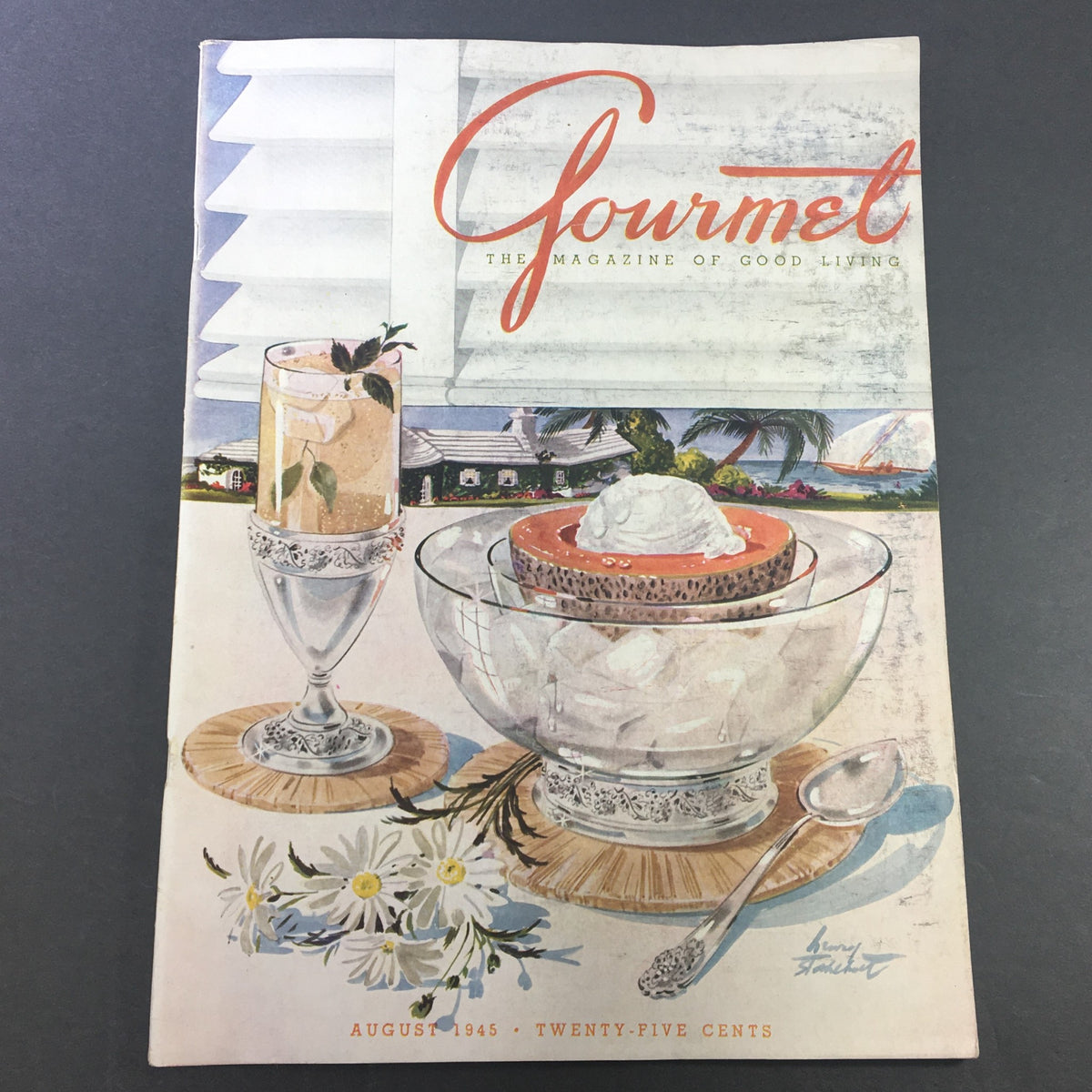


Description
Collector's Note – Why This Issue Matters
The August 1945 issue of Gourmet: The Magazine of Good Living, carrying the cover title "Clams Across The Sea," is a primary document of American culinary culture at one of the most historically precise and consequential months of the twentieth century. August 1945 is not simply a month in the war's final year — it is the month the war ended. The atomic bombings of Hiroshima and Nagasaki occurred on August 6 and August 9, Japan's surrender announcement came on August 15, and the formal surrender documents were signed on September 2. A Gourmet issue carrying the cover date of August 1945 was therefore on American newsstands during the final days of the Second World War, reaching its readership at the precise historical moment of the conflict's conclusion — a convergence of publication date and historical event that gives this specific issue a documentary significance within the wartime run of the title that no other single month can claim with the same precision. The contrast between the magazine's characteristic editorial register — culinary pleasure, cosmopolitan curiosity, the civilized pleasures of the table — and the historical enormity of the events unfolding in August 1945 is itself a primary document of the specific cultural atmosphere in which American domestic life was suspended between the end of one era and the uncertain beginning of another. For collectors building a serious archive of vintage Gourmet magazine issues across the wartime period, the August 1945 issue occupies a singular position — the wartime issue published during the war's final days, carrying editorial content conceived and produced in the weeks before the surrender that no editor could have anticipated with certainty when the issue went to press.
The "Clams Across The Sea" cover title is a primary editorial document whose specific resonances in August 1945 reward careful attention. The oceanic framing — clams as a subject that crosses seas, that travels across water, that connects distant coastlines and culinary traditions — carries an unmistakable geographical and geopolitical charge in a month defined by events in the Pacific Ocean theater of a global war. Whether or not that resonance was consciously intended by the editorial team that titled the piece, it exists as a historical fact of reception: a Gourmet reader in August 1945 encountering a cover story about clams crossing the sea was encountering that title in a cultural atmosphere saturated with news from the Pacific, with reports of naval operations, island campaigns, and the oceanic distances that separated American forces from American shores. Beyond that contextual layer, the specific choice of clams as a cover subject in August 1945 reflects the genuine culinary geography of the period. Clams — available along both American coasts, unrationed throughout the war, and representing a category of seafood that home cooks could access without the point-rationing constraints that governed meat and many canned goods — had become an increasingly prominent ingredient in wartime American cooking precisely because of their availability. A Gourmet cover story celebrating clam-based cookery in August 1945 is therefore simultaneously a document of wartime ingredient pragmatism elevated to culinary aspiration and a preview of the post-rationing abundance that the magazine's readership was beginning to anticipate. Collectors focused on magazines from 1945 as primary documents of the American home front's final wartime months will find this issue providing unusually concentrated evidence of how food-focused publishing was navigating the transition between scarcity and abundance at the war's precise moment of conclusion.
Situating this issue within Gourmet's own institutional history adds a dimension of significance that purely contextual analysis cannot capture. The magazine had been founded in January 1941 and had spent its entire first four and a half years publishing through the war — every issue from its second number onward produced in the shadow of a global conflict that had reshaped every aspect of American domestic life including the food supply, the household economy, and the emotional register in which cooking and eating were experienced. The August 1945 issue represents the effective end of that wartime publishing era, the last full month of production in which the magazine's editorial decisions were being made under the conditions — rationing, wartime psychology, the omnipresent awareness of military events — that had defined its founding years. The confirmed interior content noted in the listing — classic recipes and cooking tips from the 1940s alongside the central clam-focused feature — reflects the editorial maturity that four and a half years of wartime publishing had produced: a magazine that had learned to sustain its foundational vision of culinary pleasure and good living under conditions of genuine constraint, and that was, in August 1945, on the threshold of the postwar era in which that vision could be pursued without apology or rationing-related qualification for the first time since the magazine's second year of existence.
About the Publication
Gourmet: The Magazine of Good Living was founded in January 1941 by Earle MacAusland, whose editorial philosophy established from the outset an approach to food publishing that set the title apart from every American competitor of its era: the treatment of cuisine as a subject worthy of literary engagement, historical depth, narrative ambition, and genuine cultural seriousness rather than purely practical domestic instruction. Where other food publications of the period presented recipes as functional documents, Gourmet embedded its culinary content in story — regional portraits, travel narratives, personal histories, and cultural essays that gave its content a resonance and intellectual weight that no direct competitor fully matched. Its readership was educated, relatively affluent, and genuinely invested in food, hospitality, and the broader pleasures of a cultivated life. Published continuously from its 1941 founding until Condé Nast — which had acquired the title in 1983 — closed it in 2009 during a round of cost reductions, the magazine's nearly seven-decade run produced an archive of exceptional historical depth. The wartime issues of 1941 through August 1945 represent the founding era's most historically charged body of work, a period in which the magazine's commitments to pleasure, cosmopolitan curiosity, and the primacy of good living were sustained against conditions that made all three genuinely difficult — and in which the editorial responses to those conditions produced some of the most revealing and historically significant publishing of the title's long history.
Key Highlights Inside
- "Clams Across The Sea" — confirmed cover title and primary editorial feature — A seafood-focused cover story published in the final weeks of the Second World War, documenting Gourmet's characteristic approach of elevating an ingredient whose wartime availability — clams remained unrationed throughout the conflict — into a subject of genuine culinary aspiration and cosmopolitan cultural exploration, at the precise historical moment when the oceanic geography implicit in its title was saturated with the news of the Pacific war's conclusion.
- Classic 1940s recipes and cooking tips — confirmed interior content — Recipe and technique content developed within the specific constraints and ingredient realities of the war's final months, reflecting the culinary ingenuity that Gourmet's editorial team had refined across four and a half years of wartime publishing and that would form the foundation of the magazine's postwar editorial identity.
- Seafood and clam-focused culinary content — confirmed thematic content — Extended coverage of clam-based cookery consistent with the wartime prominence of unrationed seafood ingredients in American home cooking, documenting both the practical ingredient landscape of August 1945 and Gourmet's consistent editorial strategy of finding culinary sophistication within the constraints of what was actually available to its readership.
- Mid-century American dining culture — confirmed contextual content — Editorial material reflecting the culinary trends, cooking techniques, and lifestyle aspirations of August 1945 American domestic culture, published at the specific transitional moment between the wartime kitchen's managed scarcity and the postwar abundance that the magazine's readership was beginning to anticipate as the conflict reached its conclusion.
- Note: Specific additional interior article titles and confirmed features beyond the cover story and recipe content noted in the listing have not been independently verified for this issue. The above reflects documented cover content, confirmed listing descriptions, and the publication's known editorial conventions for this period rather than comprehensive table-of-contents information.
Condition & Rarity
Surviving copies of this issue described as being in good condition with minor edge wear and occasional rips or marks occupy an honest and collectible position within the grading spectrum for an eighty-year-old consumer magazine — condition attributes that experienced collectors of wartime-era periodicals understand as inherent to the survival of any newsstand publication across eight decades rather than as meaningful detractions from historical or collecting value. The newsstand origin designation — confirmed by the absence of a mailing label — places surviving copies in the provenance category that collectors of Gourmet and similar publications specifically prioritize, as subscription labels on issues of this age were typically applied directly to the cover in positions that either permanently obscure the primary imagery or leave irreversible adhesive damage when removed. A protective plastic covering applied during preservation is a particularly significant condition indicator for a magazine of this age, distinguishing copies that received deliberate archival handling at some point in their history from the majority of surviving examples stored in conditions that accelerate the paper degradation, yellowing, and brittleness that affect publications from this period. Federal wartime paper conservation measures, implemented from 1942 onward to redirect raw materials toward the war effort, reduced the material quality of paper stock across the American publishing industry through the war's end — meaning that Gourmet issues from 1942 through August 1945 are more susceptible to age-related deterioration than their prewar counterparts, and that any surviving copy retaining complete, legible interior pages, intact binding, and a cover that clearly communicates its original design represents a genuine and meaningful preservation of an irreplaceable primary document from one of the most historically significant months of the twentieth century.
Looking for More Issues Like This?
The August 1945 issue of Gourmet — published during the final days of the Second World War, carrying a cover story whose oceanic title resonates with the Pacific theater geography of the war's conclusion, and representing the last full month of the magazine's wartime publishing era — occupies a position within the title's archive that no other single issue can replicate. Issues from this precise window of American history surface rarely in good condition, and the combination of historical specificity and the publication's founding-era significance makes them among the most purposeful collecting targets within the full Gourmet run. The complete Gourmet magazine collection at OriginalMagazines.com spans the full arc of the title's history from its 1941 founding through 2009 and is the most reliable resource for collectors researching available issues across the wartime and early postwar era. For collectors building a broader picture of American publishing culture in 1945 — the year whose second half documents the most consequential transition in modern American history — the full 1945 magazine archive covers the range of publications from a year in which every month carries a specific and irreplaceable documentary weight.