



Description
Collector's Note – Why This Issue Matters
The August 1946 issue of Gourmet: The Magazine of Good Living, carrying the cover title "Hooked Lightning," is a primary document of American culinary culture at the first full summer of the postwar era — a moment whose specific historical character is distinct from both the wartime issues that preceded it and the settled postwar prosperity that would define the magazine's identity through the following decade. August 1946 falls eleven months after Japan's formal surrender and three months after the end of meat rationing in November 1945, placing this issue in the specific transitional window when the practical constraints of wartime cooking had been lifted but the psychological and material adjustment to postwar abundance was still actively underway. The American kitchen of August 1946 was not yet the kitchen of the prosperous 1950s; it was the kitchen of a society learning to cook without the rationing disciplines that had governed it for nearly four years, reacquainting itself with ingredients and quantities that had been managed, substituted, and conserved for so long that their unrestricted availability required a genuine recalibration of domestic practice. That Gourmet chose for its August 1946 cover a title as kinetic and unexpected as "Hooked Lightning" — a phrase that combines the patient, tactile tradition of fishing with the sudden, electric energy of a strike — reflects the editorial vitality and creative confidence that the magazine was bringing to its first full postwar summer, a season in which the pleasures of outdoor food culture, seasonal cooking, and the American landscape could finally be celebrated without the qualification and constraint that had colored every issue since 1942. For collectors building a comprehensive archive of vintage Gourmet magazine issues across the wartime and postwar transition, the August 1946 issue represents the publication in its first full season of genuinely unencumbered editorial freedom — a quality that distinguishes it from every wartime issue in the run and gives it a specific and irreplaceable position in the magazine's founding-era archive.
The "Hooked Lightning" title merits careful attention as a primary document of Gourmet's postwar editorial identity and of the specific cultural resonances of fishing as a subject in the summer of 1946. Fishing in the American cultural imagination of 1946 carried a particular charge that it does not carry in other periods: the return of millions of veterans to civilian life had produced an enormous demand for the outdoor recreational activities — hunting, fishing, camping — that represented the peacetime leisure that combat service had suspended, and the summer of 1946 was the first in which that demand could be fully expressed. A Gourmet cover story on fishing in August 1946 was therefore addressing a subject of genuine cultural immediacy — the reconnection of American men with the outdoor food traditions of a pre-war civilian life — while simultaneously pursuing the magazine's characteristic editorial strategy of elevating a vernacular American food practice into a subject of culinary sophistication and narrative depth. The "lightning" metaphor embedded in the title signals the specific thrill of the catch rather than the patience of waiting — the kinetic, muscular, suddenly resolved moment that fishing shares with no other food-gathering tradition — and its use as a cover title in August 1946 reflects the specific emotional register of a postwar readership that had experienced four years of sustained tension and was, in the summer of its first full peace, finding its way back to the pleasures of a landscape and a leisure culture that the war had temporarily removed. Collectors focused on magazines from 1946 as primary documents of the American postwar transition will find this issue providing an unusually specific window into how food-focused publishing was mediating the cultural reconnection with outdoor American life in the first full summer after the conflict's end.
Situating this issue within Gourmet's own institutional history at the point of its August 1946 publication adds a dimension of significance that the historical context alone does not fully capture. The magazine had completed its fifth full year of publication in January 1946 and was entering its sixth year — the first in which the entire editorial calendar could be planned without reference to rationing, wartime psychology, or the operational constraints that had shaped every issue since late 1941. The confirmed content of this issue — exquisite recipes, sophisticated dining tips, articles reflecting the elegance and creativity of the gourmet scene alongside the "Hooked Lightning" outdoor narrative — reflects the full range of the magazine's editorial ambitions being expressed simultaneously and without qualification for the first time in its history. The wartime issues had required a constant editorial negotiation between aspiration and constraint; the August 1946 issue documents the magazine freed from that negotiation, operating with the maturity and confidence that five years of publishing under difficult conditions had produced, and deploying that maturity toward the pleasures of postwar summer living with a directness and creative energy that the wartime issues, however significant historically, could not fully achieve. That combination — editorial maturity earned through wartime, deployed in the freedom of first peace — gives the summer 1946 issues of Gourmet a specific character within the founding era's archive that no earlier or later group of issues precisely replicates.
About the Publication
Gourmet: The Magazine of Good Living was founded in January 1941 by Earle MacAusland, whose editorial philosophy established from the outset a distinctive and consequential approach to American food publishing: the treatment of cuisine as a subject worthy of literary engagement, historical depth, narrative ambition, and genuine cultural seriousness rather than purely practical domestic instruction. Where other food publications of the period presented recipes as functional documents, Gourmet embedded its culinary content in story — regional portraits, travel narratives, personal histories, and cultural essays that gave its content a resonance and intellectual weight that no direct competitor fully matched. Its readership was educated, relatively affluent, and genuinely invested in food, hospitality, and the broader pleasures of a cultivated domestic life. Published continuously from its 1941 founding until Condé Nast — which had acquired the title in 1983 — closed it in 2009 during a round of cost reductions, the magazine's nearly seven-decade run produced an archive of exceptional historical depth. The wartime and immediate postwar issues of 1941 through 1947 represent the founding era's most historically charged body of work, encompassing the full arc from the magazine's pre-Pearl Harbor launch through the wartime years and into the first full seasons of postwar American life — a period during which the magazine's foundational commitments to pleasure, cosmopolitan curiosity, and the primacy of good living were tested by four years of war and confirmed by the peace that followed.
Key Highlights Inside
- "Hooked Lightning" — confirmed cover title and primary editorial feature — A fishing-focused narrative feature published in the first full postwar summer, documented at the specific cultural moment when the return of millions of veterans to civilian life had created an extraordinary demand for the outdoor recreational traditions that wartime service had suspended — and when Gourmet's characteristic editorial strategy of elevating vernacular American food practices into subjects of culinary sophistication and narrative depth could be pursued without the rationing-related qualifications that had shaped every issue since 1942.
- Exquisite recipes and sophisticated dining tips — confirmed interior content — Recipe and culinary content developed and presented in the first full summer of postwar ingredient availability, reflecting Gourmet's editorial maturity at the conclusion of its wartime publishing era and the specific creative freedom that the lifting of meat and food rationing in late 1945 had restored to the American kitchen and to food-focused publishing simultaneously.
- Post-war culinary and lifestyle trends — confirmed thematic content — Editorial material reflecting the cultural nuances and aspirational register of August 1946 American domestic life, when the psychological and practical adjustment to postwar abundance was still actively underway and when the magazine's vision of good living was being expressed with a directness and confidence that the wartime issues, however historically significant, had not been able to sustain without qualification.
- 1940s gourmet scene elegance and creativity — confirmed visual and editorial content — Original photography, illustration, and design representative of Gourmet's mid-1940s visual identity at the specific transitional moment between the wartime aesthetic's managed restraint and the postwar abundance that would increasingly define the magazine's visual language through the following decade.
- Note: Specific additional interior article titles and confirmed features beyond the cover story and general content categories noted in the listing have not been independently verified for this issue. The above reflects documented cover content, confirmed listing descriptions, and the publication's known editorial conventions for this period rather than comprehensive table-of-contents information.
Condition & Rarity
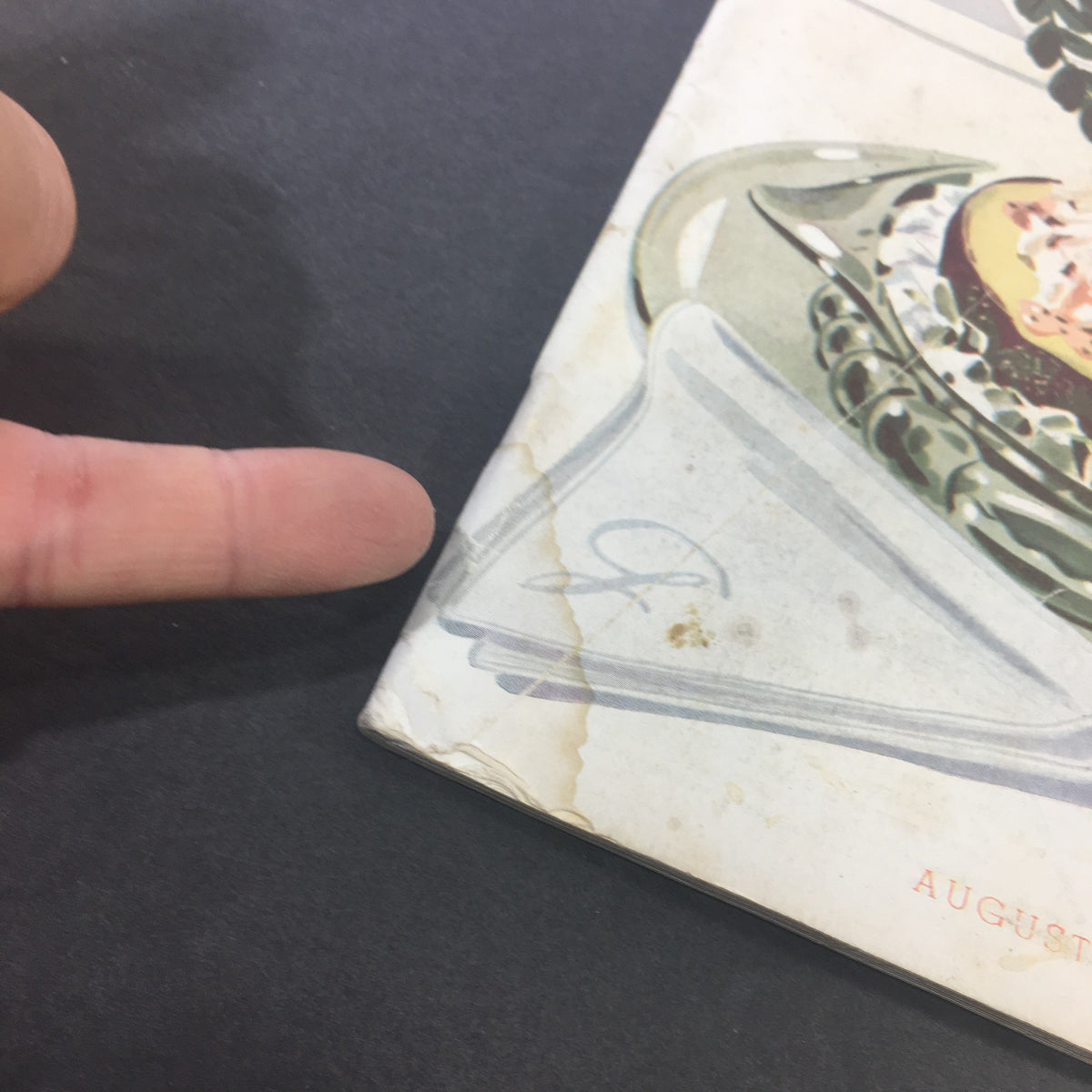
Surviving copies of this issue present a condition profile that collectors of early postwar Gourmet issues will recognize as honest and representative for a nearly eighty-year-old consumer magazine: minor edge wear and visible rips and marks consistent with age, and a rip on the back cover — a condition attribute that experienced collectors assess in terms of its structural implications rather than purely its visual impact, since a back cover rip that does not compromise the binding or extend to the interior pages has materially different implications for the issue's long-term structural integrity than one that affects binding attachment or page stability. The newsstand origin designation — confirmed by the absence of a mailing label — places surviving copies in the provenance category that collectors of postwar Gourmet specifically prioritize, as subscription labels on issues of this age were typically applied in positions that either permanently obscure cover imagery or leave irreversible adhesive damage when removed. A protective plastic covering applied during preservation indicates deliberate archival handling that has helped limit further deterioration of both cover and interior content. Federal wartime paper conservation measures, implemented from 1942 onward, reduced the material quality of paper stock across the American publishing industry through the war's end, and while August 1946 falls after the formal conclusion of hostilities, the paper and production materials used in this issue would have been sourced under conditions still transitioning from wartime conservation constraints — meaning that age-related yellowing and brittleness are inherent characteristics of surviving copies, and that any example retaining complete, readable interior pages and a structurally sound binding represents a meaningful preservation of a primary document from one of American culinary publishing's most historically specific and consequential transitional moments.
Looking for More Issues Like This?
The August 1946 issue of Gourmet — the first full postwar summer issue of the founding era's most historically significant food publication, carrying a cover story on fishing whose specific cultural resonances in the summer of returning veterans give it a documentary meaning that purely culinary analysis cannot fully capture, and representing the magazine's editorial maturity being deployed in postwar freedom for the first time — occupies a position in the founding-era archive that no wartime issue can claim and no later postwar issue precisely replicates. Issues from this specific transitional summer of 1946 surface rarely in any condition that retains both cover integrity and complete interior pages. The complete Gourmet magazine collection at OriginalMagazines.com spans the full arc of the title's history from its 1941 founding through 2009 and is the most reliable resource for collectors researching available issues across the founding and early postwar era. For collectors building a broader picture of American publishing culture in the first full year of peace, the full 1946 magazine archive covers the range of publications from a year whose specific historical character — after the war, before the Cold War's hardening, in the open and contested construction of the postwar world — gives every surviving issue a documentary significance that only deepens with retrospective distance.