
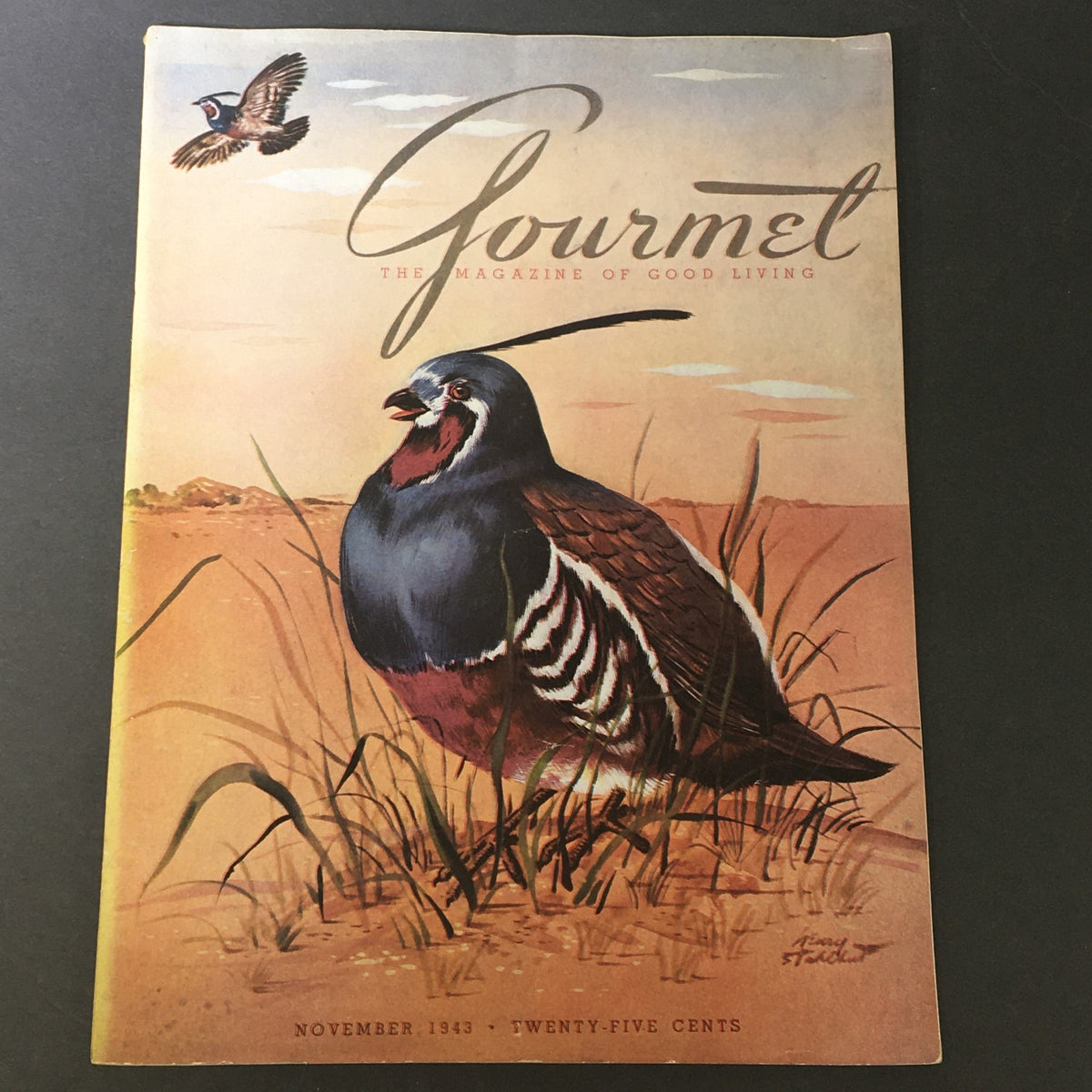


Description
Collector's Note – Why This Issue Matters
The November 1943 issue of Gourmet: The Magazine of Good Living is a primary document of one of the most historically charged Thanksgiving moments in American history — the third wartime Thanksgiving of World War II, observed by a nation that had been living under a comprehensive federal rationing system for nearly two years and that was, by November 1943, beginning to absorb the full human and material costs of a global conflict with no certain end date in sight. Thanksgiving 1943 occupied a specific and emotionally complex position in American domestic culture: the holiday's foundational emphasis on abundance, gratitude, and the gathering of family around a laden table was being observed by households in which abundance was rationed, family members were absent on multiple fronts, and the relationship between festive cooking and patriotic responsibility had become an active subject of public discourse. That Gourmet — a magazine founded on the unambiguous celebration of culinary pleasure and good living — chose to frame its November 1943 issue around "Thanksgiving Old Style" is an editorial decision that carries genuine historical weight. The phrase itself is a document of the cultural negotiation underway: the appeal to an older, pre-rationing model of Thanksgiving hospitality, held in tension with the material realities of 1943, reflects the specific psychological work that food-focused publishing was doing for its readership during the war years. For collectors building a serious archive of vintage Gourmet magazine issues, the wartime Thanksgiving issue represents the publication at its most historically revealing — a moment when its fundamental editorial commitments were being tested by circumstances the magazine's founders could not have anticipated when they launched it in January 1941.
The specific content framing confirmed for this issue — seasonal recipes, entertaining tips, and nostalgic reflections on family gatherings oriented around "old-style Thanksgiving" — documents a particular and well-documented wartime publishing strategy: the use of historical and traditional recipes as both a practical resource and an emotional anchor for readers navigating the constraints of the rationing system. By November 1943, the Office of Price Administration's rationing program covered meat, butter, lard, shortening, and most canned goods alongside sugar and coffee — the full apparatus of a traditional Thanksgiving feast was subject to point rationing in ways that required genuine culinary ingenuity to navigate. A Gourmet issue invoking "old style" Thanksgiving in this context was doing double work: providing readers with practical recipes adapted to or celebrating ingredients that remained available while simultaneously offering the emotional reassurance of continuity with pre-war domestic traditions. The photography and illustration content described for this issue — evoking nostalgia and the visual language of traditional holiday celebration — served the same dual function, documenting both the aesthetic sensibility of wartime food publishing and the specific emotional register in which Gourmet was addressing its readership during the conflict's most demanding years. Collectors focused on magazines from 1943 as primary documents of American home front culture will find this issue providing unusually rich evidence of how culinary publishing negotiated the intersection of festive tradition and wartime constraint at the holiday season's most culturally loaded moment.
It is also worth situating this issue within Gourmet's own institutional history at the specific point of its publication. November 1943 marks the magazine's third year of operation — still within its founding editorial era, still in the process of establishing the voice, the visual language, and the editorial priorities that would define it for the following six decades. The wartime period was, paradoxically, one of the most formative in the magazine's long history precisely because the constraints of rationing and the emotional demands of wartime readership required the publication to develop an editorial flexibility and a range of cultural registers — practical, nostalgic, aspirational, historically grounded — that would serve it well long after the war ended. A November 1943 issue addressing Thanksgiving in this specific cultural climate is a document of that formative editorial development at one of its most consequential annual moments, and the combination of the holiday subject, the "old style" framing, and the wartime context gives this issue a historical specificity that distinguishes it even within the already significant wartime run of the title.
About the Publication
Gourmet: The Magazine of Good Living was founded in January 1941 by Earle MacAusland, who established and maintained for decades the editorial philosophy that distinguished the title from every other American food publication of its era: the treatment of cuisine as a subject worthy of literary engagement, historical depth, and cultural seriousness rather than purely practical instruction. Where other food magazines of the period offered recipes as functional documents, Gourmet embedded its culinary content in narrative — stories of regional traditions, restaurant discoveries, travel, and personal memory that gave its recipes a cultural and historical weight no competitor fully matched. Its readership was educated, relatively affluent, and genuinely invested in food and hospitality as aspects of a cultivated life rather than mere domestic necessity. Published continuously from 1941 until Condé Nast — which had acquired the title in 1983 — shuttered it in 2009 during a round of cost reductions, the magazine's nearly seven-decade run produced an archive of exceptional depth and historical interest, with the wartime issues of 1941 through 1945 representing the founding era's most historically charged and editorially revealing body of work.
Key Highlights Inside
- "Thanksgiving Old Style" — confirmed cover theme and editorial framing — A primary document of how Gourmet addressed its most culturally loaded annual subject during the third year of American involvement in World War II, with the "old style" framing reflecting the specific tension between traditional Thanksgiving abundance and the material constraints of a fully operational federal rationing system in November 1943.
- Seasonal Thanksgiving recipes — confirmed interior content — Recipe content developed and presented within the specific constraints of the 1943 rationing system, which by November of that year covered meat, butter, lard, shortening, canned goods, sugar, and coffee — the near-complete apparatus of a traditional Thanksgiving feast — documenting the culinary ingenuity that wartime food publishing was required to exercise at the holiday season's most demanding moment.
- Entertaining tips and family gathering content — confirmed interior content — Editorial content oriented around the practical and emotional dimensions of holiday hospitality under wartime conditions, reflecting Gourmet's characteristic approach of embedding practical guidance within a broader cultural and aspirational framework rather than presenting it as purely utilitarian instruction.
- Nostalgic reflections on Thanksgiving tradition — confirmed editorial register — Content engaging with pre-war models of Thanksgiving celebration in a manner that served both as practical recipe inspiration and as emotional reassurance for a readership observing the holiday with family members absent on military service and domestic life reshaped by two years of wartime constraint.
- Period photography and illustration — confirmed visual content — Original artwork and photography representative of wartime American food magazine design, documenting both the aesthetic standards applied to culinary publishing in 1943 and the specific visual language of nostalgia and traditional domestic celebration that the magazine employed to address its readership's emotional needs during the conflict.
Condition & Rarity
Copies of this issue described as being in great vintage condition with minor edge wear and occasional small rips or marks occupy an honest and representative position within the collector grading spectrum for an eighty-plus-year-old consumer magazine — condition attributes that experienced collectors of periodicals from this era understand as inherent to the survival of any newsstand publication across more than eight decades rather than as meaningful detractions from collectible value. The absence of a mailing label noted in the listing places surviving copies in the newsstand-origin category, which collectors of wartime-era periodicals specifically prioritize, as subscription label removal from magazines of this age frequently caused surface damage that cannot be remediated and that permanently compromises cover integrity. A protective plastic covering applied during preservation is a particularly meaningful condition indicator for a magazine published in 1943, distinguishing copies that received deliberate archival treatment at some point in their history from the majority of surviving examples stored in conditions that accelerate the paper degradation and brittleness characteristic of publications from this period. Wartime paper conservation measures — implemented federally to redirect raw materials toward the war effort — meant that many publications from 1942 through 1945 were printed on lower-grade stock than their prewar counterparts, which affects the degree of yellowing, brittleness, and color fading found in surviving copies and makes any example retaining readable text, intact binding, and a cover that clearly communicates its original design a genuine and meaningful preservation across more than eight decades of existence.
Looking for More Issues Like This?
Wartime Thanksgiving issues of Gourmet from the magazine's founding years represent one of the more historically specific and emotionally resonant collecting categories within the full archive of American food publishing — issues where the subject, the date, and the cultural context converge with unusual precision to produce a document that is simultaneously a culinary artifact, a home front record, and a primary source for understanding how American domestic culture navigated the demands of the war years at their most symbolically charged annual moment. The complete Gourmet magazine collection at OriginalMagazines.com spans the full run of the title from its 1941 founding through its 2009 closure and is the most reliable resource for collectors researching specific issues across the wartime era and beyond. For collectors building a broader picture of American home front publishing culture in 1943, the full 1943 magazine archive covers the range of publications from a year that sits at the precise center of the American war effort — a moment when the domestic and the global were more tightly interwoven in everyday American life than at almost any other point in the twentieth century.