





Description
Collector's Note – Why This Issue Matters
The October 1950 issue of Harper’s Magazine, identified as Volume 201, Number 1205, was published as the magazine’s Centennial Issue. It commemorated one hundred years since Harper’s made its debut in June 1850 under the title Harper’s New Monthly Magazine. Rather than treating the anniversary as a simple ceremonial milestone, the editors used the enlarged issue to examine the publication’s literary, artistic, intellectual, and social history. Contemporary writing appeared beside selections and reflections connected with earlier decades of the magazine. This structure allowed readers in 1950 to encounter both a current literary periodical and a retrospective survey of a century of American publishing. The edition therefore represents the magazine commenting upon its own institutional identity while continuing to publish new work. Its Volume 201 designation also demonstrates the scale and continuity of the publication’s accumulated monthly record.
The issue appeared during a significant transitional period in American life. The Second World War had ended only five years earlier, the Korean War had begun in June 1950, and political discussion was increasingly shaped by the Cold War. At the same time, American publishing was evaluating the literary and cultural inheritance of the previous century. Harper’s could look back upon major changes in industrialization, immigration, transportation, science, urban growth, domestic life, war, and political reform. The Centennial Issue approached that history through essays, archival selections, fiction, poetry, illustration, and commentary rather than through a single chronological narrative. Its contents therefore preserve both what the magazine had published and how its 1950 editors chose to interpret that record. For collectors, the issue is valuable as a self-conscious statement about the role of a long-running general-interest magazine within American culture.
The literary contributors give the edition importance beyond its anniversary format. William Faulkner contributed the fiction “A Name for the City,” while W. H. Auden contributed the poem “Precious Five.” Katherine Anne Porter’s “The Prisoner” added another work by a major twentieth-century American writer. Historical surveys examined Harper’s illustrations, book culture, scientific reporting, immigration coverage, domestic technology, and other subjects represented across its archive. The combination of newly published literature and edited historical material makes the magazine useful to readers studying both individual authors and periodical history. Its contents reflect the breadth through which Harper’s defined itself after a century of publication. Related literary and historical issues can be examined through the collection of vintage Harper’s Magazines and through other magazines published in 1950.
About the Publication
Harper’s Magazine made its debut in June 1850 as a publication of the New York book-publishing firm Harper & Brothers. Its original title was Harper’s New Monthly Magazine. The first printing sold out, and the publication rapidly developed a substantial national readership. Early issues relied heavily on material previously published in Britain, but the magazine increasingly printed original work by American writers, artists, political figures, travelers, and commentators. Its pages addressed literature, politics, science, history, economics, religion, travel, social customs, technology, and the arts. Fiction and poetry appeared beside essays, reporting, reviews, illustrations, and recurring departments. The magazine documented developments ranging from industrial inventions and exploration to political movements and changing patterns of domestic life. It also published writers who became central figures in American letters, including Mark Twain, Henry James, Jack London, Theodore Dreiser, and William Dean Howells. By 1950, Harper’s possessed an archive extending across the Civil War, Reconstruction, industrial expansion, two world wars, and the beginning of the Cold War. The Centennial Issue gave its editors an opportunity to reconsider that long record for a mid-twentieth-century audience. Surviving editions now provide primary evidence of both the subjects covered and the editorial assumptions through which generations of readers encountered them.
Key Highlights Inside
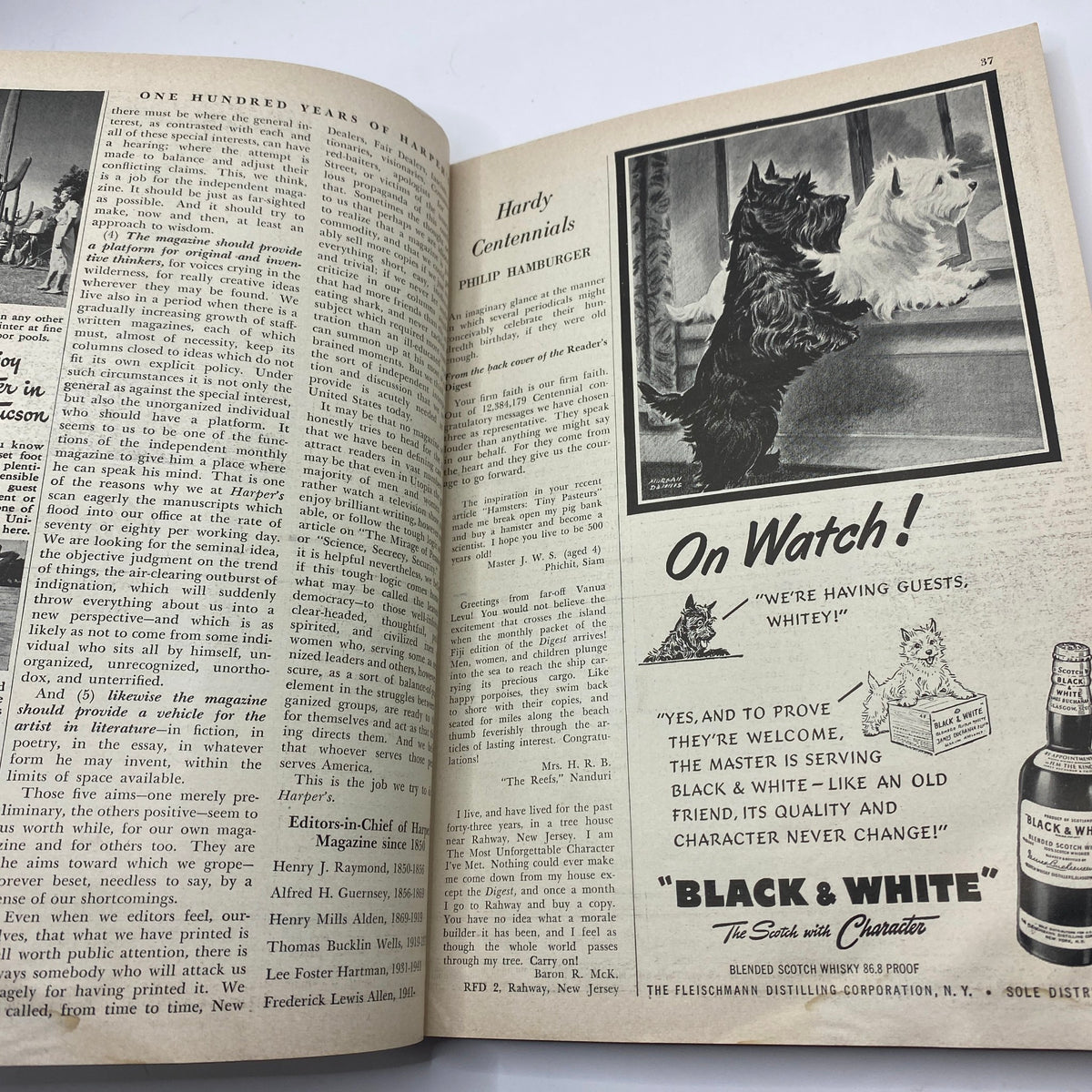
- “One Hundred Years of Harper’s,” credited to the Harper’s staff, provides the issue’s central institutional retrospective. The article examines the magazine’s development across its first century of publication. Its presence establishes the edition as a deliberate historical survey rather than merely a regular monthly issue with commemorative cover wording.
- William Faulkner contributed the fiction “A Name for the City.” The story concerns the imagined early history and naming of Jefferson, Mississippi, within the fictional world associated with much of Faulkner’s writing. It was later connected with material incorporated into his 1951 work “Requiem for a Nun,” giving the magazine appearance additional bibliographic interest.
- W. H. Auden’s poem “Precious Five” appears in the Centennial Issue. Its inclusion places contemporary poetry beside the magazine’s historical reviews and archival selections. Readers should consult the original text rather than infer its structure or meaning solely from the title.
- Katherine Anne Porter contributed the fiction “The Prisoner.” Her appearance strengthens the issue’s representation of major twentieth-century literary voices. The story’s characters, setting, and themes should be established from the complete work rather than reconstructed from abbreviated contents records.
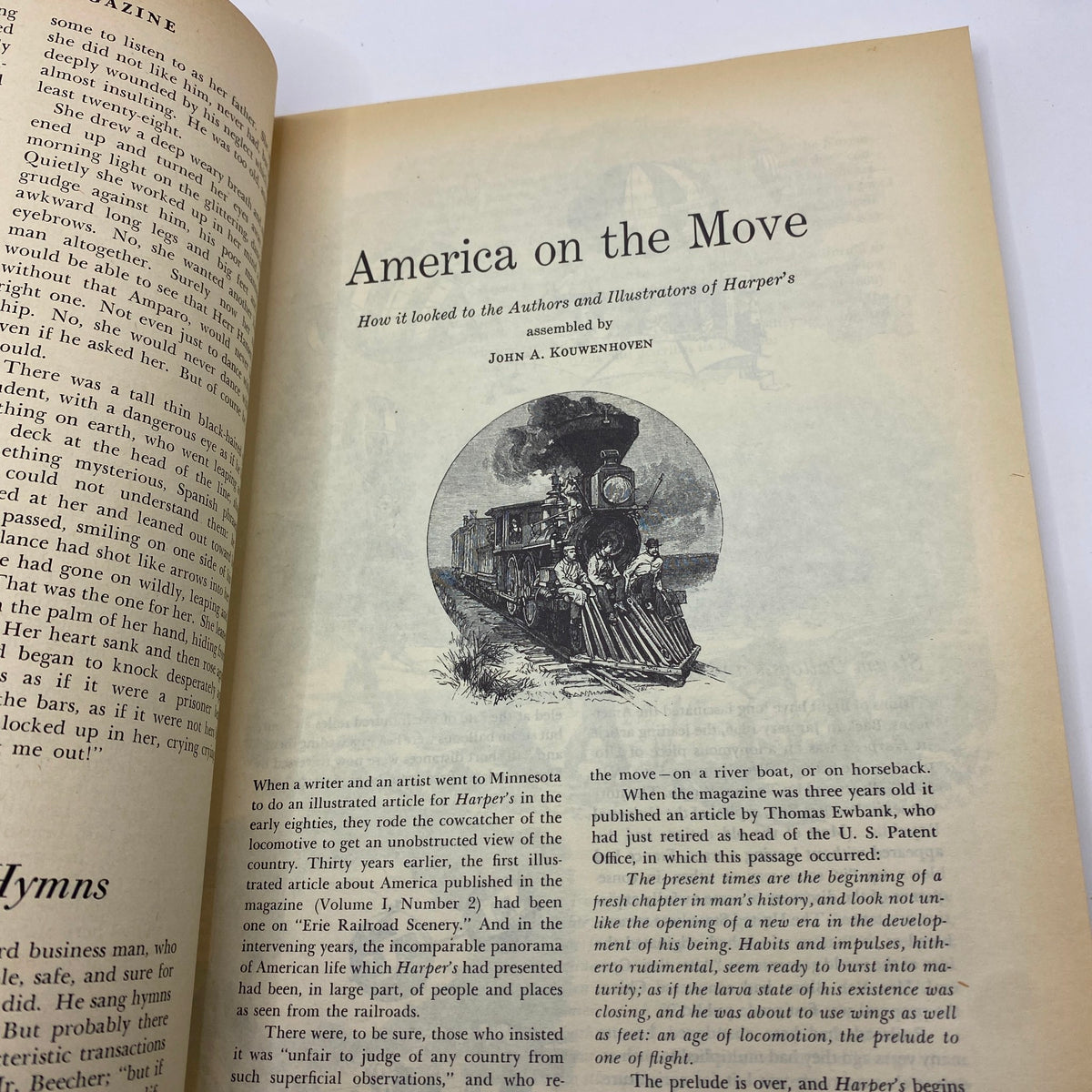
- John Atlee Kouwenhoven contributed “How It Looked to the Authors and Illustrators of Harper’s,” while C. Hartley Grattan wrote “A Century of Books.” These features examine visual and literary culture across the magazine’s first hundred years. Together with edited archival selections, they demonstrate how the Centennial Issue used the publication’s own history as source material.
Condition & Rarity
The October 1950 Centennial Issue is described as being in good overall condition with signs of age, previous handling, and storage. Minor water damage is specifically reported and should be considered an important part of the condition assessment. Moisture exposure may produce waviness, tide marks, discoloration, stiffness, surface adhesion, or changes in the texture of the paper. The extent and location of the damage should be evaluated through the accompanying photographs and direct inspection. Affected pages should also be checked for odor, active mold, weakened edges, or areas that remain joined together. No mailing or address label is reported on the cover, allowing the commemorative design and printed issue information to remain unobstructed. The absence of a label is a physical characteristic rather than automatic proof of exceptional grade or scarcity. A plastic protective covering accompanies the magazine and may reduce additional exposure to dust, fingerprints, and surface abrasion. The sleeve cannot reverse earlier water damage or confirm the condition of pages hidden inside. Collectors examining another example should inspect the binding, cover attachment, page sequence, tears, writing, clipping, stains, brittleness, fading, and previous repairs. The Centennial designation creates clear historical interest, but rarity should be determined through documented surviving availability rather than the anniversary status alone.
Looking for More Issues Like This?
Exact anniversary issues can require patience to identify when research is focused on a particular volume, issue number, and group of contributors. The October 1950 edition is especially relevant to readers interested in American literary history, magazine publishing, William Faulkner, W. H. Auden, and Katherine Anne Porter. Related essays, fiction, poetry, and cultural commentary can be explored through the broader collection of vintage Harper’s Magazines. Earlier editions help reconstruct the archive that the Centennial Issue was created to commemorate. Later issues show how the magazine continued adapting its literary and political identity after the anniversary. The collection of original magazines from 1950 provides a wider view of the year in which the commemorative edition appeared. Publications from that year preserve contemporary discussion of the Korean War, the Cold War, literature, science, entertainment, advertising, domestic life, and postwar social change. Comparing several titles reveals how different publications interpreted the same historical period for distinct readerships. Closely dated magazines remain useful even when this precise Volume 201, Number 1205 edition is not represented. Together, the Harper’s and 1950 collections provide a strong foundation for continued research into American literature and mid-century periodical culture.