
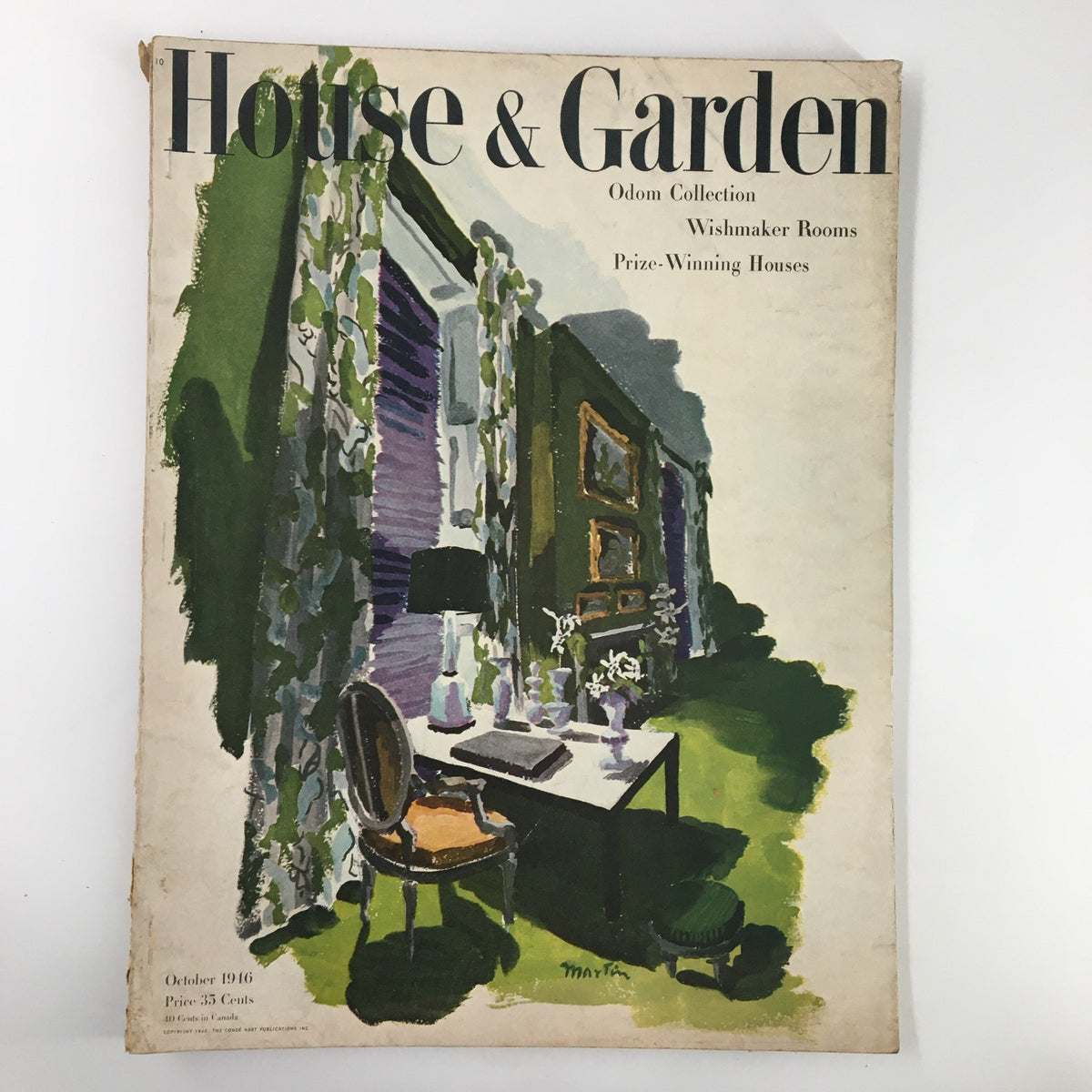


Description
Collector's Note – Why This Issue Matters
The October 1946 issue of House & Garden Magazine focused on prize-winning houses is a primary document of one of the most consequential shifts in American domestic architecture and design. The timing is everything. World War II had ended in August 1945, and by the fall of 1946 the United States was in the earliest stages of the suburban building boom that would reshape the physical landscape of the country over the following two decades. Millions of returning veterans were forming households, the GI Bill was making home ownership accessible to a new middle class, and the housing industry was scrambling to meet demand on a scale it had never previously encountered. A House & Garden feature on prize-winning houses published in October 1946 captures that moment of transition — the architectural and design ideals being held up as aspirational models at the exact moment the mass housing market was beginning to define what American domestic life would look like for a generation. For collectors building archives of 1946 American print culture, this issue is a design history document of genuine depth.
The prize-winning format is particularly significant as a historical record. Architectural competitions and awards in the immediate postwar period were not simply aesthetic exercises — they were contested arguments about what American homes should be, who they should serve, and how the values of modernism, traditionalism, and practical livability should be balanced against each other. The houses featured in a 1946 House & Garden award compilation reflect the editorial and professional consensus of the moment: which design directions the arbiters of taste believed deserved recognition and emulation. Reading those choices against what actually got built in the late 1940s and 1950s — the ranch houses, the Cape Cods, the early Levittown variations — reveals the gap between aspirational design culture and mass-market reality, a gap that makes this kind of primary source invaluable to architectural historians and serious collectors alike. The photography and visual presentation in House & Garden issues of this era were consistently among the finest in American magazine publishing, making surviving copies with intact pages a meaningful resource beyond their value as collectible objects.
About the Publication
House & Garden was founded in 1901 and acquired by Condé Nast Publications in 1915, which transformed it into one of the premier American shelter magazines of the twentieth century. Its editorial focus combined architecture, interior design, gardening, and the decorative arts, addressed to an affluent readership with both the means and the interest to engage seriously with questions of home design and domestic aesthetics. By the mid-1940s it was one of the most visually sophisticated magazines in American publishing, using high-quality photography and printing to present interiors and gardens with a level of production value that set it apart from more mass-market competitors. Its October issues traditionally featured substantial architectural content as readers turned their attention toward interior spaces during the autumn months, and the postwar years represent some of the magazine's most historically interesting editorial territory — a publication navigating between prewar luxury traditions and postwar democratic design ideals.
Key Highlights Inside
- Prize-winning houses feature: The issue's central editorial focus presents award-winning residential designs from the immediate postwar period — architectural and design choices being held up as models of excellence at the precise moment the American housing boom was beginning, making this a primary source document for postwar domestic design history.
- Post-World War II design aesthetics: The October 1946 date places this issue in the first full year of peacetime, when design culture was actively processing the transition from wartime austerity toward a new domestic optimism — a tension visible in the kinds of houses being recognized and celebrated.
- Photography and visual documentation: House & Garden in this era used high-quality photographic reproduction to document interiors and exteriors with considerable care, making the surviving visual record in intact issues a primary archive of mid-century residential design that is not easily replicated from other sources.
- No-label newsstand presentation: The absence of an address label allows the cover artwork — characteristic of House & Garden's tradition of commissioning distinctive seasonal cover illustrations — to be viewed without disruption, which is the preferred state for collectors of this title.
- Broader postwar domestic culture context: Beyond the prize-winning houses feature, additional content on gardens, interiors, and decorative arts would reflect the full editorial range of a fall 1946 issue. Specific additional interior content beyond what is stated in the listing is unconfirmed.
Condition & Rarity
The absence of an address label on this issue is a meaningful condition distinction for a postwar House & Garden. The magazine had a substantial subscriber base throughout the mid-1940s, and clean newsstand copies — which present the cover artwork without label disruption or the paper damage that label removal typically causes — are proportionally less common among surviving examples. The noted binding wear is consistent with a nearly eighty-year-old magazine and is a standard condition attribute for publications of this vintage that were stored on shelves rather than kept flat. Minor wear throughout is similarly expected. The protective plastic covering indicates deliberate preservation. When evaluating any surviving copy of this issue, cover integrity and the quality of the interior photographic reproductions are the primary grading considerations — House & Garden's value as a collectible and as a design history resource both depend heavily on the visual content remaining clear and intact. The coated stock used for photographic pages in publications of this era is generally more stable than uncoated text pages, but is susceptible to cracking if the magazine has been stored in conditions of low humidity.
Looking for More Issues Like This?
Immediate postwar issues of House & Garden in no-label condition with intact photographic content are a more specific find than their original print runs might suggest — these were working reference magazines that accumulated wear and were rarely archived with collectors in mind. If this issue has already found a home, the 1946 magazine collection is worth exploring for other publications from that pivotal transitional year, spanning the full range of American print culture in the first full year of postwar life.