



Description
Collector's Note – Why This Issue Matters
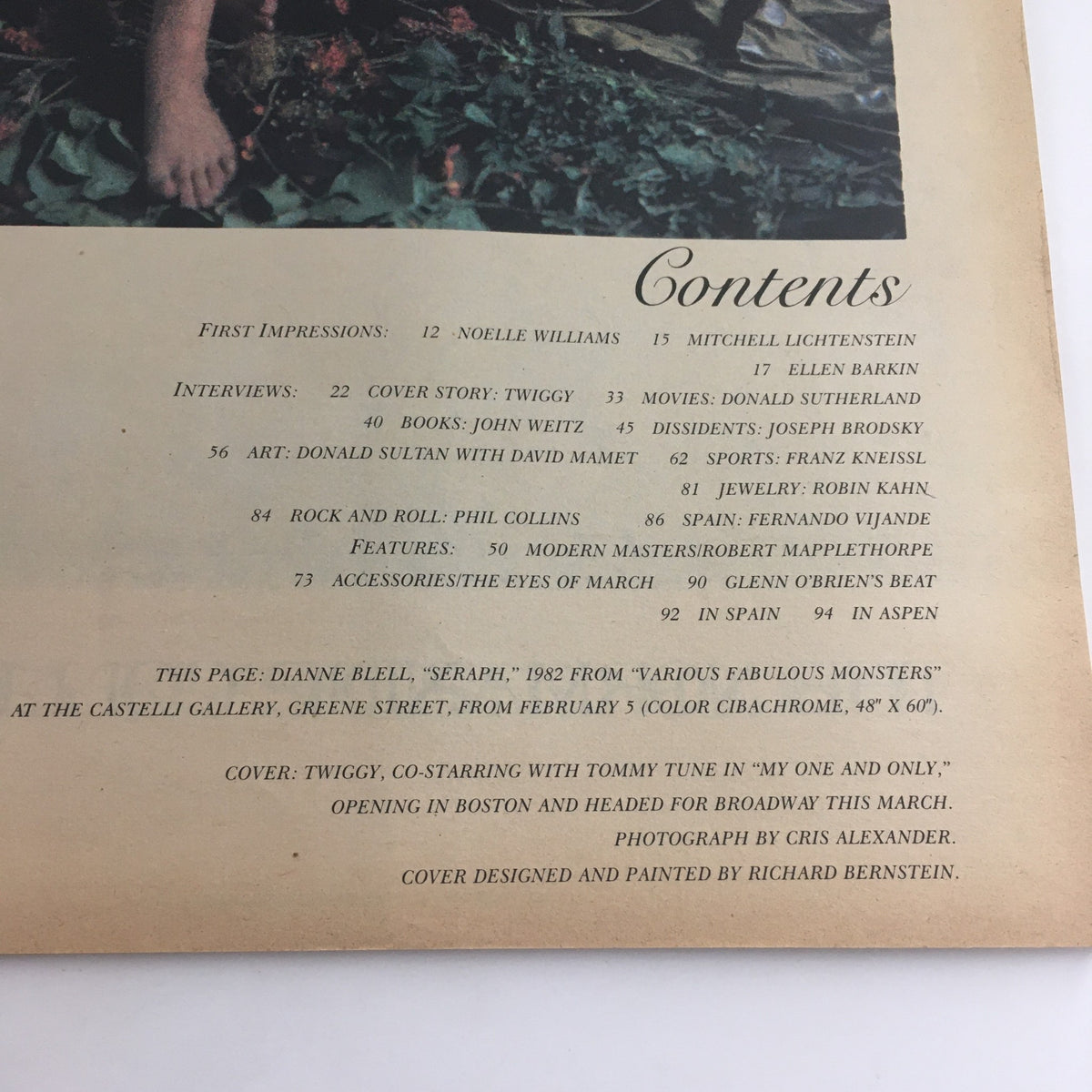
The March 1983 issue of Interview brings together two figures whose cultural trajectories intersect in ways that reward close attention. Twiggy — born Lesley Lawson — was not merely revisiting past glories by 1983. The woman who had defined the visual language of 1960s fashion had spent the intervening decade and a half demonstrating genuine range: a successful transition into acting, a Tony Award-winning Broadway run in My One and Only opposite Tommy Tune, and a continued presence in fashion that refused the nostalgia trap. The pairing of Twiggy and Tommy Tune on this cover is not incidental — by early 1983 they were collaborators, co-stars in what would become one of the most celebrated Broadway productions of the year, and their joint appearance in Interview captures that creative partnership at its moment of maximum public attention.
Tommy Tune's presence here is equally significant. By 1983 he was among the most decorated figures in American musical theater — a performer, choreographer, and director of extraordinary height and distinctiveness who had accumulated Tony Awards across multiple categories in a way that few theater professionals have matched before or since. My One and Only, which opened on Broadway in May 1983, was built substantially around Tune and Twiggy's chemistry, and an Interview feature in March of that year — two months before opening night — places this issue squarely in the anticipation phase of what the theater world already understood was a major production. For collectors who follow vintage Interview magazine issues, a cover featuring two Tony Award-winning performers at the moment of their highest-profile collaboration is a specific and meaningful cultural document.
The broader context of Interview in early 1983 matters for understanding why this particular issue carries the weight it does. The magazine was at a creatively fertile point in its history — still animated by the Warhol sensibility that had founded it while simultaneously expanding its cultural reach. A cover pairing a British fashion icon with an American theater giant reflects the magazine's characteristically eclectic definition of celebrity: not Hollywood, not rock music, but the specific world of high fashion and live performance that Interview had always treated as the most interesting territory. Collectors building focused archives around magazines from 1983 will find this issue a distinctive artifact of a cultural moment when fashion history and Broadway history briefly occupied the same frame.
About the Publication
Interview magazine was founded by Andy Warhol in 1969 and built its identity around the celebrity interview as an art form — transcribed conversations presented with minimal editorial intervention, allowing subjects to speak at length in their own voices while the magazine's distinctive graphic sensibility provided the surrounding context. By 1983 it had become the defining document of New York's intersection of art, fashion, film, and music, with a readership that spanned the creative class on both coasts and in Europe. Its large format, its willingness to treat fashion and performance as subjects of genuine intellectual interest, and its Warhol-inflected fascination with celebrity as a cultural phenomenon all gave it an editorial identity that no other American publication of the era could replicate.
Key Highlights Inside
- Cover feature on Twiggy and Tommy Tune, published approximately two months before the Broadway opening of My One and Only — the musical that united them as co-stars and would go on to win multiple Tony Awards including Best Musical.
- The pairing documents a specific and time-limited creative collaboration between one of fashion history's most iconic figures and one of American musical theater's most decorated performers.
- No address label confirmed — indicating newsstand origin and preserving the cover art as originally presented, without subscription delivery marking.
- Specific interior articles, additional interviews, and fashion content beyond the cover feature are unconfirmed from the listing; refer to the issue directly for the complete contents, which would reflect Interview's characteristic mix of celebrity conversation and visual culture coverage.
Condition & Rarity
The absence of an address label is a meaningful positive for any surviving copy of this issue. Interview's readership in 1983 skewed toward subscription, and clean newsstand copies with no label present are less common in the surviving pool than labeled subscription copies. The cover art — particularly significant for a magazine whose large-format visual identity was central to its editorial character — survives without the adhesive mark or residue that subscription delivery would have left. Good condition with minor wear consistent with age is an honest and realistic grade for a forty-plus-year-old magazine on the coated stock Interview used; the key condition points to evaluate in any surviving copy of this issue are spine integrity, cover surface preservation, and the state of the interior pages around the primary feature. Protective plastic sleeving indicates deliberate preservation effort. For a niche cultural publication from this era, survival in coherent condition with a clean cover face represents a meaningful preservation outcome.
Looking for More Issues Like This?
Early-eighties Interview issues with clean newsstand provenance and culturally significant cover pairings are consistently harder to source than their historical importance might suggest — the magazine's relatively specialized readership meant smaller print runs than mass-market titles, and survival rates reflect that. If this March 1983 issue is no longer available, the full vintage Interview magazine collection at OriginalMagazines.com is the best place to browse for other issues spanning the Warhol era and beyond. The 1983 magazine archive covers the full year across multiple titles for collectors building a focused early-eighties cultural library.