
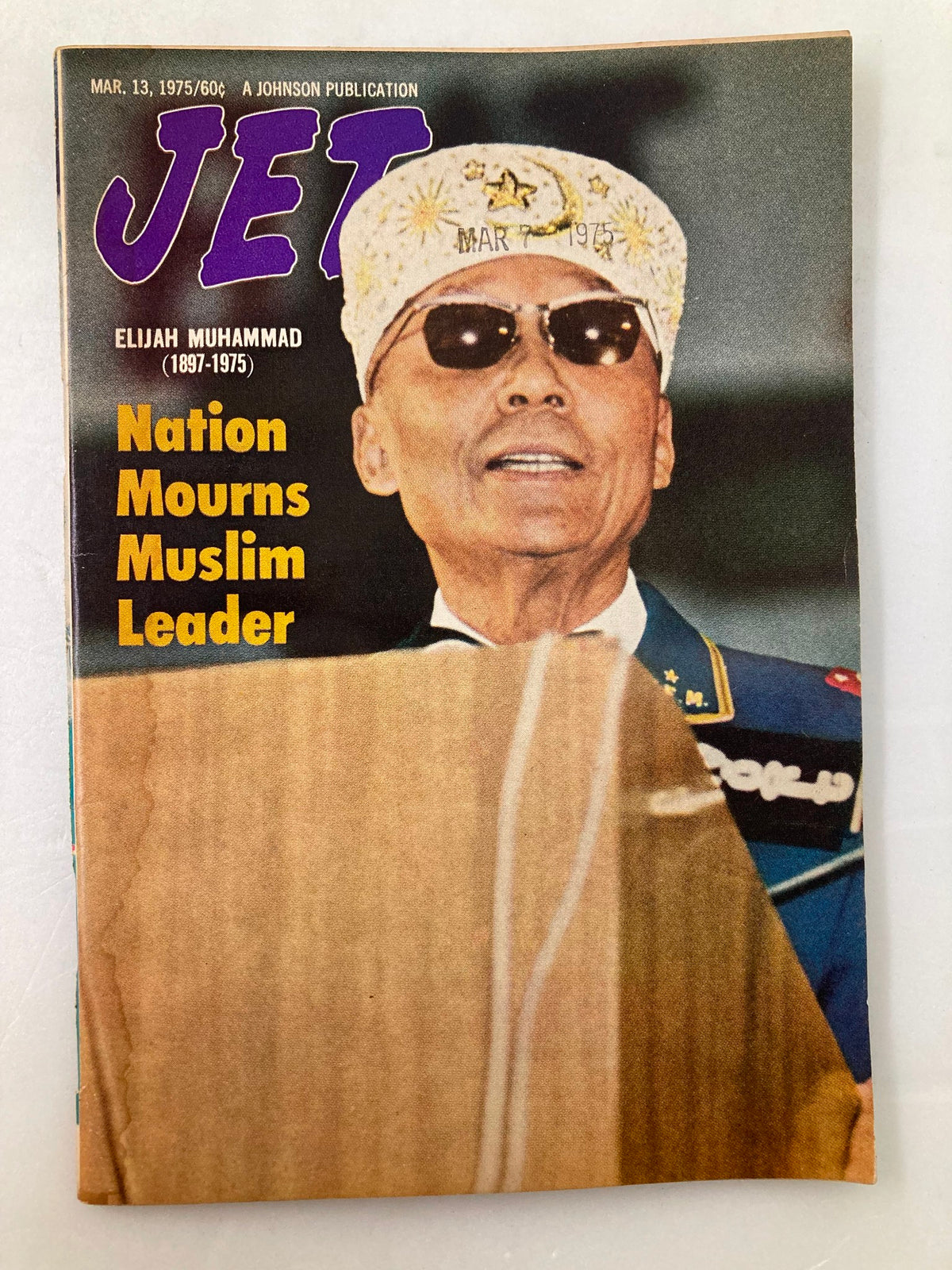
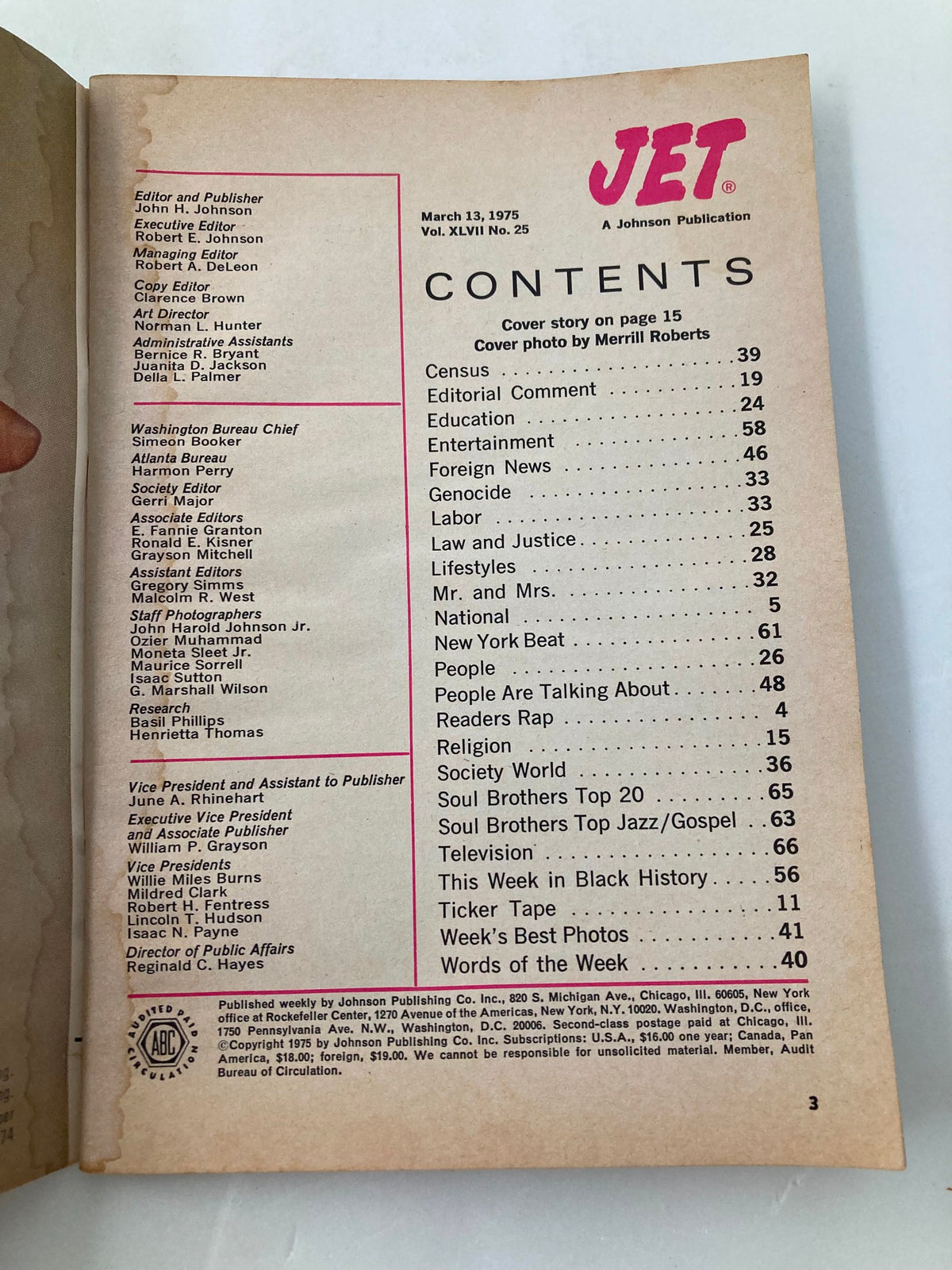


Description
Collector's Note – Why This Issue Matters
The March 13, 1975 issue of Jet Magazine — Volume 47, Number 25 — featuring Elijah Muhammad on the cover is a document of one of the most significant moments of succession and transition in twentieth-century African American religious and political history. Elijah Muhammad, the leader of the Nation of Islam since 1934, died on February 25, 1975 — just sixteen days before this issue's cover date. He had led the organization for more than four decades, transforming it from a small religious movement into one of the most influential Black nationalist organizations in the United States, with a prison ministry, a network of businesses and schools, and a national membership that had attracted figures including Malcolm X and Muhammad Ali. A Jet cover story on Elijah Muhammad published in the immediate aftermath of his death is a primary document of how the Black press reported on and processed that loss — in real time, within days of the event, before the full implications of the succession were known. Collectors building archives of Jet Magazine's coverage of Black political and religious history will find this issue among the most historically charged single-subject covers in the publication's mid-1970s run.
The timing of this issue's publication also coincides with the beginning of a fundamental transformation of the Nation of Islam itself. Elijah Muhammad's son, Warith Deen Mohammed, would assume leadership of the organization following his father's death and almost immediately begin steering it toward mainstream Sunni Islam — a transition that represented one of the most dramatic ideological shifts in the history of American religion. The March 13, 1975 Jet cover story was published at the very threshold of that transformation, before its direction was clear. For collectors documenting 1975 through its print culture, this issue captures a pivotal succession moment in Black American institutional history at the precise week it was occurring — a document of genuine historical immediacy that no retrospective account can replicate.
About the Publication
Jet Magazine was founded in Chicago in November 1951 by John H. Johnson of Johnson Publishing Company — the same publisher who produced Ebony — as a compact, digest-sized weekly designed to provide Black Americans with comprehensive national news coverage in an accessible and affordable format. Its pocket-sized dimensions distinguished it physically from Ebony's large format, and its weekly publication schedule allowed it to cover breaking news and current events with a timeliness that its monthly counterpart could not match. By the 1970s, Jet was one of the most widely read publications in Black American households, functioning as a combination of news digest, celebrity coverage, and community record that had no direct equivalent in mainstream white-owned media. Its coverage of Black political, religious, and cultural figures — including extensive ongoing coverage of the Nation of Islam and its leadership — made it an essential primary source for any serious study of African American life in the mid-twentieth century.
Key Highlights Inside
- Elijah Muhammad cover story: Published sixteen days after Elijah Muhammad's death on February 25, 1975, this issue documents the Nation of Islam's most significant leadership transition in its history — reported in the Black press with the immediacy of a weekly publication covering a story that was still actively unfolding.
- Nation of Islam transition context: The issue arrives at the precise moment when Warith Deen Mohammed was assuming leadership and the future direction of the organization was still being determined — making this a contemporaneous primary document rather than a retrospective assessment.
- All pages intact: The listing specifically confirms complete page integrity — a meaningful condition note for a fifty-year-old digest-format weekly, as Jet's compact size and lightweight paper stock make intact, complete copies more significant than they might appear at first assessment.
- No address label: The absence of a subscriber label presents the cover clearly and without disruption — a condition preference for collectors of this title and format.
- Broader March 1975 editorial content: As with all Jet issues of the period, additional content would have reflected the full landscape of Black American news, culture, and community life in mid-March 1975. Specific additional interior content beyond the Elijah Muhammad cover story is unconfirmed in the listing.
Condition & Rarity
Jet Magazine's digest format presents specific condition considerations that differ from standard magazine-sized publications. The compact dimensions and lightweight paper stock used throughout the publication's history age more visibly than the coated stock of larger format magazines — tanning, brittleness at the spine, and page fragility are the standard condition challenges for surviving copies of any vintage Jet issue. Good condition with minor wear and all pages intact is a meaningful positive assessment for a fifty-year-old weekly digest, and the complete page integrity noted in the listing is the most important single condition attribute for this format. The protective plastic covering indicates deliberate preservation. The no-label status eliminates the most common cover deficit in surviving subscriber copies of this era. When evaluating any surviving copy of this issue, page completeness and structural integrity of the spine and cover attachment are the primary grading variables — followed by the clarity of the Elijah Muhammad cover imagery and the degree of overall paper toning throughout the interior.
Looking for More Issues Like This?
A no-label Jet issue from the week of Elijah Muhammad's death — with all pages intact and in good condition — is a specific and historically significant find for collectors of both Black press history and mid-twentieth-century American religious and political documentation. If this issue has already found a home, the full archive of Jet Magazine issues is the place to browse for other historically significant covers from the publication's remarkable run across the decades. The 1975 magazine collection is also worth exploring for anyone building a broader documentary picture of that transformative year in American cultural and political history.