


Description
Collector's Note – Why This Issue Matters
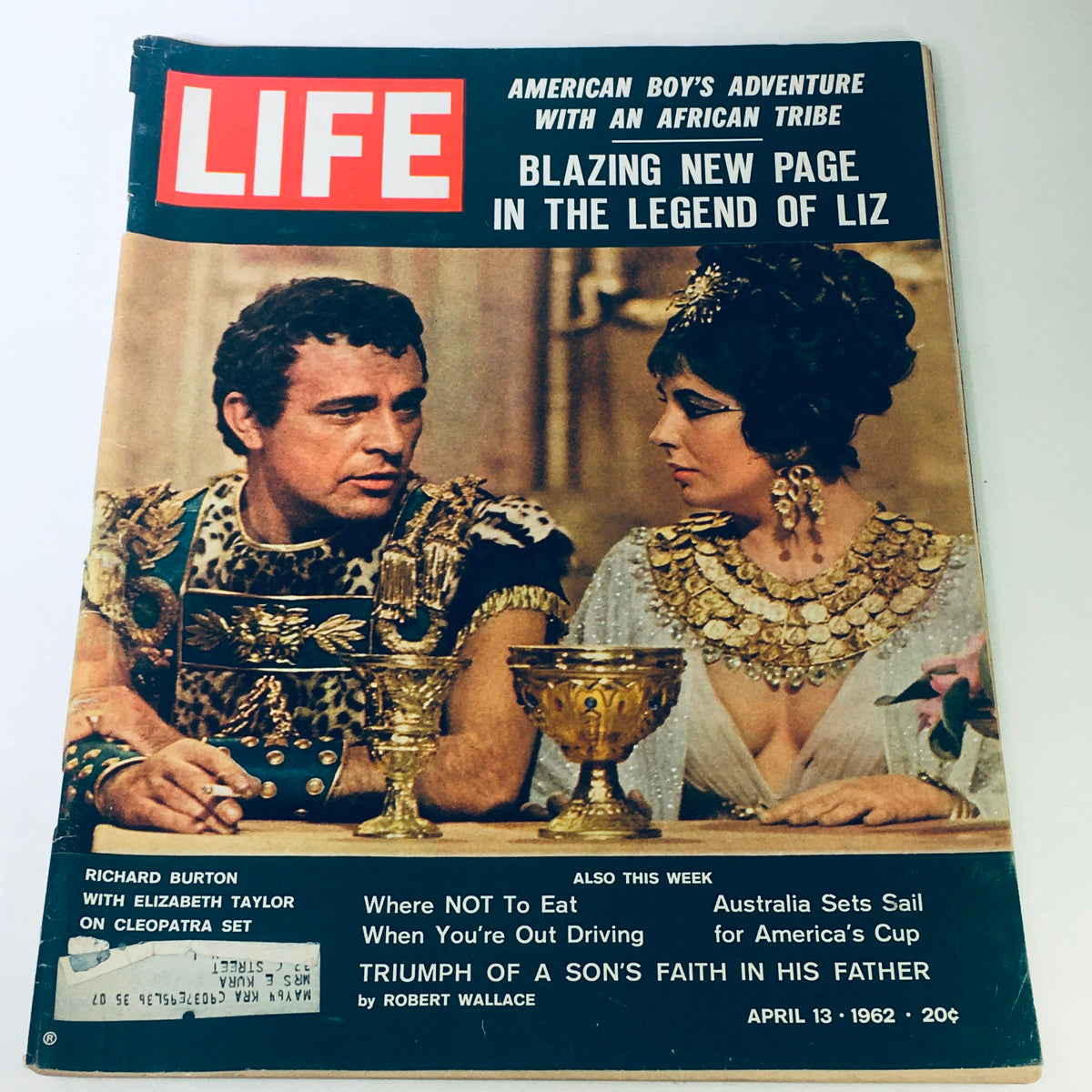
April 13, 1962 was not simply another week in Hollywood. It landed in the precise eye of one of the most sensational scandals the entertainment world had ever generated. Elizabeth Taylor and Richard Burton had met on the Rome set of Cleopatra in late 1961, and by early 1962 their affair had become an international obsession — front-page news across Europe and America, condemned by the Vatican, and covered with an intensity that made the modern celebrity news cycle look restrained by comparison. Both were married to other people when the affair began. Taylor had already been widowed, divorced, and was one of the most photographed women on earth. Burton was a Welsh actor of towering theatrical reputation, widely regarded as the finest classical stage performer of his generation, now trading the London stage for Hollywood money and global fame. When Life put them on the cover in April 1962, it was ratifying what every reader already knew: this was the story of the moment. For collectors building a comprehensive record of mid-century Hollywood coverage, the Elizabeth Taylor magazine archive documents her presence in the press across multiple decades, and this issue represents one of the most charged moments in that entire run.
The timing matters in another respect as well. Cleopatra — the film that brought Taylor and Burton together — was still in production in April 1962 and would not be released until June 1963. The affair was therefore unfolding entirely in public, without the film itself yet existing as a finished object. Life's coverage captured the couple at the moment of maximum intrigue, before the movie had given the public a formal narrative container for what they were witnessing. That quality — the rawness of it, the sense of a story still happening — is precisely what makes issues from this period so valuable as primary documents. The Life magazine archive spans the full breadth of the publication's golden era, but its Hollywood coverage from the early 1960s represents some of the most culturally resonant material in the entire run. And for collectors focused on a specific year, the 1962 magazine collection offers essential context for just how much was happening in American culture during this extraordinary twelve months.
About the Publication
Life magazine, relaunched by Henry Luce in 1936 as a large-format weekly photojournalism publication, was by the early 1960s still the most widely circulated magazine in the United States, with readership figures that dwarfed most competitors. Its editorial identity rested on photography — the carefully sequenced photo essay, the full-bleed portrait, the kind of visual storytelling that made it the dominant vehicle for American popular culture at mid-century. A Life cover appearance in 1962 carried a cultural weight that is difficult to overstate; it meant that a subject had been elevated to the level of national conversation. The magazine's Hollywood coverage was particularly authoritative, combining access, production values, and editorial ambition in a way that defined how Americans understood celebrity during the studio era and its aftermath.
Key Highlights Inside
- Taylor and Burton cover feature: The issue centers on Elizabeth Taylor and Richard Burton, whose affair on the Rome set of Cleopatra had become the dominant entertainment story of 1961–62, covered here at the height of public fascination.
- Hollywood at a turning point: The feature documents one of the last moments of the classic Hollywood star system operating at full cultural intensity — Taylor was among the last true studio-era superstars, and Burton represented the collision of British theatrical prestige with American commercial filmmaking.
- Visual storytelling format: As a Life feature, the coverage would have been built around the publication's signature photo-essay approach — striking imagery supported by authoritative editorial text, presented in the large-format layout that made Life covers genuinely iconic as standalone visual objects.
- Note on interior specifics: Detailed article titles, photographer credits, and additional feature content beyond the Taylor-Burton story are unconfirmed in available listing documentation. The above reflects what is verifiable from the cover subject, publication date, and known editorial practices of Life during this period.
Condition & Rarity
Early 1960s issues of Life survive in moderate numbers relative to wartime issues, but copies featuring major Hollywood cover subjects in display-worthy condition are consistently more sought-after than the survival rate alone would suggest — demand simply runs higher for covers of this cultural weight. The condition profile described here is characteristic of a well-traveled subscriber copy from this era: an address label on the front cover, minor edge wear, small marks, and a minor rip are all within the expected range for a sixty-year-old weekly that was read and handled rather than archived. None of these attributes are disqualifying for research or display purposes; they are the normal biography of a magazine that circulated in the world. The address label is among the most common condition notes for subscriber-era Life issues and is standard in collector grading for this title. A protective plastic sleeve is the correct long-term storage solution for ungraded newsprint periodicals, preventing further oxidation and surface wear. For an issue of this specific cultural significance, a complete, legible copy with an intact cover image remains a meaningful addition to any serious mid-century Hollywood collection.
Looking for More Issues Like This?
Taylor-Burton Life covers from the early 1960s are among the more actively pursued issues in classic Hollywood collecting, and this particular moment in their story — captured before Cleopatra had even been released — makes the April 1962 issue especially hard to replace. The Elizabeth Taylor magazine collection is the most direct place to continue the search, with coverage spanning her career from child star through icon. The full Life magazine archive is worth browsing for its broader Hollywood and cultural coverage, and collectors wanting to explore the full sweep of what was on American newsstands during this remarkable year will find the 1962 magazines collection a rich companion resource.