
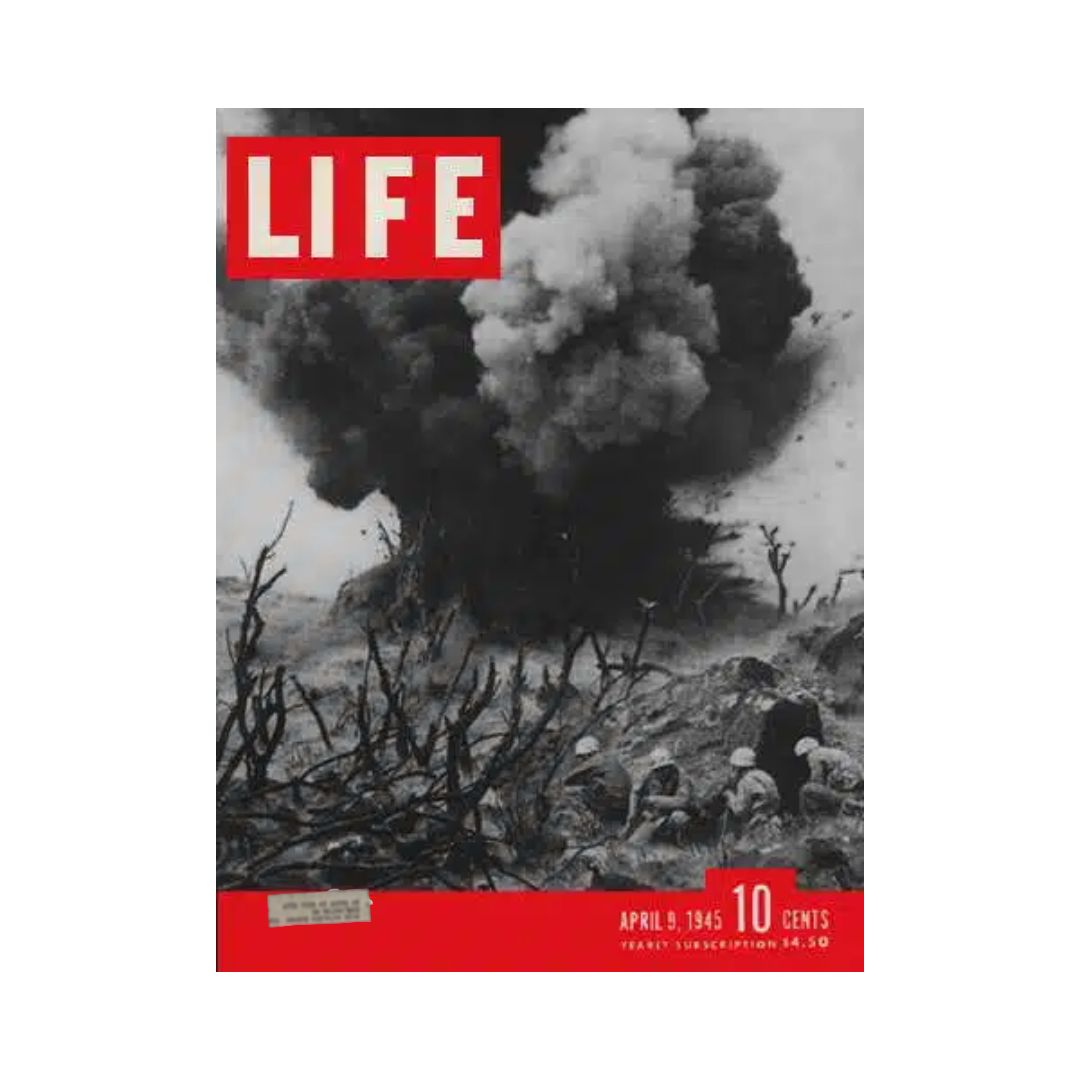

Description
Collector's Note – Why This Issue Matters
The April 9, 1945 issue of Life magazine arrives at one of the most dramatic and consequential moments of the entire Pacific War, and the combination of its Iwo Jima coverage and Robert Capa's photography gives it a place among the most historically significant issues the publication produced in its wartime run. The Battle of Iwo Jima had concluded on March 26, 1945 — just two weeks before this issue's publication date — after thirty-six days of some of the most brutal and costly fighting of the entire Pacific campaign. The battle had produced one of the most iconic photographs in American military history: Joe Rosenthal's image of Marines raising the flag on Mount Suribachi, taken on February 23, which had already been published and was already becoming the defining visual symbol of American sacrifice and determination in the Pacific. But the photographic and journalistic coverage of Iwo Jima extended far beyond that single image, and Life's April 9 coverage — appearing in the immediate aftermath of the battle's conclusion — represents one of the most comprehensive mainstream documentary treatments of the engagement as it was being processed by the American public in real time. The noted Robert Capa photography of airborne landings at Iwo Jima connects this issue to one of the greatest combat photographers in history, a man whose work from Normandy, Spain, and across multiple theaters of the war had established a standard for battlefield photography that remains definitive. For collectors building a serious documentary archive of Life magazine issues from the Pacific War's final months, this issue is one of the most historically dense and visually significant pieces available from the entire wartime run.
The "Hitler's Last Resort" feature noted in the listing adds a further dimension of historical significance that places this issue precisely within the final weeks of the European war alongside its Pacific War coverage — a combination that reflects the extraordinary historical compression of April 1945, when both major theaters of the Second World War were simultaneously approaching their conclusions. By April 9, 1945, Allied forces had crossed the Rhine in force and were advancing rapidly into the German interior, Soviet forces were closing on Berlin from the east, and Hitler was in his Berlin bunker in the final days of the Third Reich. A feature on "Hitler's Last Resort" in this specific week was therefore not a retrospective analysis but live journalism from the final chapter of Nazi Germany's collapse — reporting produced as the events it described were still unfolding, by a magazine whose photographers and correspondents were embedded with Allied forces across Europe. The convergence of Iwo Jima's aftermath in the Pacific and Germany's final collapse in Europe in a single Life issue from April 9, 1945 makes this one of the most historically concentrated editions of the publication's entire wartime publishing history, documenting the simultaneous endgame of two different wars that together constituted the largest armed conflict in human history.
Robert Capa's presence as a credited photographer in this issue deserves particular attention from collectors and researchers who understand his place in the history of photography. Capa — born Endre Ernő Friedmann in Budapest in 1913 — had by 1945 established himself as the most celebrated and consequential combat photographer in the world, having covered the Spanish Civil War, the Sino-Japanese War, the North African campaign, and the D-Day landings at Normandy, where his photographs of American troops hitting Omaha Beach on June 6, 1944 remain among the most powerful images ever made of combat. His work for Life across the war years was central to how the American public understood and visualized the conflict, and his photographs consistently combined technical mastery with a quality of human presence and emotional truth that set them apart from purely documentary war photography. A Life issue carrying Capa photographs of the Iwo Jima airborne landings is therefore not simply a piece of wartime journalism but a primary document of one of the great photographers' work at the climactic moment of the war he had been covering since its earliest days. Those assembling a comprehensive archive of 1945 magazines as primary documents of the war's final months will find this issue among the most photographically distinguished and historically layered pieces in that entire collection.
About the Publication
Life magazine, relaunched by Henry Luce in 1936 as a large-format photojournalism weekly, reached the absolute peak of its historical mission and cultural authority during the years of the Second World War, when its photographers were accredited to every major theater of the conflict and its weekly issues constituted the primary visual record through which tens of millions of American households understood and experienced a war being fought on multiple continents simultaneously. The magazine's large-format pages allowed war photographs to be reproduced at a scale and with an emotional impact that no other publication could match, and the photographers it employed — including Robert Capa, W. Eugene Smith, Margaret Bourke-White, Carl Mydans, and George Strock, among others — produced some of the most significant images in the history of photography under the most extreme possible conditions. At its wartime peak Life reached upwards of 8 million direct subscribers with total readership estimated considerably higher through pass-along circulation, making a single issue's photograph reach potentially into the tens of millions of viewers. The April 9, 1945 issue was produced by a newsroom that understood with complete clarity that it was documenting the final weeks of the largest war in human history, and every dimension of the issue — its photography, its editorial selection, its balance of Pacific and European coverage — reflects the extraordinary historical circumstances in which it was assembled and published.
Key Highlights Inside
- Robert Capa's photographs of airborne landings at Iwo Jima — produced by the most celebrated combat photographer of the Second World War, whose work from Normandy, Spain, and across multiple theaters had established the definitive standard for battlefield photography — constitute the visual centerpiece of an issue that arrived in American households just two weeks after the conclusion of one of the Pacific War's most brutal and costly engagements.
- The "Hitler's Last Resort" feature documents the final collapse of Nazi Germany in the specific week of April 9, 1945 — when Allied forces were advancing rapidly into the German interior and Hitler had retreated to his Berlin bunker — making this one of the most precisely timed pieces of live journalism about the Third Reich's final days produced by any American publication during the war.
- The combination of Iwo Jima aftermath coverage and European endgame reporting in a single April 1945 issue reflects the extraordinary historical compression of that specific week, when the Pacific and European wars were simultaneously entering their final phases — a convergence that makes this issue one of the most historically concentrated single editions in Life's entire wartime run.
- The confirmed feature "A Photographer Meets the Strangest People" provides a secondary human-interest dimension that reflects Life's consistent editorial approach of balancing the weight of wartime coverage with the full range of American life — a combination that made the magazine essential reading across every demographic and that gives surviving issues from this period an editorial breadth that purely military-focused publications of the era cannot match.
- The April 9, 1945 publication date places this issue just three weeks before Adolf Hitler's suicide on April 30 and Germany's unconditional surrender on May 8 — making it one of the final issues of Life to cover the European war as an ongoing conflict rather than a concluded historical event, and giving its "Hitler's Last Resort" feature a retrospective prescience that its editors could not have fully anticipated when they assembled the issue.
- Note: Specific additional article titles, full page references, and complete interior editorial contents beyond the confirmed features noted in the listing have not been independently verified for this issue. The above reflects what is documented from the listing description, publication date, and the well-established historical record surrounding the Battle of Iwo Jima, Robert Capa's wartime photography career, and the state of the European war in the first week of April 1945.
Condition & Rarity
Surviving copies of the April 9, 1945 Life in collectible condition represent a meaningful minority of the original print run, and eighty years of attrition have been considerable for a publication printed on the combination of coated photographic stock and lighter editorial paper that characterized Life of this era — paper engineered for weekly reading rather than archival preservation across multiple generations of ownership. The listing describes this issue as being in good condition — a characterization that, applied honestly to an eighty-year-old weekly magazine, implies structural integrity throughout, complete and legible content including the Capa photographs that are the primary visual asset of the issue, and the characteristic aging that any surviving copy of a publication this old will inevitably display: some degree of tanning to outermost pages, possible spine softening, and the small handling marks that accumulate across eight decades of varied storage. The listing notes that the cover shown is a stock photo and that the received copy is the exact issue but may not match the image precisely — an honest disclosure that reflects the reality of selling individual vintage copies whose specific cover condition may vary from a reference image, and that collectors evaluating this issue should treat as an invitation to request specific condition photographs if cover presentation is a primary collecting priority. The large-format pages of Life from this period are more susceptible to edge stress and corner wear than smaller-format periodicals, and the Capa photographs — printed on the magazine's heavier coated photographic stock — typically survive in better condition than the cover and outer pages when assessing any surviving copy of this issue. Protective plastic sleeve storage is the appropriate preservation standard for large-format coated-stock magazines of this type and era.
Looking for More Issues Like This?
The April 9, 1945 Life is one of the most historically concentrated and photographically distinguished issues the magazine produced in its entire wartime run — Robert Capa's Iwo Jima photography combined with live coverage of Germany's final collapse, published in the extraordinary two-week window between the battle's conclusion and the Third Reich's surrender — and copies in good collectible condition are consistently sought by World War II historians, Capa photography researchers, and serious Life magazine archivists who understand the specific weight this particular edition carries. The Life magazine collection at OriginalMagazines.com spans a wide and carefully assembled range of issues from across the publication's remarkable run, and is the essential starting point for anyone building a serious archive of mid-twentieth-century American photojournalism and wartime visual history. For collectors drawn to the full sweep of the most consequential year of the twentieth century, the 1945 magazine collection offers a rich and varied cross-section of that extraordinary year across multiple titles and editorial perspectives — capturing the full arc from the final battles of the European and Pacific wars through the atomic bombings and Japan's surrender to the first uncertain steps of the postwar world that followed.