
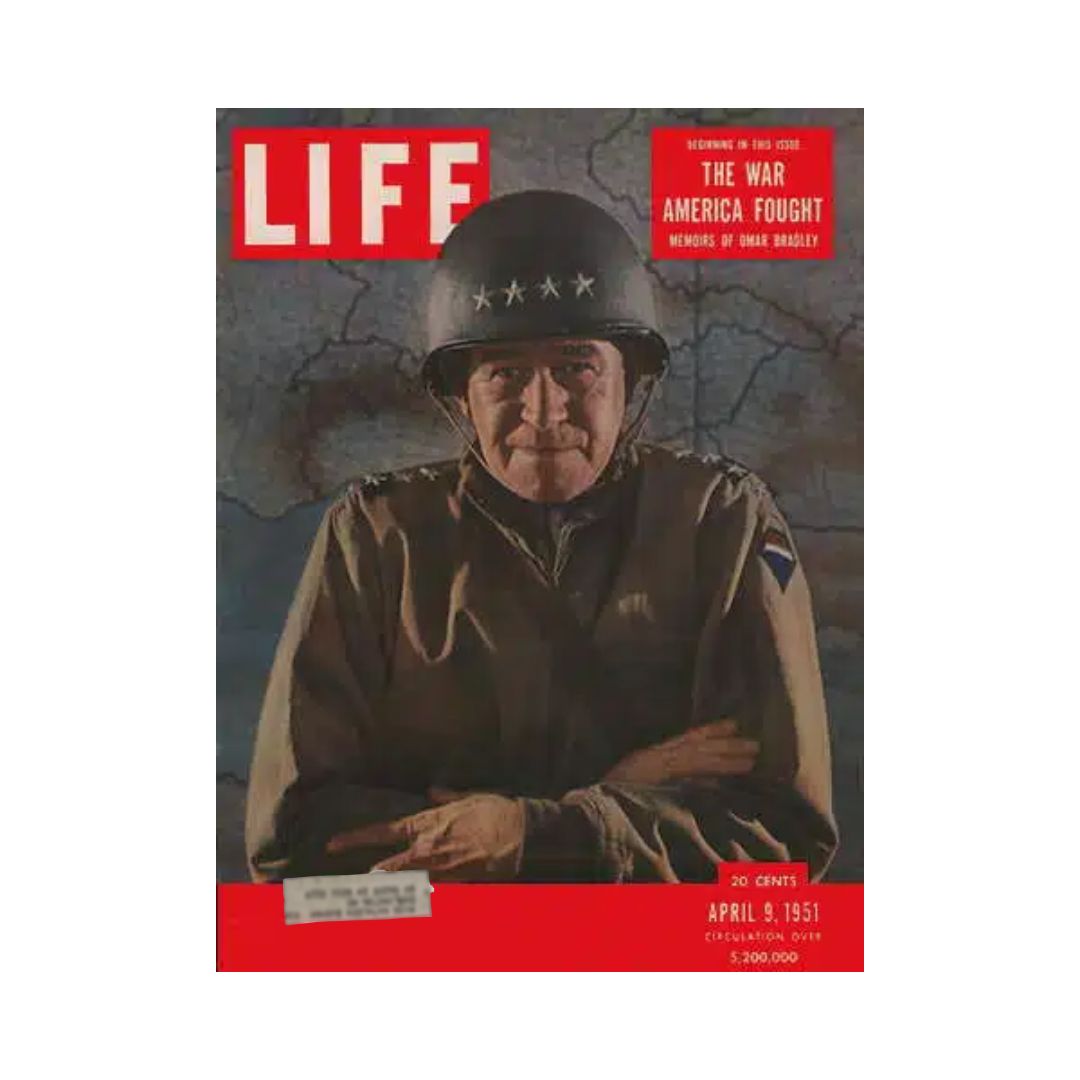

Description
Collector's Note – Why This Issue Matters
The April 9, 1951 issue of Life magazine is one of the most editorially rich single numbers in the publication's early 1950s run, and its table of contents reveals a publication engaging simultaneously with the immediate crises of the Korean War, the most consequential military memoir serialization of the postwar period, and one of the most celebrated works of photojournalism in the history of the medium. General Omar Bradley's memoir serialization — "The Personal Story of General Bradley: The War America Fought," illustrated by Bill Mauldin — is the centerpiece of this issue and one of the most significant pieces of primary military historical documentation that Life published in the postwar decade. Bradley was the last living five-star general of the U.S. Army, had commanded the largest American field army in history during the European campaign of World War II, and was in April 1951 serving as the first Chairman of the Joint Chiefs of Staff — a role that placed him at the absolute center of the Korean War's strategic decision-making at the most fraught moment in that conflict's history. His memoir, appearing in Life's pages with Bill Mauldin's illustrations, combined the authority of the period's most respected military commander with the visual storytelling gifts of the cartoonist who had done more than any other artist to document the experience of the American infantry soldier. The pairing of Bradley's strategic perspective with Mauldin's ground-level visual intelligence is a combination that no subsequent account of World War II can replicate. Collectors focused on the full scope of Life's postwar military and historical journalism will find the Life magazine collection at OriginalMagazines.com the most comprehensive resource for issues across this extraordinary period.
The W. Eugene Smith photograph essay "Spanish Village" — listed as a Pictorial Essay in this issue's table of contents — deserves extended attention, because it is one of the most celebrated single photo essays in the history of photojournalism and one of the most important pieces Smith ever published. Smith's work in this period was at the peak of its creative and moral authority, and "Spanish Village" — documenting the daily life of a small village in Extremadura, Spain, under the shadow of Franco's dictatorship — combined the documentary specificity of great photojournalism with the formal beauty of fine art photography in ways that permanently expanded the definition of what a magazine photo essay could achieve. The essay has been reproduced, analyzed, and taught for over seventy years as one of the foundational texts of twentieth-century photographic practice, and it appeared in this April 9, 1951 Life issue as a primary publication context — meaning that any surviving copy of this specific number is also the primary print vehicle for one of the most important photographs of the postwar era. That an issue containing both the Bradley memoir with Mauldin illustrations and the W. Eugene Smith "Spanish Village" essay exists as a single magazine number is a collecting circumstance of remarkable historical density. The 1951 magazines collection at OriginalMagazines.com gathers publications from a year that was consequential across American military, political, and cultural history simultaneously.
The "Speaking of Pictures" feature on Bob and Sue Rauschenberg — listed in the table of contents as using blueprint paper, sun lamp, and a nude to produce "vaporous fantasies" — is another element of this issue that deserves specific attention from collectors and cultural historians. Robert Rauschenberg was in April 1951 at the very beginning of his career, and his appearance in Life's "Speaking of Pictures" feature in this specific issue is a primary document of one of the most significant American visual artists of the twentieth century at the earliest stages of his public visibility. The "Speaking of Pictures" format — in which Life documented unusual or striking photographic processes and visual experiments by emerging artists — occasionally produced exactly this kind of historically significant early-career documentation, and the April 9, 1951 appearance of Rauschenberg's blueprint work in this context is a genuinely remarkable archival find for collectors of modern American art history in its primary publication form.
About the Publication
Life magazine was founded in its modern incarnation in 1936 by Henry Luce and had established itself by April 1951 as the most widely read general-interest weekly in the United States, with a circulation of several million copies and a readership estimated at several times that number through its extensive circulation in homes, waiting rooms, libraries, and public spaces. Its editorial identity was built on photojournalism of exceptional quality — it had done more than any other American publication to establish the photograph as the primary language of mass media — and its format combined the week's news photographs and photographic essays with feature journalism, art coverage, science, sports, and the kind of celebrity and cultural content that made it genuinely general-interest rather than specifically news-oriented. The April 9, 1951 issue demonstrates the full range of that format operating at the highest level of its editorial ambition.
Key Highlights Inside
- General Omar Bradley memoir — "The War America Fought," illustrated by Bill Mauldin — a major serialization of the memoir of the last living five-star Army general, the commander of the largest American field army in World War II history, illustrated by the cartoonist whose infantry-level visual documentation of the war had made him one of the most honored artists of the conflict — a combination of strategic authority and ground-level perspective that constitutes a primary historical document of extraordinary importance.
- W. Eugene Smith: "Spanish Village" — landmark photojournalism — the primary Life publication context of one of the most celebrated and most studied photo essays in the history of the medium, documenting rural Spanish life under Franco's dictatorship in a series of images that permanently expanded the formal and moral possibilities of magazine photojournalism and that have been reproduced and analyzed continuously for over seventy years.
- Robert Rauschenberg — "Speaking of Pictures" early career appearance — documentation of one of the most significant American visual artists of the twentieth century at the earliest stages of his public visibility, with his blueprint and sunlight photography featured in Life's experimental visual arts format in April 1951, representing one of the earliest primary publication records of his emerging artistic practice.
- Korean War coverage — "Airborne and Armor Link Up in Korea" — contemporaneous photographic coverage of the Korean War at one of its most tactically complex phases, published while Bradley — whose memoir appears in the same issue — was serving as Chairman of the Joint Chiefs and directing the strategic response to the conflict's ongoing escalation.
- Thomas Griffith: "England's Revolution Runs Down" — analytical journalism on postwar British political and social transformation, engaging with the specific trajectory of the Labour government's domestic program at the moment of its electoral vulnerability, providing the kind of international political context that complemented the issue's American military and domestic coverage.
- Oscar coverage — "Jose and Judy Win Oscars" — contemporaneous coverage of the 1951 Academy Awards, documenting the specific celebrity culture of early 1950s Hollywood at the moment of one of its most significant annual events, with the photographic authority that made Life's entertainment coverage the standard against which all competitors were measured.
Condition & Rarity
The listing notes that the image shown is a stock photo and that condition is as described — indicating this issue is part of a larger inventory rather than a unique single example, and that condition assessment should be based on the listing's description rather than a specific photograph of the individual copy being sold. For a seventy-five-year-old weekly magazine with the editorial content documented here, condition evaluation centers on the integrity of the W. Eugene Smith photo essay's printing quality — since the essay's value as both a collecting object and a historical document depends directly on the visual quality of Smith's photographs in their primary publication form — and the completeness of the Bradley memoir installment with Mauldin's illustrations. The standard condition variables for Life issues of this era apply: presence or absence of a newsstand address label affects display value, and any toning, edge wear, or handling marks should be assessed against the specific issue being shipped. The issue's documentary significance — the Smith essay, the Bradley memoir, and the Rauschenberg appearance in a single number — gives it a historical depth that sustains collector relevance across a wide range of condition grades.
Looking for More Issues Like This?
The April 9, 1951 Life magazine — with W. Eugene Smith's "Spanish Village" essay, the Bradley memoir illustrated by Mauldin, and the early Rauschenberg documentation all in a single issue — is one of the editorially densest and most historically significant numbers in the publication's entire postwar run, and serious collectors of photojournalism history, military memoir, and modern American art history all have reasons to seek it out. For those assembling a broader collection of Life's most important postwar issues, the Life magazine collection at OriginalMagazines.com is the most comprehensive place to explore what's currently available. The 1951 magazines collection offers essential context from a year that was consequential across American military, political, and cultural history in ways that continue to reward close examination.