
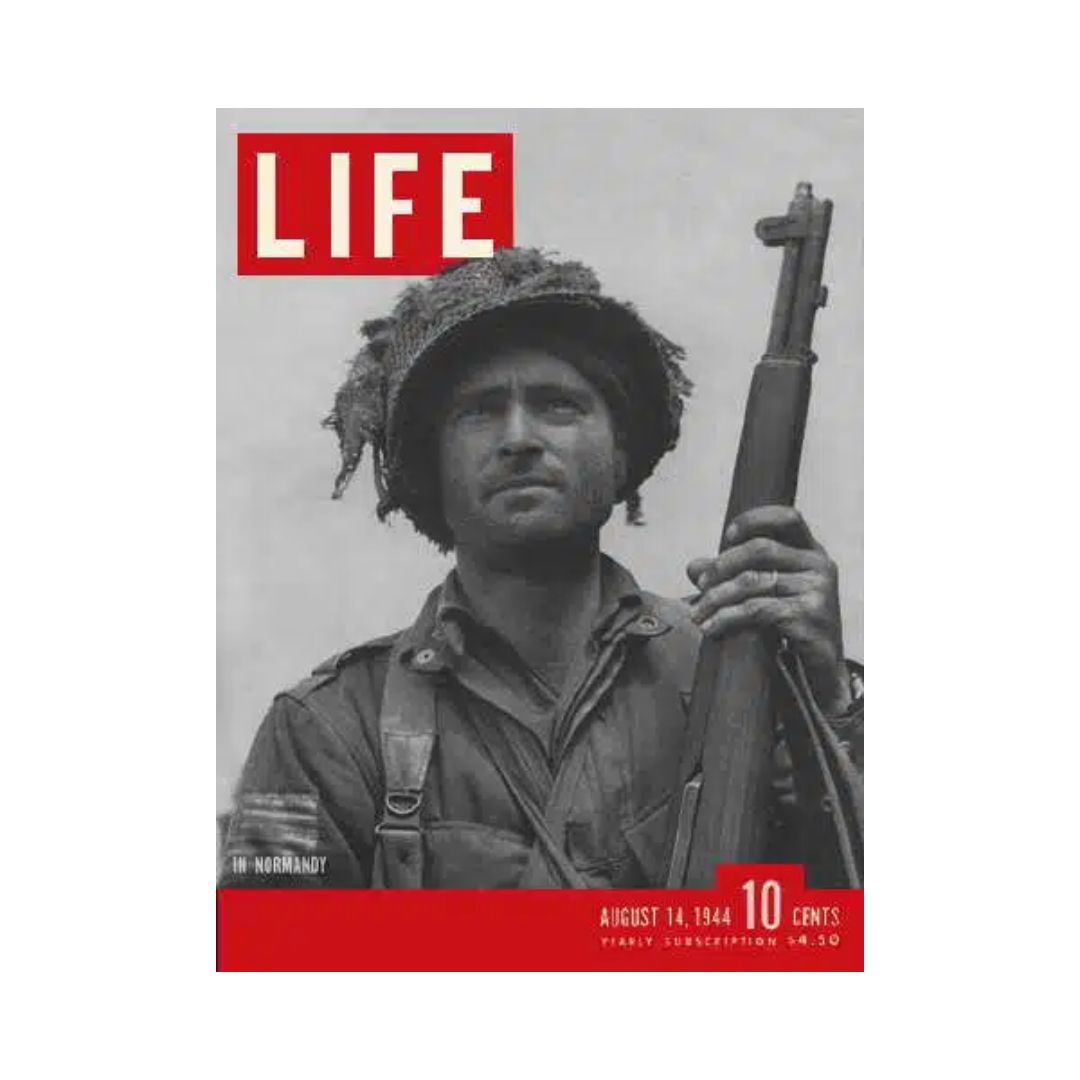

Description
Collector's Note – Why This Issue Matters
Life Magazine's August 14, 1944 issue documenting GIs in Normandy arrives at one of the most consequential moments of the Second World War. The D-Day landings had taken place on June 6, 1944, and by August the Allied breakout from Normandy — Operation Cobra — was underway. The "Break-through in France" coverage listed in this issue's table of contents places it precisely at that hinge point, when the grinding attritional warfare of the hedgerow country was giving way to the rapid armored advance across France that would carry Allied forces toward Paris by the end of the month. Life's photographers were embedded with American forces throughout the Normandy campaign, and the visual record they produced — published in real time to a domestic readership of tens of millions — constitutes one of the most important bodies of photojournalism in the history of the medium. Collectors building a serious archive of vintage Life Magazine issues from the Second World War era consistently identify the summer 1944 issues as among the most historically significant in the entire weekly run.
The supporting content in this issue extends its documentary value well beyond the battlefield coverage. William C. Bullitt's article "The Future of France" — Bullitt had served as the first U.S. Ambassador to the Soviet Union and as Ambassador to France during the fall of Paris in 1940 — brings a perspective of unusual authority to the question of what a liberated France would look like. The coverage of Marshal Tito places the issue in the broader Allied strategic picture, as Yugoslavia's partisan resistance was a significant factor in the European theater. The Ledo Road photographic essay documents the Allied supply route through Burma — another theater of the war receiving Life's serious photographic attention simultaneously with Europe. And the profile of Chester Gould, creator of Dick Tracy, offers a glimpse of domestic American culture carrying on amid the war — the kind of tonal range that made Life's wartime issues read as complete documents of American life rather than simply war dispatches. For collectors researching American magazines from 1944, this issue captures the war at its most pivotal summer moment across multiple theaters and through multiple editorial lenses.
About the Publication
Life Magazine was launched on November 23, 1936 by Henry Luce under Time Inc. as a large-format weekly photojournalism magazine, and by the Second World War it had become one of the most widely read publications in American history, with a readership estimated at over 20 million per issue. Its editorial model built photography as primary narrative — images came first, text served them — and its roster of staff photographers during the war years included Margaret Bourke-White, Robert Capa, W. Eugene Smith, and others who were producing some of the most important photojournalism ever made. Life's wartime issues functioned simultaneously as news delivery, morale documentation, and visual history, giving the American civilian population its most direct window into what the war looked like. The weekly run from 1936 to 1972 constitutes the magazine's core collectible archive.
Key Highlights Inside
- "Break-through in France" — coverage of the Allied breakout from Normandy in late July and early August 1944, one of the decisive turning points of the Western European campaign.
- "The Future of France" by William C. Bullitt — a significant analytical piece by the former U.S. Ambassador to France, written as Allied forces were on the verge of liberating Paris.
- Coverage of Marshal Tito, documenting the Yugoslav partisan resistance as a significant Allied factor in the broader European theater.
- Photographic essay on the Ledo Road — Life's simultaneous coverage of the Burma theater supply route, illustrating the magazine's global wartime reach.
- Editorial on War and Civil Liberties, and coverage of the Dewey presidential campaign — documenting the domestic American political landscape running in parallel with the war effort.
- Close-up profile of Chester Gould, creator of Dick Tracy, by John Bainbridge — a reminder of Life's characteristic tonal range between battlefield documentation and domestic American culture.
Condition & Rarity
Condition for this issue is described in general terms consistent with an eighty-year-old weekly magazine; the listing notes that the image shown is a stock photo representing the issue rather than the specific copy to be received, which is standard practice for dealers holding multiple copies of the same issue. Life's coated stock holds up better than newsprint-based publications of the same era, but browning, edge wear, and spine brittleness are common findings in copies that have not been stored in controlled conditions over eight decades. The wartime issues of Life from 1943 and 1944 were produced in enormous print runs for the domestic market, but the natural attrition of eighty years means that copies in genuinely fine condition — bright covers, tight spines, clean interior pages — represent a meaningfully smaller fraction of original production. Summer 1944 Normandy issues in particular generate consistent collector demand from WWII history researchers, military memorabilia collectors, and Life archive completionists simultaneously.
Looking for More Issues Like This?
The summer and autumn 1944 Life issues documenting the liberation of France are among the most historically significant in the magazine's entire wartime run, and this Normandy breakout issue is a cornerstone entry in that sequence. The broader Life Magazine archive at OriginalMagazines.com covers the full weekly run from 1936 onward, making it the most comprehensive place to explore wartime issues and the decades that followed. Collectors focused specifically on the Second World War era will find the 1944 magazine collection essential browsing — it's the year the war turned decisively in the Allies' favor, and the print record from those twelve months captures that turning point in real time.