
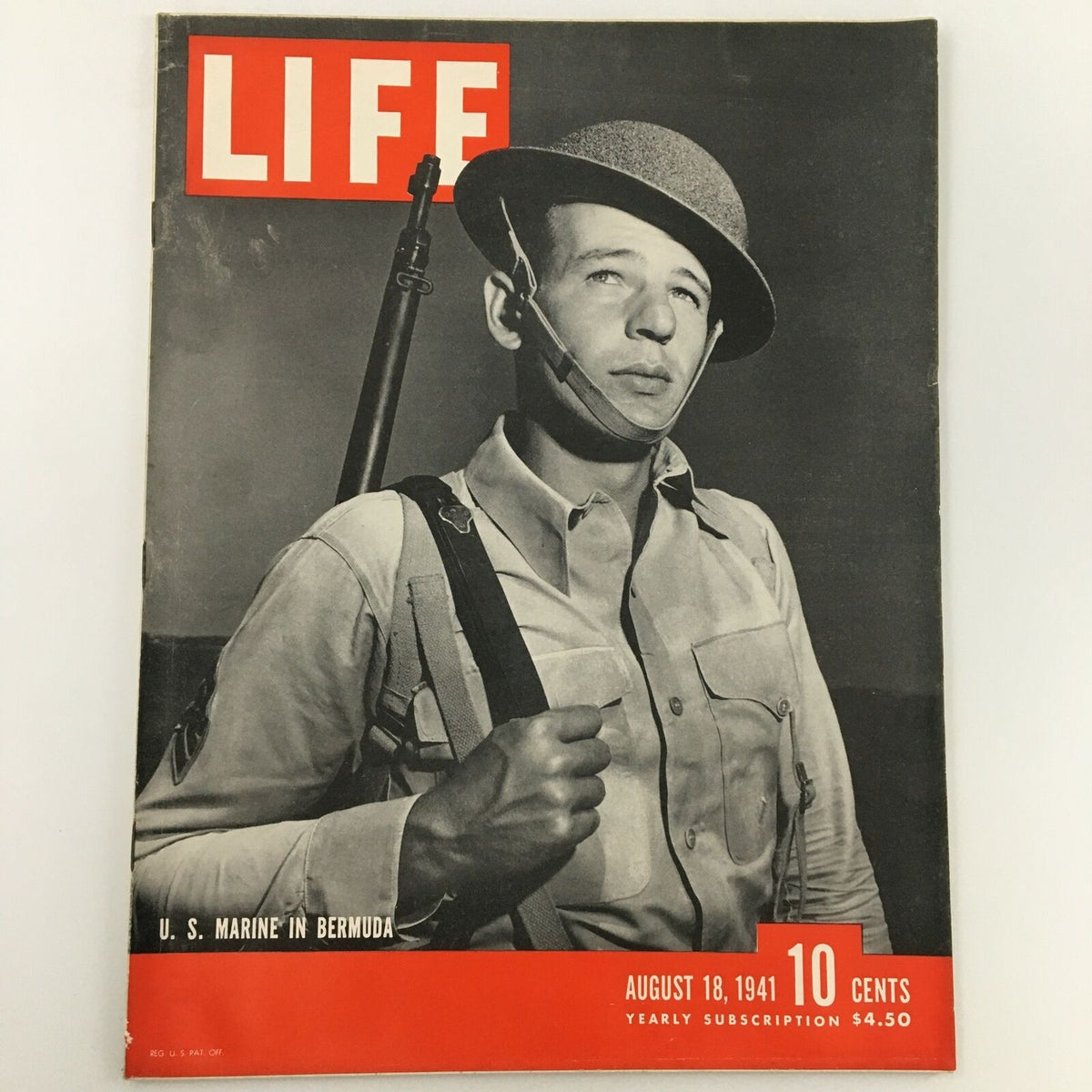

Description
Collector's Note – Why This Issue Matters
The August 18, 1941 issue of Life, published as Volume 11, Number 7, presents a U.S. Marine stationed in Bermuda on its cover. The image belongs to a decisive period when the Second World War was already reshaping Europe and the Atlantic, although the United States had not yet formally entered the conflict. American military forces were expanding, overseas defense positions were being strengthened, and public attention was increasingly focused on national preparedness. By placing an individual Marine on the cover, Life gave a human face to this larger process of mobilization. The issue appeared less than four months before the attack on Pearl Harbor brought the United States directly into the war.
Bermuda had become strategically important to the defense of Atlantic shipping routes and the approaches to North America. The United States obtained rights to develop military facilities there as part of the broader Anglo-American base arrangements negotiated while Britain was fighting Nazi Germany. The cover subject therefore represents more than routine military service in a distant location. He stands within the expansion of American naval and air defenses that preceded the country’s formal declaration of war. The issue’s photographic essay, “Bermuda Becomes U.S. Defense Bastion,” gave contemporary readers a visual explanation of the island’s changing military role.
As a historical object, the magazine captures American life at the boundary between official neutrality and active preparation for global conflict. Its pages combine defense reporting with science, cinema, art, international news, and the visual advertising culture of 1941. That mixture is characteristic of Life, which presented major events alongside entertainment and everyday experience rather than isolating them into separate publications. Collectors studying the magazine’s wartime photography can explore additional issues in the archive of vintage Life magazines. The broader collection of magazines published in 1941 provides further context for how American print media documented defense mobilization and a world already at war.
About the Publication
Life was an American general-interest picture magazine published by Time Inc. in its influential weekly format beginning in 1936. It was created for a broad national audience and used large photographs, extended visual essays, concise reporting, and carefully designed page sequences to explain current events. Its editorial range included politics, war, science, industry, society, travel, entertainment, art, and ordinary American life. Photographers were central to the magazine’s identity, with images often functioning as the principal form of storytelling rather than merely illustrating written articles. During the years surrounding World War II, Life became an especially important visual record of military preparation, combat, civilian industry, and the home front. Its large page format also provided substantial space for contemporary advertisements, many of which reveal the consumer products, graphic design, and social attitudes of their era. Complete issues are therefore studied not only for individual cover subjects but also for the wider editorial and commercial environment preserved within their pages.
Key Highlights Inside
- The issue was published on August 18, 1941 as Volume 11, Number 7 and contains 88 pages. Its cover photograph shows a U.S. Marine in Bermuda during the months immediately preceding America’s formal entry into World War II.
- A major photographic essay titled “Bermuda Becomes U.S. Defense Bastion” begins on page 61. The feature documents the island’s emerging place within American Atlantic defense planning and provides the principal editorial context for the Marine pictured on the cover.
- The week’s defense reporting includes coverage of congressional debate over extending military service and a report concerning complaints that had affected Army morale. These subjects reveal the political and practical challenges involved in enlarging the American armed forces before Pearl Harbor.
- A national-defense feature examines the use of U.S. Navy blimps to locate submarines. The article reflects contemporary interest in anti-submarine patrols and the protection of sea routes at a time when the Battle of the Atlantic was already underway.
- The issue includes an article titled “Nazi Germany After Two Years of War” by Stephen Laird. Its presence places the Bermuda coverage within a broader examination of the European conflict and the military power confronting Britain and its allies in 1941.
- Additional features address psychologists measuring the mental capacities of infants, artist Henry Bouche’s railroad murals, and the film Here Comes Mr. Jordan. Other departments include international news photographs, correspondence from readers, and a visit to entertainer Gertrude Niesen’s residence in Newport.
Condition & Rarity
The reported condition is Very Good to Excellent, with the magazine described as having little, if any, minor wear. Its newsstand origin and absence of a subscriber address label leave the Marine cover photograph and surrounding typography unobstructed. For collectors of illustrated weekly magazines, a label-free cover generally offers the strongest visual presentation because no mailing block covers part of the original design. The description does not report substantial tears, detached covers, missing pages, writing, water exposure, or serious binding damage. Those attributes should nevertheless be confirmed by examining the spine, page count, cover attachment, corners, and interior photographs before assigning a precise grade. Large-format issues of Life are particularly susceptible to edge wear, spine separation, folds, and handling creases because of their dimensions and paper construction. The accompanying plastic protective covering is a later preservation accessory rather than an original part of the publication, but it can help reduce dust, abrasion, and further handling wear during storage.
Looking for More Issues Like This?
The August 18, 1941 issue is a particularly focused historical reference because its cover and principal photo essay document the development of American defenses in Bermuda before Pearl Harbor. Exact complete examples with clean, label-free covers may take patience to identify. The broader collection of original Life magazines includes additional photographic records of military affairs, politics, entertainment, science, and everyday American culture. Readers researching the surrounding period can also browse other original magazines from 1941. Examining several publications from that year provides a fuller view of how the United States understood the approaching conflict before it became an active combatant.