
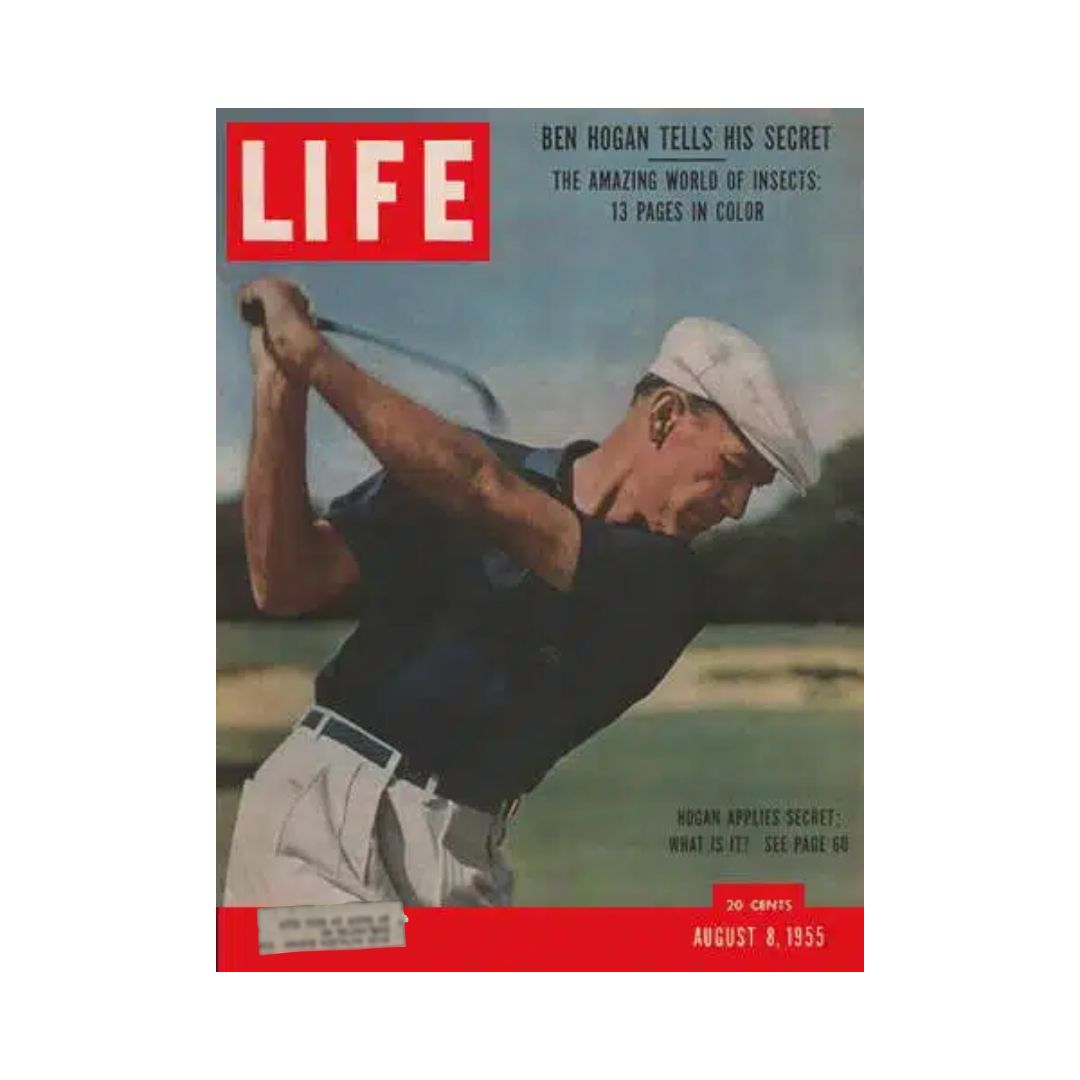

Description
Collector's Note – Why This Issue Matters
August 8, 1955 is a publication date of specific and historically layered significance, and this Life Magazine issue documents it with a table of contents whose individual items carry primary source significance across multiple distinct collecting communities. The Ben Hogan golf secret feature on page 60 — "This Is My Secret: Ben Hogan Finally Reveals the Grip that Made Him the Champion" — is the single most commercially and historically significant item in this issue's documented contents and one of the most famous single sports journalism features in Life Magazine's entire run. Hogan was the most technically studied golfer in American sports history, and the specific revelation of his grip secret in Life had been anticipated by golfers for years before the August 1955 publication. Hogan had developed his pronated grip and swing modifications after his near-fatal 1949 car accident, and the resulting technique had produced the most dominant run of major championship victories of the postwar era — the 1950 U.S. Open, 1951 Masters, 1951 U.S. Open, 1953 Masters, 1953 U.S. Open, and 1953 Open Championship. For golfers and sports historians, this Life feature is a primary source document of what Hogan himself identified as the mechanical foundation of his championship golf, published at the specific career moment when his technical mastery was most actively being sought by the playing community. The feature generated one of the most significant single-article responses in Life's sports coverage history, and surviving copies with this feature intact are among the most actively sought in the Life back-catalog by golf collectors. For collectors building an archive of Life Magazine issues from the fifties, this August 8, 1955 edition is one of the most specifically collector-significant sports primary sources in the publication's mid-decade run.
The science and technology content documented in the Week's Events features adds a second primary source dimension of extraordinary historical significance. The announcement on page 26 — "U.S. to Launch a Man-Made Moon — An Artificial Satellite Will Circle the Earth at 18,000 mph" — is a primary document of the American announcement of what would become the Vanguard satellite program, made at the Geneva International Astronautical Conference in 1955 and constituting one of the first public official statements of American intent to launch an Earth-orbiting satellite. This announcement preceded Sputnik's October 1957 launch by more than two years, and a Life feature documenting it in August 1955 is a primary source record of the Space Race's earliest official public phase — before the satellite race had become the politically charged superpower competition it would become after Sputnik's launch. The atomic industries Geneva conference coverage on page 17 adds a further primary source of the specific mid-fifties "Atoms for Peace" moment — the first Geneva Conference on the Peaceful Uses of Atomic Energy had occurred in August 1955, and a contemporaneous Life report on its outcomes is a primary document of the American nuclear establishment's specific early public relations effort to reframe atomic science as civilian and beneficial rather than purely military. Collectors researching American magazines from 1955 will find this Life issue a primary source document of extraordinary range across sports, space history, and atomic age journalism.
The additional content documented in the table of contents adds further historical and cultural primary source dimensions. The Cordell Hull obituary feature on page 41 — "A Great Statesman Passes: Cordell Hull, 'the Father of the U.N.,' is Buried in Washington" — is a primary document of Hull's specific historical recognition at his death, constituting a primary source record of how mid-fifties American journalism was memorializing the architect of the United Nations at the specific moment of his passing. The Isamu Noguchi King Lear costumes theater feature on page 64 — reporting London critics' reactions to John Gielgud's production — adds an art history primary source dimension: Noguchi was one of the most significant American sculptors of the century, and his theatrical design work for Gielgud's King Lear is a primary document of his crossover between sculptural and theatrical visual culture. The Andreas Feininger, Roman Vishniac, and Edward S. Ross insect photography essay adds three of the most significant names in mid-century photographic science to the issue's documentary roster. The "Swaps" article on page 81 documents one of the most significant racehorses of the era at a historically specific career moment.
About the Publication
Life Magazine was founded by Henry Luce in November 1936 and by August 1955 had been publishing for nineteen years as the most widely circulated photojournalism publication in the United States. Its combination of large-format photographic authority, comprehensive news coverage, and the specific editorial intelligence that brought science, sports, arts, theater, and human interest into a single authoritative weekly format gave it a reach and cultural influence that no competitor matched. The August 8, 1955 issue represents Life at its mid-fifties editorial peak, its roster of photographers including Andreas Feininger and Roman Vishniac for the insect essay, and its sports coverage producing the Ben Hogan grip revelation that would become one of the most referenced single articles in the publication's sports journalism history.
Key Highlights Inside
- Ben Hogan "This Is My Secret" golf grip feature on page 60 — a primary source document of the most technically studied golfer in American sports history revealing the mechanical foundation of his championship technique, constituting one of the most historically significant single sports journalism features in Life Magazine's entire run and among the most actively collected sports primary source articles in the publication's mid-fifties catalog.
- "U.S. to Launch a Man-Made Moon" on page 26 — a primary document of the American official announcement of the satellite program that preceded Sputnik by more than two years, constituting a primary source record of the Space Race's earliest official public phase at the specific 1955 moment when the superpower satellite competition was being formally announced to the American public for the first time.
- Atomic Industries Geneva conference coverage on page 17 — a contemporaneous primary source of the first International Conference on the Peaceful Uses of Atomic Energy in August 1955, documenting the American nuclear establishment's specific early Atoms for Peace public relations effort at the precise moment of its most formal international expression.
- Cordell Hull obituary feature on page 41 — a primary document of the founding Secretary of State's historical recognition as "Father of the U.N." at his death, constituting a primary source record of mid-fifties American journalism's memorialization of one of the most significant architects of the postwar international order.
- Isamu Noguchi King Lear theater feature on page 64 with John Gielgud — a primary document of one of the most significant American sculptors engaging theatrical design, with London critical reactions to his costumes constituting a primary source record of the crossover between sculptural and theatrical visual culture at a specific 1955 production moment.
- Insect photography essay by Andreas Feininger, Roman Vishniac, and Edward S. Ross on page 43 — a primary source visual document by three of the most significant names in mid-century photographic science, constituting a primary record of Life's characteristic ambition to bring the most accomplished available photographic talent to its natural science documentary coverage.
Condition & Rarity
Life Magazine issues from August 1955 are approaching their seventy-first year of existence, and the condition landscape for surviving copies of this specific issue reflects both the general attrition of that age and the specific and sustained collecting pressure that the Ben Hogan golf secret feature generates from the golf collecting community alongside the space history and atomic age primary source dimensions. The listing uses stock photography and directs collectors to the described condition for assessment — the standard practice for a large inventory from this period. Life's large-format staple-bound design made it susceptible to cover separation, page stress, and the accumulated wear of seven decades, and surviving copies that retain the complete Ben Hogan sports feature and the satellite announcement pages in readable form are meaningful survivors from a print run of this age. The listing images are the primary condition reference for this specific example. Collectors evaluating surviving examples should prioritize the Hogan feature page completeness and the satellite announcement pages as primary condition criteria for this issue's most specifically historically significant content.
Looking for More Issues Like This?
A surviving copy of the August 8, 1955 Life Magazine with the Ben Hogan golf secret revelation, the first American official satellite announcement, the Atoms for Peace Geneva conference documentation, the Cordell Hull memorial, and the Isamu Noguchi theater feature is among the most multiply historically significant single issues in the publication's mid-fifties archive — the convergence of golf history's most famous single instructional article, the Space Race's earliest public announcement, and the atomic age's most optimistic public moment in a single August 1955 weekly gives this issue a primary source profile extending across sports history, space exploration history, and postwar American institutional history simultaneously. If this issue is no longer available, the full Life Magazine collection at OriginalMagazines.com is the most comprehensive place to browse surviving issues from across the publication's history. The 1955 magazine collection brings together issues from across that year's major publications for collectors interested in the full breadth of American print journalism during one of the mid-fifties' most scientifically and culturally consequential years.