
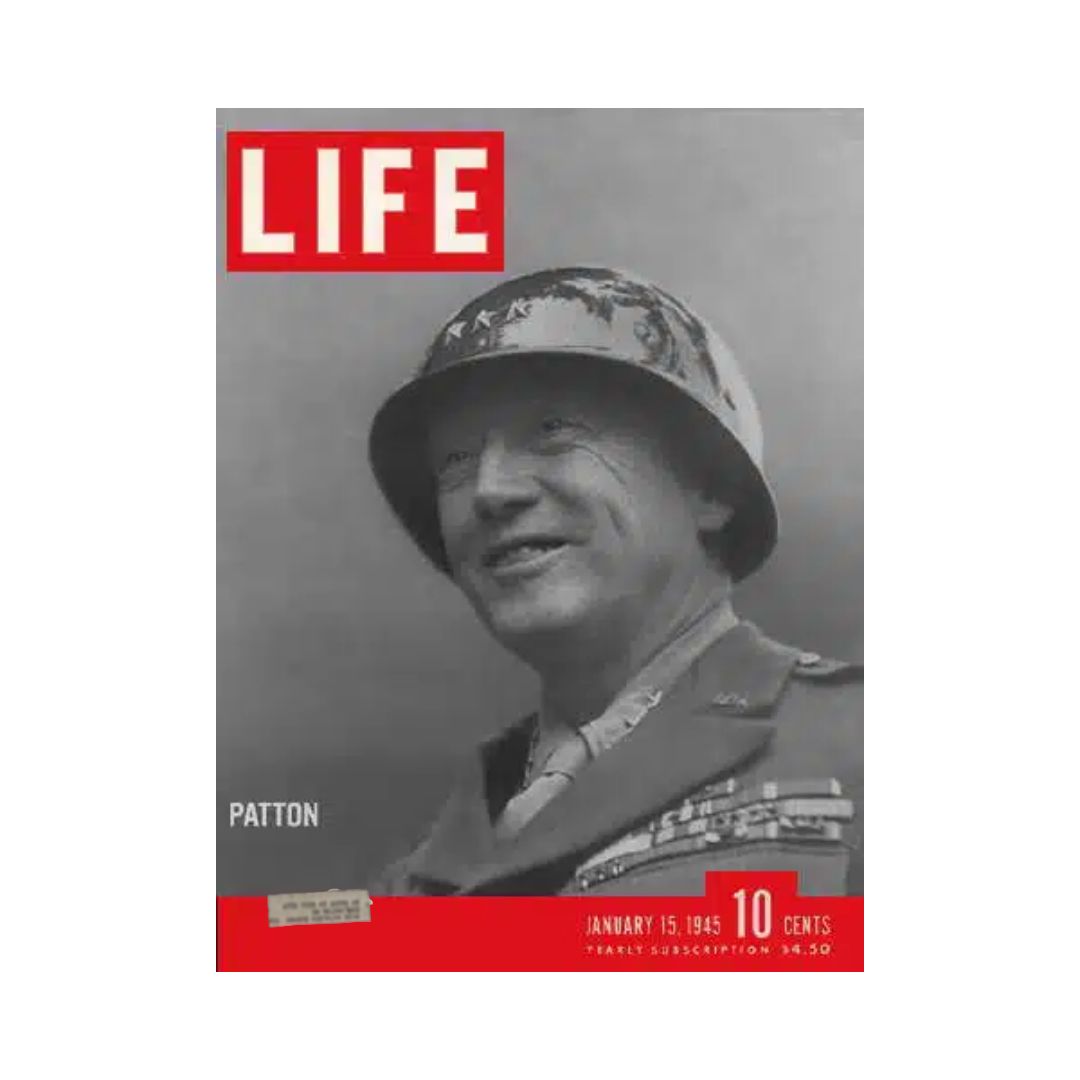

Description
Collector's Note – Why This Issue Matters
The January 15, 1945 issue of Life magazine arrives at one of the most dramatic turning points of the Second World War in the European theater. The lead news section's coverage of the Allied effort to squeeze the German Bulge places this issue directly within the Battle of the Bulge — Hitler's last major offensive on the Western Front, which had begun on December 16, 1944 and was still being fought when this issue went to press. General George S. Patton's presence on the cover is editorially precise: it was Patton's Third Army that had executed one of the most celebrated maneuvers of the entire war, turning ninety degrees in brutal winter conditions and driving north to relieve the besieged American forces at Bastogne on December 26, 1944. By the time this issue reached newsstands, Patton had become the most publicly celebrated American field commander of the European campaign. A Life cover in January 1945 was the highest-visibility platform American print journalism could offer, and placing Patton there in this specific week was a deliberate editorial statement about who the American reading public understood to be the face of Allied momentum in Europe.
The interior contents of this issue extend well beyond the war coverage, and that breadth is itself historically telling. John Hersey's close-up profile of a Soviet business executive reflects the complex moment of Soviet-American alliance that would unravel so completely within just a few years — Hersey, who would go on to write Hiroshima the following year, was already one of the most trusted journalists covering the war and its human dimensions. The theater section covers On the Town, Leonard Bernstein's debut Broadway musical, which had opened just weeks earlier in December 1944 — making this one of the earliest major national magazine notices of a work that would become a canonical piece of American musical theater. The painting of Ingrid Bergman by Alexander Brook documents her status at the absolute peak of her Hollywood prominence, one year after Gaslight and two years after Casablanca. For collectors building around vintage Life magazine issues, WWII-era covers featuring named commanders represent some of the most historically anchored entries in the entire run.
The photographic essay on Boston and the feature on Rio's Copacabana Beach speak to Life's consistent editorial ambition to hold the full range of American life alongside the war — to document a nation that was simultaneously fighting a global conflict and living, traveling, attending theater, and watching birds in winter. That dual focus is what makes individual issues from this period so valuable as primary documents: they show the war not as the only thing happening but as the overwhelming context within which ordinary American life was still being conducted. The 1945 magazine archive captures this final year of the war across multiple publications, and this January issue sits near the beginning of what would prove to be the conflict's decisive final months in Europe.
About the Publication
Life magazine, relaunched by Henry Luce in November 1936 as a large-format weekly photojournalism publication, had by 1945 become the most widely read magazine in the United States, with a circulation approaching five million copies per week. Its oversized format was designed to showcase photography as a primary narrative medium, and its combination of photographic essays, war correspondence, cultural coverage, and advertising created a visual record of mid-twentieth-century American life that remains unmatched in scope and reach. During the Second World War, Life functioned as the primary visual news source for millions of American families, publishing combat photography, portraits of military figures, and home-front documentation in a format that newspapers could not replicate. Its weekly frequency gave it a responsiveness to breaking events that monthly publications could not approach, and its editorial staff during the war years included some of the most accomplished photographers and journalists of the century.
Key Highlights Inside
- General George S. Patton cover during the Battle of the Bulge — Published in the immediate aftermath of Patton's Third Army relief of Bastogne, this cover documents the moment of his greatest public prominence as a field commander, at the decisive turning point of the Western Front campaign.
- The Week's Events: Allies Squeeze the German Bulge — Contemporaneous news coverage of the Battle of the Bulge as it was being fought, representing the American public's real-time understanding of the campaign rather than retrospective analysis.
- John Hersey: Close-Up on a Soviet Business Executive — A profile by one of the era's most respected war correspondents, documenting the Soviet-American alliance at its operational peak before the postwar fracture that would produce the Cold War.
- Theater coverage of On the Town — Among the earliest national magazine notices of Leonard Bernstein's debut Broadway musical, which had opened in December 1944 and would become one of the defining works of American musical theater.
- Ingrid Bergman painted by Alexander Brook — An art feature documenting Bergman at the height of her Hollywood prominence, one year after her Academy Award for Gaslight.
- Cpl. Russ Engel: The Incredible Patrol — First-person combat writing published while the war was still being fought, representative of Life's wartime practice of publishing soldier-authored accounts alongside staff journalism.
Condition & Rarity
Wartime Life issues present a specific set of condition considerations that distinguish them from the magazine's pre- and postwar runs. Paper rationing during the Second World War affected the stock quality of American magazines across the board, and Life issues from 1942 through 1945 were printed on lighter, more acidic paper than the publication used before or after the war. This means that surviving copies are more susceptible to toning, brittleness at the edges, and browning at the page margins than equivalent issues from adjacent years — characteristics that are inherent to the paper stock rather than indicators of poor storage. The large format of Life also creates specific vulnerability points: spine stress from the oversized binding, corner wear from handling, and cover separation at the staple points are the condition variables most relevant to collector evaluation of any surviving copy of this issue. A copy presenting in good readable condition with intact binding and a displayable Patton cover represents a solid grade for a eighty-year-old large-format newsprint publication. The protective plastic sleeve is the appropriate current storage solution for issues of this paper weight and format.
Looking for More Issues Like This?
WWII-era Life issues with named commander covers are among the most historically significant entries in the entire run, and the Patton cover in particular — timed to the Battle of the Bulge relief — is one of the more purposefully sought issues from the war years. The full Life magazine collection at OriginalMagazines.com is the most comprehensive place to explore what's available across the publication's wartime and postwar run. For collectors working the full documentary landscape of the war's final year, the 1945 magazine archive brings together issues from multiple titles that together tell the story of that extraordinary twelve months from January through the surrenders in May and August.