



Description
Collector's Note – Why This Issue Matters
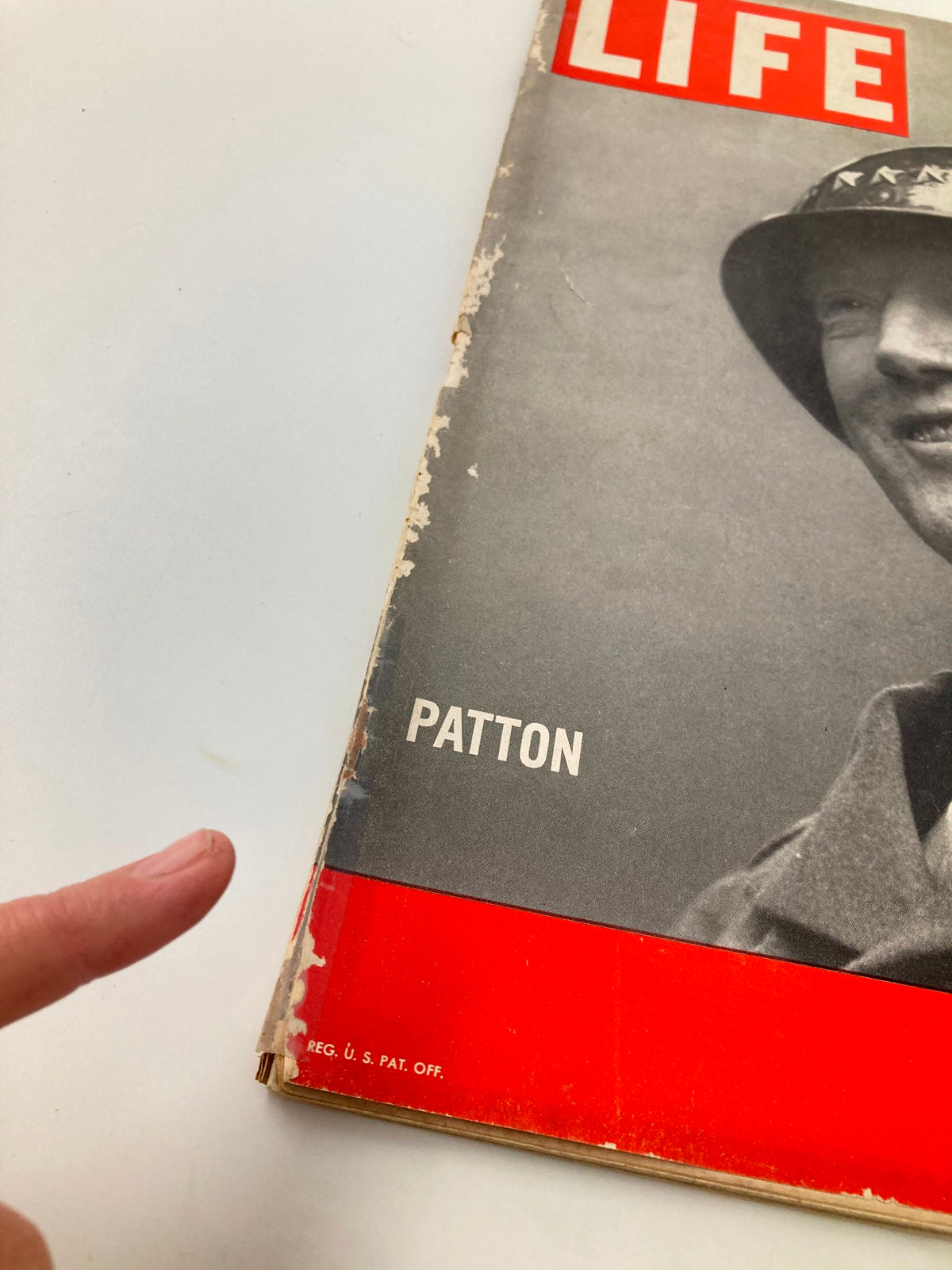
The January 15, 1945 issue of Life Magazine places General George S. Patton on its cover at one of the most dramatic moments of his entire military career — and one of the most decisive of the entire European war. Just weeks before this issue's publication date, Patton's Third Army had executed one of the most celebrated military maneuvers of the Second World War: the rapid 90-degree pivot northward in brutal winter conditions to relieve the besieged American forces at Bastogne during the Battle of the Bulge. The German Ardennes offensive had launched on December 16, 1944, catching Allied command by surprise and creating a crisis that threatened to reverse the momentum of the entire Western campaign. Patton's ability to redirect three divisions of the Third Army within 48 hours — a feat that most military planners considered logistically impossible — and reach Bastogne by December 26th had turned potential catastrophe into a defining American victory. A Life cover dated January 15, 1945 captures Patton in the immediate aftermath of this achievement, at the precise moment the American public was absorbing the scale of what his army had accomplished. Collectors researching Patton's documented presence in the wartime press will find related material in the George Patton magazine archive at OriginalMagazines.com.
The significance of this issue extends beyond a single general's reputation. January 1945 was a moment of extraordinary tension and evolving hope on the American home front. The Battle of the Bulge had shaken public confidence in the war's swift conclusion — casualty figures were arriving at a rate that reminded families the conflict was far from over — and the news from the Pacific, where the Philippines campaign and the approach to the Japanese home islands were generating their own brutal arithmetic, offered little comfort. Life Magazine in this period was the primary visual record of the war for the American public: its photographs, its portraits of military leaders, and its combination of news reporting with human storytelling constituted how most Americans understood what was happening overseas. A Patton cover in this specific week was an editorial argument — this is the man, this is the moment, this is what American military capability looks like — directed at a readership that needed both information and reassurance. The 1945 magazines collection at OriginalMagazines.com provides broad context across publications from the war's final year, a period that generated some of the most historically significant American press coverage of the entire twentieth century.
Patton himself was a figure of genuine complexity whose public image in January 1945 was itself a carefully managed narrative. The soldier-slapping incidents of August 1943 had nearly ended his career, and his relief from command after the Normandy breakout had kept him out of the public eye for months. His return with the Third Army and the Bastogne relief had rehabilitated his public standing dramatically, and a Life cover in January 1945 reflects that rehabilitation at its peak. He would be dead by December of the same year, killed in a traffic accident eight months after Germany's surrender, making any press document from his wartime peak a record of a figure whose time at the center of events was shorter than it appeared.
About the Publication
Life Magazine was founded by Henry Luce in 1936 as a weekly photojournalism publication and rapidly became the most influential visual news magazine in the United States, reaching circulations that at its peak exceeded thirteen million copies per week. During the Second World War it functioned as the preeminent visual record of the conflict for the American home front — its photographers, including Margaret Bourke-White, W. Eugene Smith, and Robert Capa, produced images that defined how the war was understood and remembered. Its audience was the broadest possible cross-section of literate American society, and its combination of large-format photography with accessible reporting made it a fixture in American homes across class and regional lines. A wartime Life cover carried genuine cultural authority: it told readers not just who was on the cover but who mattered, and why, at that specific moment in the war.
Key Highlights Inside
- Cover portrait of General George S. Patton — published in the immediate aftermath of the Third Army's relief of Bastogne during the Battle of the Bulge, the military achievement that cemented Patton's reputation as the most aggressive and effective American field commander of the European theater.
- Issue dated January 15, 1945 — published while the Battle of the Bulge was still concluding and the Allied push toward Germany was resuming, placing its military coverage at a pivotal transition point in the final phase of the European war.
- Label on back cover — confirming subscriber distribution, with the label confined to the back rather than the front cover, leaving the Patton portrait on the cover face intact for display purposes.
- Note: Specific article titles, photographic features, and additional interior content details beyond the confirmed cover subject have not been independently verified for this issue. The highlights above reflect confirmed cover content and well-documented historical context for Patton, the publication, and the period.
Condition & Rarity
The noted condition describes a good-condition copy with minor wear throughout, some marks, a label on the back cover, and binding wear with intact overall structure — stored in a plastic protective sleeve. The back cover label placement is a meaningful distinction: subscription labels on Life issues of this era were applied to the back cover rather than the front in many cases, meaning the Patton cover portrait on the front face survives without label adhesion damage. Binding wear on a large-format weekly magazine of this age is entirely expected — Life's staple-bound construction was not designed for decades of storage, and copies that retain structural integrity after eighty years represent survivorship above the norm. Minor marks and age-consistent wear throughout the pages are standard disclosures for a publication of this vintage and format. For a collector prioritizing the cover image and its historical significance, a good-condition copy with an intact front cover and sound page structure is a fully displayable and historically valuable example of this issue.
Looking for More Issues Like This?
Wartime Life Magazine covers featuring major military commanders are among the most actively sought issues in the WWII collectibles market, and a Patton cover from the Bulge aftermath represents one of the more historically charged of the war's final year. If this January 1945 issue has already been claimed, the George Patton magazine collection at OriginalMagazines.com is the best starting point for other issues documenting his wartime career across publications. Collectors building a comprehensive picture of the war's final year through the American press will find the 1945 magazines collection an essential resource for period publications spanning the European and Pacific theaters through to V-J Day.