


Description
Collector's Note – Why This Issue Matters
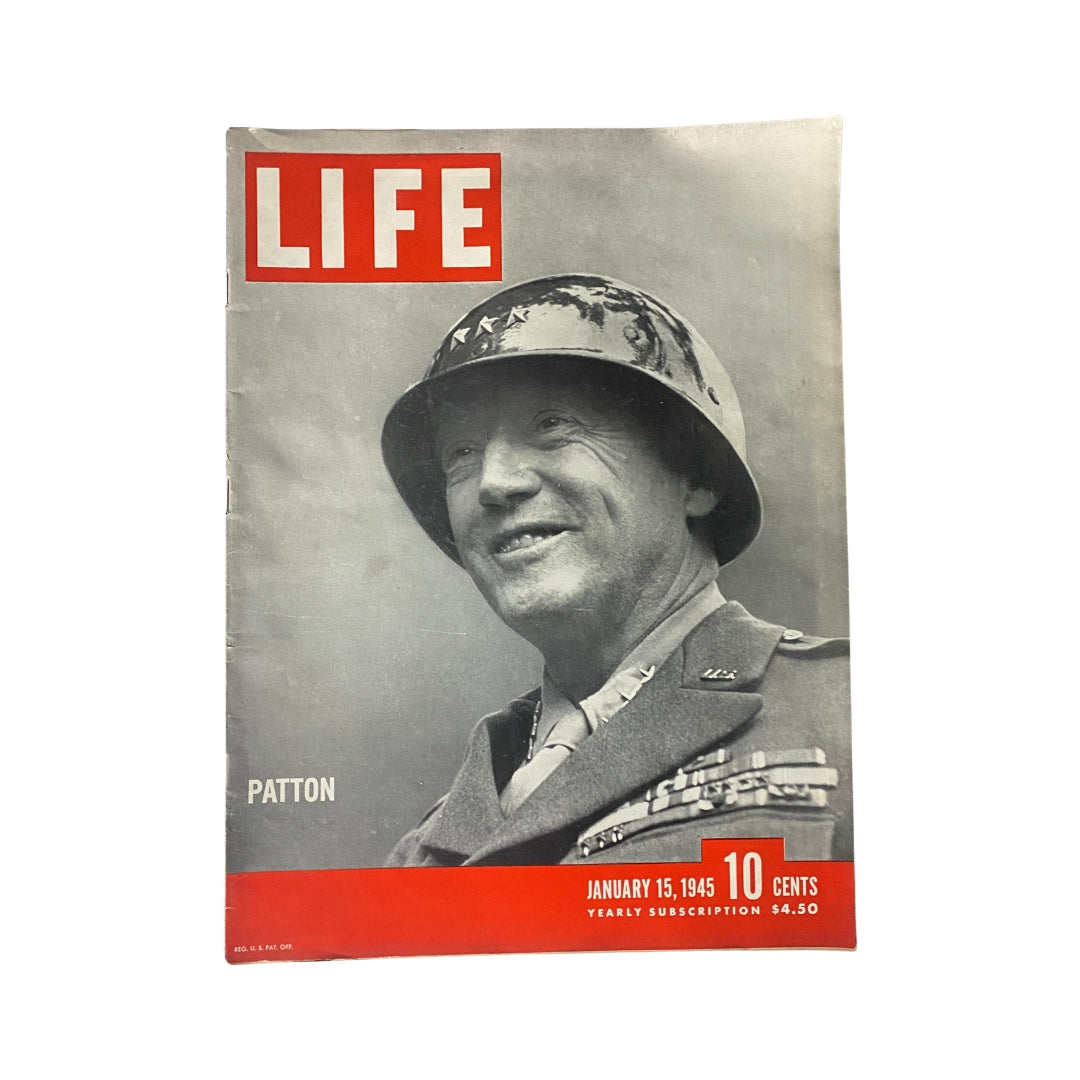
January 15, 1945 is one of the most historically specific and consequential publication dates in Life Magazine's wartime archive, and the General George S. Patton cover story arrives at a precisely charged moment in the final phase of the Second World War in Europe. The "Allies Squeeze the German Bulge" Week's Events feature on page 15 documents the Battle of the Bulge's decisive Allied counteroffensive — the German offensive had begun on December 16, 1944, and by January 15, 1945, the Allied forces under Patton's Third Army were actively squeezing the German salient that had briefly threatened Allied lines in Belgium and Luxembourg. Patton's specific role in the Battle of the Bulge was among the most celebrated of his career: he had famously turned his Third Army ninety degrees in December 1944, executing one of the most operationally audacious pivots in American military history to relieve the besieged American forces at Bastogne. A Life cover story on Patton published on January 15, 1945 — while the Bulge's resolution was still actively under way and his specific operational achievement was the most recent and most dramatically successful American military action of the war — is a primary document of the general at the precise peak of his wartime public reputation, before the post-war controversies that would follow. For collectors building an archive of Life Magazine issues from the Second World War period, this January 15, 1945 edition is a primary document of the most celebrated American field commander of the European Theater at his most historically specific and most dramatically consequential operational moment.
The John Hersey "Soviet Business Executive" Close-Up on page 39 is a historically significant secondary document that rewards specific attention. Hersey was one of the most important American journalists of the twentieth century — his subsequent Hiroshima (1946) remains one of the defining works of American literary journalism — but in January 1945 he was a Life staff writer whose Close-Up on Soviet economic management constitutes a primary source of American journalistic engagement with the Soviet system at the specific late-war moment when the American-Soviet alliance was at its most formally cooperative and when the post-war shape of the Soviet-American relationship was still being actively negotiated. A Hersey Close-Up on Soviet economic life in January 1945 is a primary document of how the American mainstream press was engaging the Soviet ally at the specific moment between wartime cooperation and the Cold War antagonism that would follow. The Churchill Greece parley feature on page 24 documents the specific and historically consequential December 1944 Churchill visit to Athens, where he had brokered the fragile agreement that would shape Greek political life for decades — a contemporaneous primary source of one of the most significant individual diplomatic interventions of the war's final phase. Collectors researching American magazines from 1945 will find this Life issue a primary source document of extraordinary range across military history, diplomatic history, literary journalism, and American cultural life.
The "On the Town" theater feature on page 49 adds a specific and historically interesting cultural dimension. On the Town — the Leonard Bernstein, Betty Comden, and Adolph Green musical — had opened on Broadway on December 28, 1944, just eighteen days before this issue's publication, making the Life theater feature a contemporaneous primary source of the show at its Broadway debut. On the Town would prove one of the most significant American musicals of the twentieth century, and a January 15, 1945 Life feature on it constitutes a primary document of the show's original reception at its moment of debut. The Ingrid Bergman painting by Alexander Brook on page 37 adds a primary document of Bergman's specific late-war public profile — she was at the height of her Casablanca-era fame — and John Hersey's literary presence alongside military and diplomatic journalism reflects the specific editorial ambition that made Life's wartime journalism the most accomplished in American photojournalism history.
About the Publication
Life Magazine was founded by Henry Luce in November 1936 and by January 1945 had been publishing for eight years, having long since established itself as the most widely circulated photojournalism publication in the United States. Its wartime coverage — conducted with the full resources of its photographic roster and its editorial staff — had made it the primary visual and journalistic framework through which millions of Americans understood the war's progress, its human dimensions, and its most significant figures. The January 15, 1945 issue represents Life at the height of its wartime authority, its combination of the Patton cover story, the Hersey Soviet Close-Up, the Battle of the Bulge news, the Churchill Greece parley, and the On the Town theater debut reflecting the publication's characteristic ambition to document the full breadth of American and world life in a single authoritative weekly package.
Key Highlights Inside
- General George S. Patton cover story with "Allies Squeeze the German Bulge" Week's Events on page 15 — a primary document of the most celebrated American field commander of the European Theater at the precise operational peak of his wartime reputation, published while the Battle of the Bulge's Allied counteroffensive — including Patton's Third Army's audacious December 1944 pivot to relieve Bastogne — was still actively resolving.
- John Hersey "Soviet Business Executive" Close-Up on page 39 — a primary source document by one of the most significant American journalists of the twentieth century, engaging Soviet economic life at the specific late-war moment of maximum American-Soviet alliance cooperation and constituting a primary record of how the American mainstream press understood the Soviet system at the precise threshold of the Cold War's emergence.
- Churchill Greece parley feature on page 24 — a contemporaneous primary source of Churchill's December 1944 Athens visit, one of the most significant individual diplomatic interventions of the war's final phase, documenting the fragile Greek political agreement that would shape the country's post-war trajectory.
- "On the Town" theater feature on page 49 — a contemporaneous primary source of the Leonard Bernstein, Betty Comden, and Adolph Green musical at its Broadway debut eighteen days after its December 28, 1944 opening, constituting a primary document of one of the most significant American musicals of the twentieth century at its original critical reception moment.
- Ingrid Bergman painting by Alexander Brook on page 37, "The Keys of the Kingdom" movie feature, and "The Incredible Patrol" by Cpl. Russ Enge — the fine arts, cinema, and frontline military journalism range of a January 15, 1945 Life reflecting the publication's characteristic breadth of engagement with American cultural and military life at the war's final European phase.
- Boston photographic essay on page 65, Winter Birds nature feature on page 54, Pius XII Christmas Mass on page 26, and "Stones for Hitler's Victory Monument Lie Idle in Sweden" on page 23 — the full documentary and human interest range that placed the Patton cover and the Hersey Close-Up in the comprehensive weekly context that gave Life its specific primary source authority.
Condition & Rarity
Life Magazine issues from January 1945 are approaching their eighty-second year of existence, and the condition landscape for surviving copies of this specific issue reflects both the general attrition of that age and the specific historical collecting significance of a Patton cover story published during the Battle of the Bulge's resolution. The listing directs collectors to the photographs as the primary condition reference — the standard practice for a publication of this age from a large inventory — and the absence of a mailing label is a notable condition positive that preserves the Patton cover image in its complete, unobstructed form. Life's large-format staple-bound design made it susceptible to cover separation, page stress, and the accumulated wear of more than eight decades, and surviving copies from this period that retain structural integrity with complete editorial content represent meaningful survivors. Wartime paper quality reflects the materials constraints of 1945 production standards. The plastic protective sleeve provides ongoing archival protection. Collectors evaluating surviving examples of this issue should prioritize the Patton cover image legibility, the completeness of the Hersey Close-Up and the Battle of the Bulge news pages, and overall structural soundness as primary condition criteria.
Looking for More Issues Like This?
A label-free copy of the January 15, 1945 Life Magazine with the Patton Battle of the Bulge cover, John Hersey's Soviet Close-Up, the Churchill Greece parley documentation, and the On the Town Broadway debut feature is among the most multiply historically significant single issues in the publication's wartime archive — the convergence of Patton's operational peak, a major Hersey journalism document, Churchill's most consequential personal diplomatic intervention, and the debut of one of the century's most significant American musicals in a single weekly issue gives this edition a primary source profile extending across military history, diplomatic history, literary journalism, and theater history simultaneously. If this issue is no longer available, the full Life Magazine collection at OriginalMagazines.com is the most comprehensive place to browse surviving issues from across the publication's wartime archive and locate other military leadership covers, Battle of the Bulge documentation, or significant issues from Life's most historically charged wartime year. The 1945 magazine collection brings together surviving issues from across that year's major publications for collectors working to document the full breadth of American print journalism during the most decisive final year of the Second World War.