

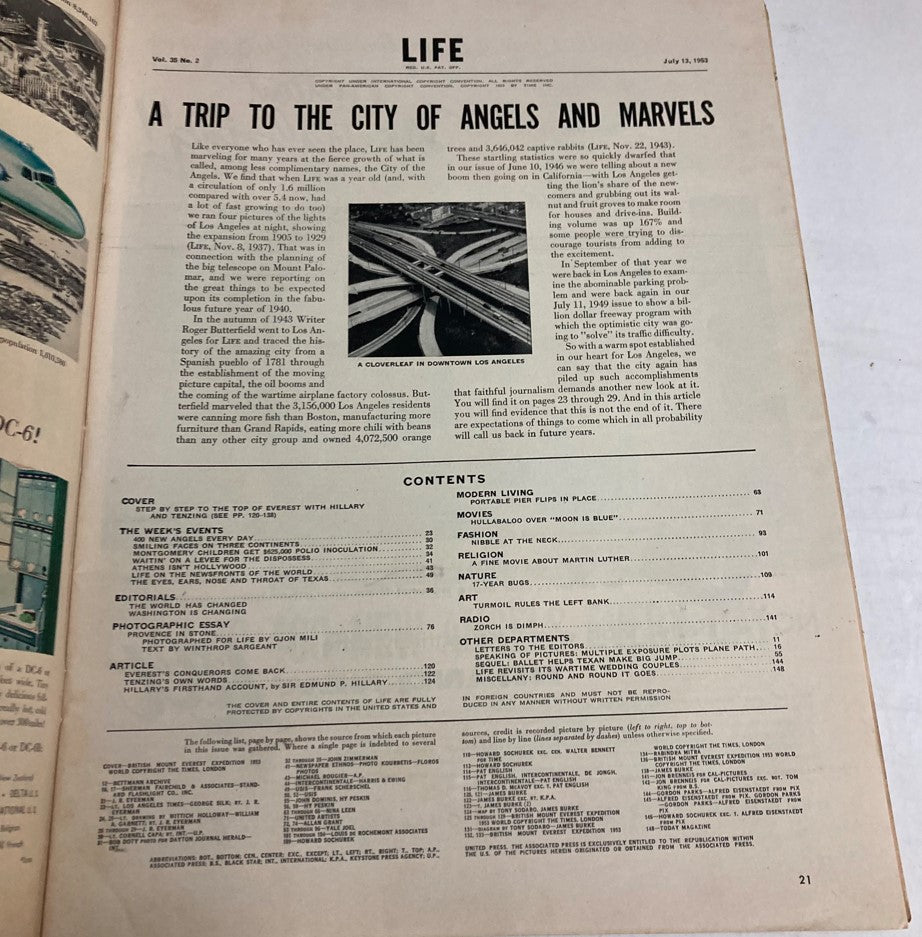


Description
Collector's Note – Why This Issue Matters
The July 13, 1953 issue of Life magazine featuring Edmund Hillary and Tenzing Norgay's ascent of Mount Everest is one of the most historically significant issues in the publication's entire run — and one of the most important magazine documents of twentieth-century exploration. The first successful summit of Everest occurred on May 29, 1953, achieved by Hillary, a New Zealand beekeeper and mountaineer, and Tenzing Norgay, a Sherpa climber of extraordinary experience and skill, as part of the ninth British expedition to Everest led by Colonel John Hunt. The news reached London on the morning of June 2, 1953 — the day of Queen Elizabeth II's coronation — in what became one of the most celebrated pieces of timing in the history of British public life. By July 13, when this Life issue appeared, the world had had six weeks to absorb the news of the summit, and Life's photographic treatment of the expedition represented the most comprehensive American visual documentation of the achievement available to the general public. For collectors pursuing vintage Life magazine issues that document landmark moments in human achievement, the Hillary and Tenzing Everest issue is one of a small number of covers that require no contextual argument for their significance — the event is among the most universally recognized of the century.
The cultural weight of the Everest summit in 1953 deserves precise historical framing. This was not merely an athletic achievement — it was understood, in the immediate postwar context, as a validation of human endurance and ambition at a moment when the world was still processing the catastrophic failures of will and civilization that the preceding decade had produced. The British expedition's success arrived coincident with the coronation of a young queen, and the combination of the two events produced an outpouring of national and imperial sentiment in Britain that was extraordinary even by the standards of 1950s public emotion. In the United States, the story landed differently — Hillary was a Commonwealth figure, Tenzing a Nepali Sherpa, and the achievement belonged to no single nation — but the human dimensions of the story transcended those distinctions. Life's July 13 coverage brought the photographs and the narrative to the broadest possible American readership in the format the magazine had mastered: large-format photojournalism that made the reader feel present at an event they could not otherwise access. The broader context of this remarkable year in postwar history is documented across the 1953 magazine archive, which places this issue alongside the full range of events — the Korean War armistice, the coronation, the first hydrogen bomb tests — that defined a pivotal year in postwar global history.
It is also worth noting the specific historical complexity that the Hillary-Tenzing summit introduced into the public record. The question of which of the two men stepped onto the summit first became a subject of diplomatic sensitivity almost immediately, with British expedition management and Commonwealth politics creating pressure to present the achievement as a joint effort rather than assign individual priority. Both men handled the question with considerable grace over the subsequent decades, and the summit has come to be understood as genuinely collaborative in a way that the first-footstep question obscures rather than clarifies. A 1953 Life issue documenting the event captures the story at the moment of its initial public framing, before decades of retrospective analysis had complicated and enriched the narrative — which is precisely what makes contemporaneous magazine documentation of historical events irreplaceable as primary sources.
About the Publication
Life magazine, relaunched by Henry Luce in November 1936 as a large-format weekly photojournalism publication, was by 1953 the most widely read magazine in the United States, with a circulation approaching six million copies per week. Its oversized format was designed to showcase photography as a narrative medium in its own right, and its combination of photographic essays, long-form journalism, and advertising created the most comprehensive visual record of mid-twentieth-century American and world events available to the general public. The magazine's ability to deploy photographers to major world events and return with images that defined those events in the public imagination was its central editorial and commercial proposition, and the Everest coverage of 1953 was a near-perfect expression of that capability — a remote, visually spectacular, historically momentous event rendered accessible and immediate through photojournalism. Life ran as a weekly through 1972, and its issues from the late 1940s through the 1960s represent the apex of American photojournalistic magazine publishing.
Key Highlights Inside
- Edmund Hillary and Tenzing Norgay Everest summit coverage — Life's photographic documentation of the first successful ascent of the world's highest peak, published six weeks after the May 29, 1953 summit, representing the most comprehensive American visual treatment of the achievement available to the general public at the time.
- High-altitude expedition photography — The photographic record of the 1953 British Everest expedition is among the most studied in the history of mountaineering and exploration photography; the images published in Life were central to how the American public visualized the achievement and the landscape in which it occurred.
- Postwar exploration narrative at its cultural peak — The Everest summit arrived at a specific moment of postwar optimism and appetite for human achievement stories, and Life's treatment reflects the magazine's mastery of the narrative frameworks — adventure, national pride, human endurance — that made exploration stories resonate with a mass readership.
- July 1953 postwar context — Published one week after the Korean War armistice was signed on July 27 — actually preceding the armistice by two weeks, meaning this issue appeared in the final days of the active Korean War — this issue sits within one of the most eventful months of the postwar decade.
Condition & Rarity
Surviving copies of this issue with cover creases, interior page marks, and the general character wear described in the listing represent the honest condition range for a seventy-year-old large-format weekly magazine that passed through active readership. Life's oversized format created specific structural vulnerabilities — cover creasing from handling, corner wear, and spine stress from the large binding are characteristic of issues of this age and size rather than exceptional defects. The paper stock combination of coated cover and interior newsprint ages at different rates, and interior toning at page margins is expected. These characteristics document the issue's history without compromising its value as a primary source for the Everest summit coverage. The large-format photographic pages — which are the primary documentary and display asset of any Life issue — should be evaluated for surface condition and color fidelity in surviving copies, as the coated stock used for photographic spreads is susceptible to surface abrasion and moisture damage over this time span. The protective plastic sleeve is appropriate current storage for large-format magazines of this age and paper weight.
Looking for More Issues Like This?
The Hillary and Tenzing Everest issue is one of the genuinely landmark covers in Life's entire run, and copies in any condition that preserves the photographic spreads intact draw sustained collector interest from mountaineering historians, postwar cultural researchers, and Life specialists alike. The full Life magazine archive at OriginalMagazines.com is the most comprehensive place to browse what's available across the publication's history, including other landmark exploration and achievement covers from the 1950s. For collectors working the full documentary landscape of this extraordinary postwar year, the 1953 magazine archive brings together issues from multiple titles that together capture the full texture of one of the most eventful years of the decade.