

Description
Collector's Note – Why This Issue Matters
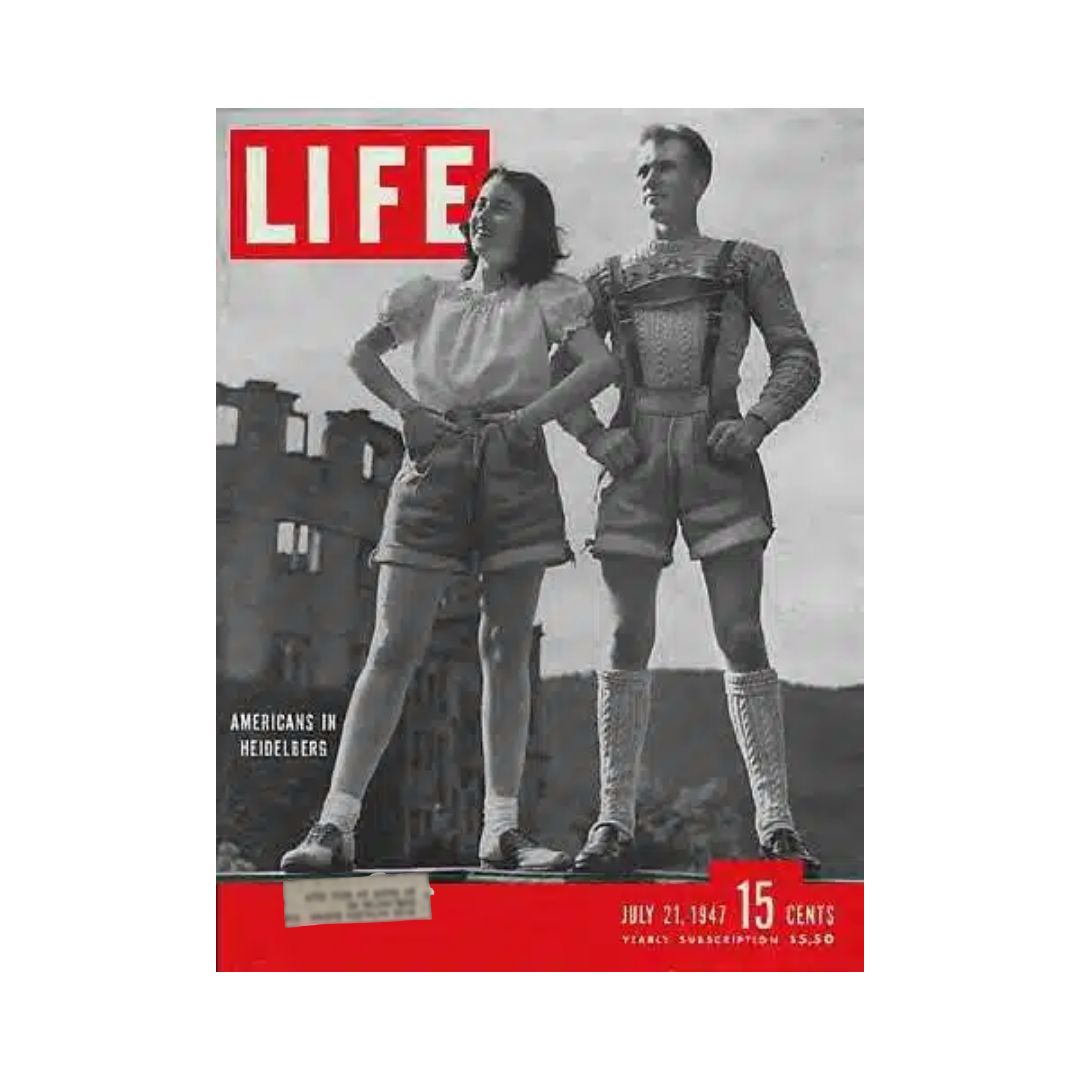
The July 21, 1947 issue of Life magazine — "Americans in Heidelberg" — documents one of the most consequential and least examined aspects of the postwar American experience: the massive civilian and military presence in occupied Germany and the cultural encounter it produced between Americans and the Germans they were governing. By July 1947, the American occupation of Germany was two years old, and the nature of that occupation was shifting significantly. The initial punitive impulse had given way to a more complicated reality — the United States was now responsible for feeding, administering, and rebuilding a country that had just been its enemy, and the personal relationships between occupiers and occupied were generating a human story that Life, with its photographic documentary tradition, was uniquely positioned to tell. Heidelberg had survived the war largely intact — it was one of the few major German cities not heavily bombed — and it had become a significant center of American military administration and university life, making it the perfect setting for a Life cover story on what the American occupation actually looked like on the ground. For collectors building a serious archive through the Life magazine run of the postwar occupation era, this July 1947 issue is a primary document of that experience at a historically specific and underexamined moment.
The listing's mention of Marshall Plan editorial content places this issue in extraordinary historical context. Secretary of State George Marshall had delivered his Harvard commencement address proposing European economic reconstruction on June 5, 1947 — just six weeks before this issue's publication date. The Marshall Plan was still being debated and not yet legislated when this Life appeared on newsstands; Congress would not pass the Economic Cooperation Act until April 1948. A July 1947 Life issue covering Americans in Germany alongside editorial ideas about European reconstruction captured the exact moment when American foreign policy was being reconceptualized from occupation to reconstruction — one of the most consequential strategic pivots in twentieth-century American history. The combination of the Heidelberg ground-level human story and the Marshall Plan policy discussion in a single July 1947 issue gives it a historical density that transcends either story individually. For anyone researching American foreign policy and postwar European reconstruction in 1947, this issue documents the precise week when both the human reality of the occupation and the strategic argument for transforming it into reconstruction were simultaneously visible.
The Georgia prison incident noted in the listing — guards killing seven prisoners — documents a domestic American story that was itself historically significant in the context of 1947. The postwar period was producing intense pressure on the American penal system, and incidents of prison violence were generating civil liberties debates that would eventually contribute to reform movements. The Eva Braun album mentioned in the listing — photographs from Hitler's partner's personal collection — reflects Life's role in publishing documentary material about the Nazi regime for an American audience still processing the full dimensions of what had just happened in Europe. Each of these editorial elements contributes to the picture of July 21, 1947 as a moment when America was simultaneously managing its occupation responsibilities, debating its reconstruction strategy, confronting its domestic institutions, and absorbing the documentary record of the war it had just won.
About the Publication
Life magazine, relaunched by Henry Luce in its modern photojournalism format in 1936, was by July 1947 in its eleventh year and at the height of its postwar authority and circulation. Its format combined photographic essays with reported journalism, human interest features, cultural criticism, and entertainment coverage for a broad mainstream American readership. Its postwar documentation of occupied Europe — including Germany, Japan, and the emerging Cold War landscape — was among the most sustained and significant body of photojournalism produced in the immediate postwar period, and the occupation-era issues from 1945 through 1949 represent a distinctive and historically important chapter in the publication's long run.
Key Highlights Inside
- "Americans in Heidelberg" cover story — photographic documentation of American military and civilian life in one of the few major German cities to survive the war largely intact, published July 21, 1947, two years into the occupation and six weeks after Marshall's Harvard address proposing European reconstruction.
- Marshall Plan editorial content — engagement with the then-still-debated proposal for European economic reconstruction, published at the precise moment when American foreign policy was pivoting from occupation to reconstruction strategy.
- Georgia prison incident coverage — documentation of the killing of seven prisoners by guards, contributing to the postwar civil liberties debate about American institutional violence.
- Eva Braun album feature — publication of documentary photographic material from Hitler's partner's personal collection, part of Life's sustained effort to document the Nazi regime for American readers still processing the war's full dimensions.
- Additional features including "The World's Worst Job," a theatrical review of "Brigadoon," and human-interest content consistent with Life's format of combining serious journalism with accessible entertainment coverage.
Condition & Rarity
The listing notes that the image shown is a stock photo and that condition is as described rather than verified against the specific copy to be received — an important transparency note for collectors who prioritize condition assessment before acquisition. For any surviving copy of this issue, the primary evaluation criteria are cover integrity, interior page completeness, and the absence of significant foxing or brittleness in the coated paper stock that Life used throughout this period. Copies in good condition with minor wear typical of their age represent acceptable collector-grade examples of a seventy-eight-year-old weekly magazine. A plastic protective sleeve confirms preservation intent. Postwar occupation-era Life issues are sought by World War II history collectors, Marshall Plan and Cold War origin researchers, and Life magazine completists simultaneously.
Looking for More Issues Like This?
Postwar occupation-era Life issues from 1946 through 1949 are among the most historically specific and least commonly assembled in collector archives — documenting a period of American history that is crucial but often overshadowed by the war years that preceded it and the Korean War that followed. If this July 1947 issue has already found a home, the full Life magazine collection at OriginalMagazines.com spans the publication's postwar coverage across its most historically consequential years. The complete 1947 magazines collection is essential browsing for anyone building a serious archive of the Marshall Plan era and the reconstruction of postwar Europe.