

Description
Collector's Note – Why This Issue Matters
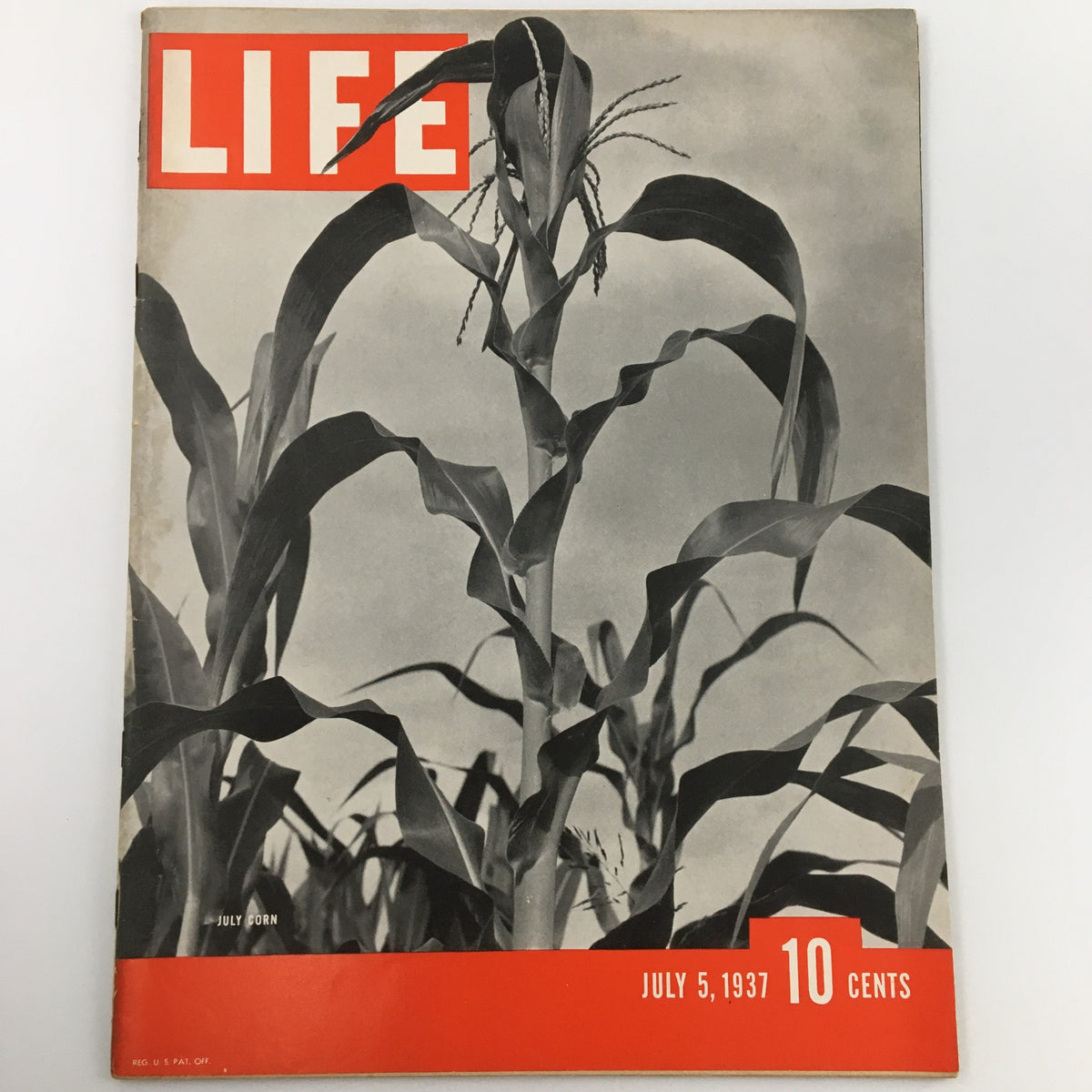
The July 5, 1937 issue of Life Magazine, identified as Volume 3, Number 1, features the photographic cover commonly cataloged as “July Corn.” The image presents tall corn plants as the central visual subject, turning an ordinary agricultural crop into a bold seasonal composition. Contrary to the wording of the original listing title, the cover is not a photograph of a farm newsstand. Its subject is the corn itself, photographed closely enough that the leaves and stalks dominate the frame. The choice gave Life an unmistakably American summer image for the first weekly issue of its third numbered volume. Corn carried immediate associations with farming, food production, rural labor, and the agricultural landscape familiar to millions of readers. The cover therefore transforms a common crop into a concise visual emblem of July in the United States.
The issue appeared less than a year after Time Inc. relaunched Life as a weekly publication centered on photojournalism in November 1936. During these early months, the magazine was still establishing the visual methods that would make it one of the most influential American periodicals of the twentieth century. A cover devoted entirely to corn demonstrates how its editors could treat landscape, agriculture, animals, machinery, and ordinary objects as subjects worthy of dramatic photography. The image did not require a celebrity portrait or a major news event to command attention. Corn was also deeply connected to the economic life of the Midwest and to broader national discussions about farming during the Great Depression. The supplied information and accessible issue records do not identify a particular farm, farmer, location, or cover photographer, so those details should remain unconfirmed. What can be stated securely is that the cover records Life’s early confidence in allowing a carefully selected photograph to communicate season, place, and national identity.
The complete magazine extends far beyond its agricultural cover and provides a varied photographic record of the summer of 1937. Its principal news coverage includes the American steel strike, a major labor conflict involving industrial workers, corporations, law enforcement, and state authority. A separate portfolio examines paper production and follows the movement of timber toward the manufacture of newsprint. Cultural features address France’s Bastille Day, the work of Pierre-Auguste Renoir, and a Nebraska religious pageant. The issue also includes reporting on Palestine during the British Mandate, when political conflict and competing national movements were receiving increasing international attention. Its film department presents *Knight Without Armor*, starring Marlene Dietrich and Robert Donat, placing contemporary cinema beside labor reporting, art, agriculture, and international affairs. Readers can study related examples through other early issues of Life Magazine and through a wider selection of magazines published in 1937.
About the Publication
Life Magazine was relaunched by Time Inc. on November 23, 1936, as a weekly general-interest periodical built around photojournalism. Publisher Henry Luce envisioned a magazine in which photographs would carry much of the narrative rather than serving merely as decoration for written articles. Its large page format gave photographers and editors room to reproduce images with unusual visual impact. Photo essays used sequences of pictures, captions, headlines, and short passages of text to guide readers through events and personalities. The magazine covered politics, war, labor, science, art, entertainment, sports, society, agriculture, industry, and everyday American life. Its intended audience was broad, extending well beyond professional photographers or readers of specialized news publications. Life made distant events visually accessible to people encountering them in homes, waiting rooms, schools, and public libraries. The publication also elevated the professional visibility of photographers whose work became closely associated with major events of the twentieth century. By July 1937, the weekly version of Life was still young but had already developed a recognizable emphasis on powerful individual photographs and carefully constructed visual narratives. Its early issues reveal how editors experimented with animals, landscapes, public figures, machinery, architecture, and ordinary objects as potential cover subjects. Surviving editions now function as primary visual records of both the events they documented and the editorial choices through which contemporary Americans were encouraged to understand them.
Key Highlights Inside
- The verified cover subject is identified as “July Corn” and consists of a close photographic study of tall corn plants. Its seasonal agricultural theme gives the issue an immediately recognizable connection to midsummer and rural America. No specific farm, location, farmer, or photographer should be attributed to the image without additional primary documentation.
- The issue includes a substantial feature on the steel strike then affecting American industry. Archival descriptions connect the coverage with the use of infantry or other state forces during the labor conflict. The exact captions, locations, companies, and individuals pictured should be taken from the original article rather than reconstructed from summary listings.
- “Portfolio on Paper” examines the production chain behind paper and newsprint. Surviving descriptions indicate that the feature follows logs moving from forests toward industrial processing and newspaper production. It provides an especially appropriate subject for a photographic magazine whose own circulation depended on large-scale printing and paper manufacturing.
- The issue contains a feature on the art of Pierre-Auguste Renoir as well as coverage connected with France and Bastille Day. These pages bring European art and national ceremony into the same edition as American labor and industrial reporting. The complete layouts should be consulted before assigning particular paintings, exhibitions, locations, or critical judgments to the magazine.
- The Movie of the Week department presents *Knight Without Armor*, starring Marlene Dietrich and Robert Donat. The historical drama was adapted from James Hilton’s novel and set against the upheaval surrounding the Russian Revolution. Its inclusion preserves a contemporary magazine treatment of the film during its original theatrical period.
Condition & Rarity
The July 5, 1937 issue is described as being in very good to excellent condition with little or no significant wear reported. For an oversized weekly magazine from the 1930s, that description suggests an unusually clean and visually presentable surviving example. Minor handling traces may still be present even when the overall appearance remains strong. Collectors should examine the broad cover edges because the large format made early Life issues vulnerable to short tears, bending, rubbing, and corner damage. The spine and staples also deserve attention because repeated reading or unsupported storage can loosen the cover and interior gatherings. The issue is identified as a newsstand example with no mailing or address label. A label-free front preserves the entire corn photograph, Life logo, date, price, and original cover composition without subscription information covering part of the image. Newsstand status is a meaningful distribution characteristic but does not independently prove completeness, high grade, or rarity. A plastic protective covering accompanies the magazine and can reduce additional dust, fingerprints, abrasion, and direct handling. The sleeve does not confirm the condition of the interior pages, staples, spine, or back cover beneath it. Any surviving example should be checked for page completeness, clipping, writing, stains, moisture exposure, brittleness, fading, detached leaves, repairs, and damage hidden along the inner binding before receiving a final collector-grade assessment.
Looking for More Issues Like This?
Exact early issues of Life can take patience to locate, particularly when research is centered on a specific photographic cover and publication date. The July Corn edition is especially relevant to readers interested in rural imagery, agriculture, early photojournalism, and American life during the Great Depression. Comparable visual records can be explored through the broader collection of vintage Life Magazines. Other issues from the publication’s first years document farms, factories, labor disputes, artists, motion pictures, public ceremonies, animals, and changing patterns of daily life. Comparing several early covers reveals how quickly Life developed its ability to turn a single photograph into a recognizable statement about a season or cultural subject. The collection of original magazines from 1937 offers a wider view of the historical year represented by this edition. Publications from that year preserve contemporary politics, labor, agriculture, cinema, art, advertising, fashion, travel, and international affairs. Examining several titles together helps place Life’s photographic approach beside the illustrated and text-driven formats used by other publishers. Although the precise July 5 edition may not always appear among related material, neighboring issues can provide substantial visual and historical context. Together, the Life and 1937 collections offer a practical foundation for continued research into early American photojournalism and Depression-era magazine culture.