


Description
Collector’s Note – Why This Issue Matters
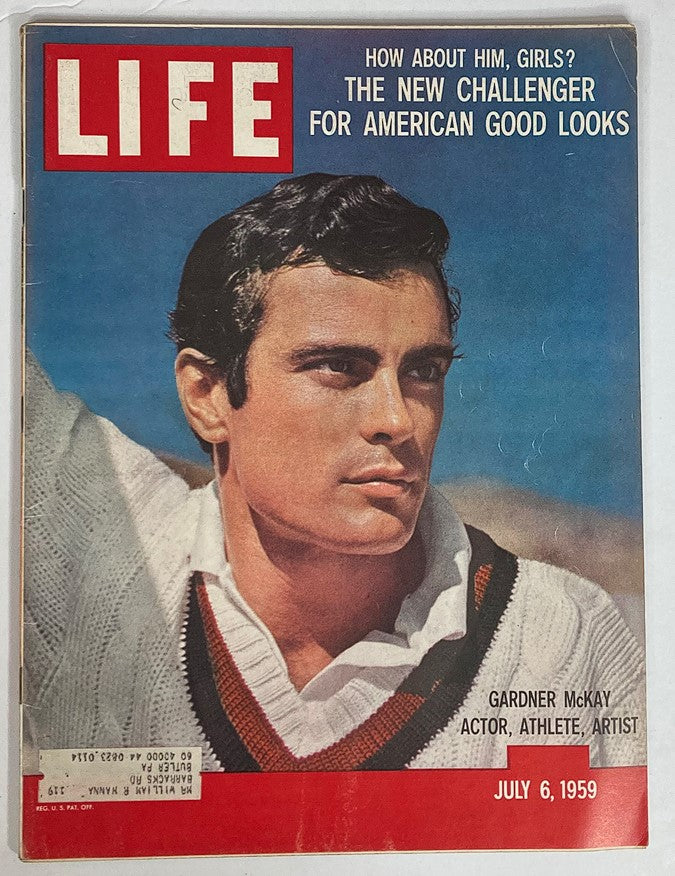
The July 6, 1959 issue of LIFE Magazine, Volume 47, Number 1, features Gardner McKay in a close photographic portrait that helped introduce him to a national audience. The cover asks, “How About Him, Girls?” and describes McKay as “The New Challenger for American Good Looks.” A smaller caption identifies him as an actor, athlete, and artist, presenting physical appearance as only one part of a carefully constructed public identity. The photograph emphasizes his height, dark features, informal clothing, and self-possessed expression rather than placing him within a conventional Hollywood costume or dramatic scene. At twenty-seven, McKay was preparing for the starring role that would bring him his greatest television recognition. LIFE’s decision to devote both its cover and a substantial photographic essay to him demonstrates how effectively a national picture magazine could create anticipation around a performer before his defining program reached viewers. The issue consequently preserves the moment when McKay was being transformed from a comparatively unfamiliar model and working actor into one of television’s newest prospective leading men.
The accompanying feature, “Gardner McKay: A New Apollo for the Ladies,” begins on page 88 and was photographed for LIFE by Allan Grant. Its title draws on the classical image of Apollo to present McKay as an idealized combination of beauty, creativity, physical ability, and masculine independence. The photographs show different aspects of the identity advertised on the cover, including acting, athletic activity, photography, sculpture, social life, and preparations for television work. McKay was also experienced with sailing, making him a particularly suitable choice for the role of schooner captain Adam Troy in the forthcoming series Adventures in Paradise. The program had not yet premiered when this issue appeared, giving the feature the character of an advance introduction rather than a retrospective celebration of an established television success. LIFE’s coverage openly acknowledged that his appearance formed a major part of his appeal while also emphasizing the varied interests that distinguished him from a conventional studio-manufactured personality. Within an archive of historical LIFE Magazine issues, this edition provides a revealing case study in the creation of mid-century celebrity through photography, promotional language, and carefully selected personal details.
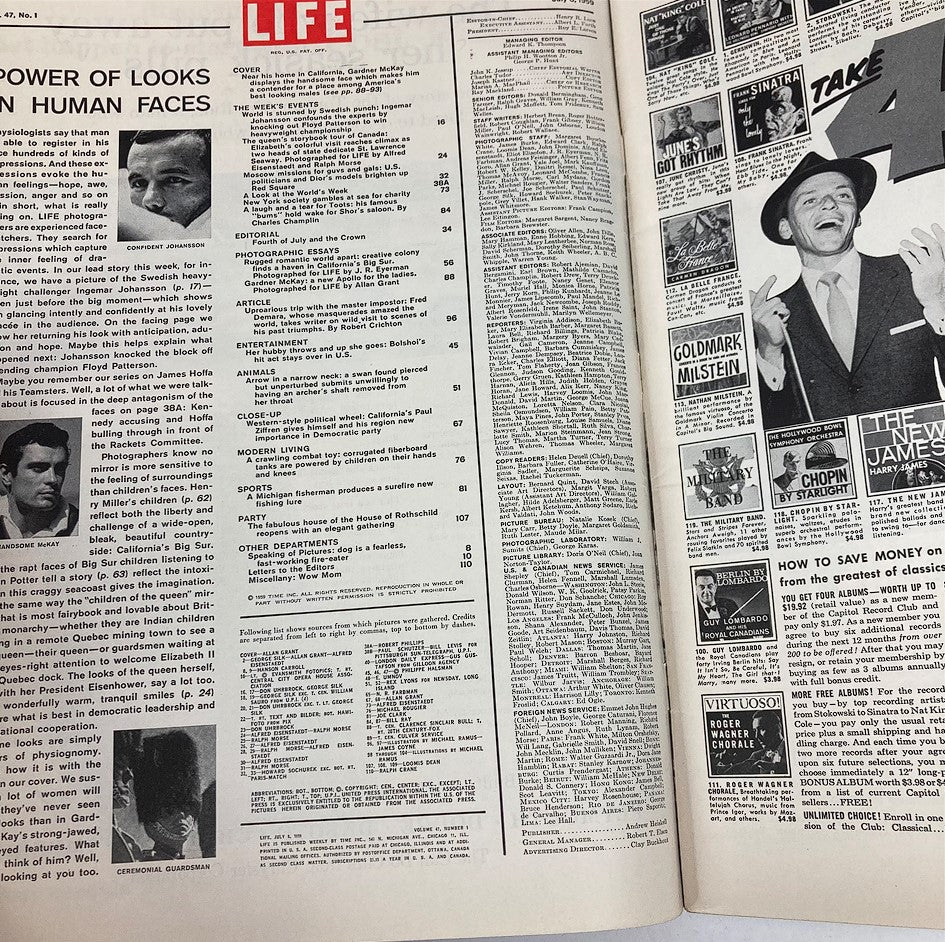
The magazine’s importance extends well beyond the Gardner McKay portfolio because its contents preserve a remarkably broad record of events and personalities from the beginning of July 1959. The week’s leading sports story examines Swedish boxer Ingemar Johansson’s unexpected victory over Floyd Patterson for the world heavyweight championship. Royal and diplomatic coverage follows Queen Elizabeth II’s Canadian tour and the dedication of the St. Lawrence Seaway by two heads of state. A photographic essay explores the artists, writers, families, and independent personalities living in California’s Big Sur region. Other features cover the Bolshoi Ballet, California political figure Paul Ziffren, master impostor Fred Demara, an innovative fishing lure, and the reopening of a Rothschild residence for an elegant gathering. The issue also includes smaller photographic stories involving a wounded swan, a children’s play tank, maritime charity gambling, and the closing of Toots Shor’s famous New York saloon. Together, these contents place emerging television celebrity beside sports history, royalty, politics, art, regional culture, invention, entertainment, and elite social life. The issue belongs naturally within the wider record of magazines published in 1959, a year when established institutions and new forms of popular fame increasingly shared the same visual culture.
About the Publication
LIFE was relaunched by Henry R. Luce as a weekly picture magazine in November 1936. Its editorial identity was based on the idea that photography could report, explain, and interpret current life with an immediacy unavailable to most text-centered publications. Large pages allowed editors to arrange extended photographic sequences, detailed captions, maps, illustrations, and narrative layouts. The magazine reported on politics, wars, diplomacy, science, business, religion, sports, entertainment, fashion, art, travel, and ordinary family experience. LIFE photographers worked throughout the United States and internationally, creating images that often became the most familiar visual records of important events. The publication also used directed photography for celebrity profiles, fashion portfolios, modern-living features, and carefully staged cover portraits. Its covers could introduce previously unfamiliar personalities to millions of readers while establishing the particular qualities through which those figures were meant to be understood. By 1959, LIFE had become one of the most influential American magazines and a major force in the development of modern photojournalism. Advertising occupied a substantial portion of each issue and documented contemporary automobiles, clothing, food, travel, appliances, financial services, and household products. The weekly format allowed serious public events to appear beside visual humor, entertainment, consumer culture, and human-interest reporting. Surviving issues now provide primary-source evidence of twentieth-century journalism, photography, graphic design, advertising, political attitudes, and the creation of celebrity.
Key Highlights Inside
- “Gardner McKay: A New Apollo for the Ladies” is the photographic essay most directly connected with the cover. Allan Grant’s images present McKay as an actor, athlete, sailor, photographer, sculptor, and socially desirable bachelor rather than defining him through one professional role. The feature documents the deliberate construction of a versatile new television personality shortly before Adventures in Paradise premiered.
- The McKay portfolio includes material connected with his preparations to portray schooner captain Adam Troy. Photographs show him around the production environment and considering the clothing appropriate for a character who had adopted an unconventional seafaring life. These images provide an advance look at a television role that would soon become central to his public reputation.
- “World Is Stunned by Swedish Punch” reports on Ingemar Johansson’s defeat of Floyd Patterson to win the heavyweight championship. The result surprised observers who had expected the American champion to retain his title. LIFE’s photographic treatment preserves the force, spectacle, and international significance of one of the year’s major sporting upsets.
- “The Queen’s Storybook Tour of Canada” follows Queen Elizabeth II during a prominent royal journey photographed by Alfred Eisenstaedt and Ralph Morse. The report reaches its ceremonial climax with the dedication of the St. Lawrence Seaway alongside President Dwight D. Eisenhower. Its images connect royal pageantry with diplomacy, engineering, and the relationship between Canada and the United States.
- “Rugged Romantic World Apart” examines the creative community established in California’s Big Sur region. J. R. Eyerman’s photographs portray artists, writers, families, and independent residents living amid the area’s dramatic coastal landscape. The essay records how remoteness, natural beauty, and unconventional lifestyles contributed to Big Sur’s growing cultural mythology.
- “Uproarious Trip with the Master Impostor” follows writer Robert Crichton on a journey with Fred Demara. Demara had become famous for assuming professional identities and performing roles for which he lacked conventional credentials. The feature revisits settings associated with his earlier impersonations while examining the personality behind his extraordinary deceptions.
- “Western-Style Political Wheel” profiles California Democratic figure Paul Ziffren. The article considers how he increased both his personal influence and the political importance of his region within the national party. Its presence reflects the growing attention being directed toward California as a center of population, wealth, and political power.
- The issue’s entertainment coverage includes a feature on a popular act associated with the touring Bolshoi Ballet. Other visual reports examine New York society gambling at sea for charity and the emotional closing of Toots Shor’s celebrated saloon. Together, these features preserve contrasting forms of performance, nightlife, social ritual, and metropolitan entertainment in 1959.
- Modern living, animals, sports, and society appear through features on a child-powered cardboard tank, a wounded swan, an innovative fishing lure, and a Rothschild gathering. Each report turns an unusual object, event, or social occasion into a compact visual narrative. Their variety demonstrates LIFE’s ability to place invention, recreation, animal rescue, and formal elegance within the same weekly publication.
Condition & Rarity
The supplied description characterizes this July 6, 1959 issue as being in Excellent overall condition. Light wear is reported and is described as consistent with the magazine’s age. The term “Excellent” should be understood as the descriptive assessment supplied with the listing rather than as a standardized or professionally certified numerical grade. The magazine shown in the listing is identified as the exact example represented rather than a stock photograph of another copy. The accompanying images should therefore be treated as the principal evidence for evaluating the cover, spine, corners, page edges, and visible surface condition. No detailed written information has been provided concerning an address label, mailing marks, creases, tears, rubbing, discoloration, or binding stress. There is likewise no confirmed statement regarding missing pages, clipped photographs, handwriting, stains, tape repairs, detached sections, or restoration. Those characteristics should remain unverified unless they can be established through the photographs or direct examination of the magazine. A plastic protective covering is reported to accompany the issue and may help limit exposure to dust and unnecessary handling. That covering is a later preservation accessory rather than an original component of the July 1959 publication. Preservation of the Gardner McKay portrait is particularly relevant because the photograph and cover wording establish the edition’s strongest visual and cultural identity. LIFE was printed in substantial numbers, so interest in an individual example should be based on its cover subject, completeness, documented contents, and actual physical condition rather than on an unsupported claim of exceptional rarity.
Looking for More Issues Like This?
Additional photographic records of twentieth-century culture can be explored through the LIFE Magazine archive. Comparing nearby issues can show how the publication moved among political events, sports, royalty, television, fashion, science, and regional American life. Other celebrity covers reveal the methods through which LIFE introduced new performers or reshaped the public image of established stars. Gardner McKay’s appearance is particularly useful for studying how photography could create intense anticipation before a television series had even premiered. Issues published during the run of Adventures in Paradise may be compared with this early feature to observe how his image changed after he became nationally recognized as Adam Troy. The photographic essays also provide opportunities to study the work of Allan Grant, Alfred Eisenstaedt, Ralph Morse, J. R. Eyerman, and other contributors associated with LIFE’s visual tradition. Sports historians can place the Johansson victory within the magazine’s wider coverage of championship boxing and American reactions to international competitors. Cultural researchers may compare the Big Sur feature with later reports on artists, alternative communities, and California’s expanding influence. The broader 1959 magazine archive supplies complementary perspectives from news, entertainment, television, fashion, business, and general-interest publications. Studying those titles together shows how emerging television stars existed beside Cold War diplomacy, royal ceremony, athletic competition, consumer aspiration, and changing regional identities. The July 6 LIFE issue contributes a particularly rich document by presenting Gardner McKay’s manufactured arrival as a new romantic ideal within a week otherwise filled with consequential news and varied photographic storytelling.