
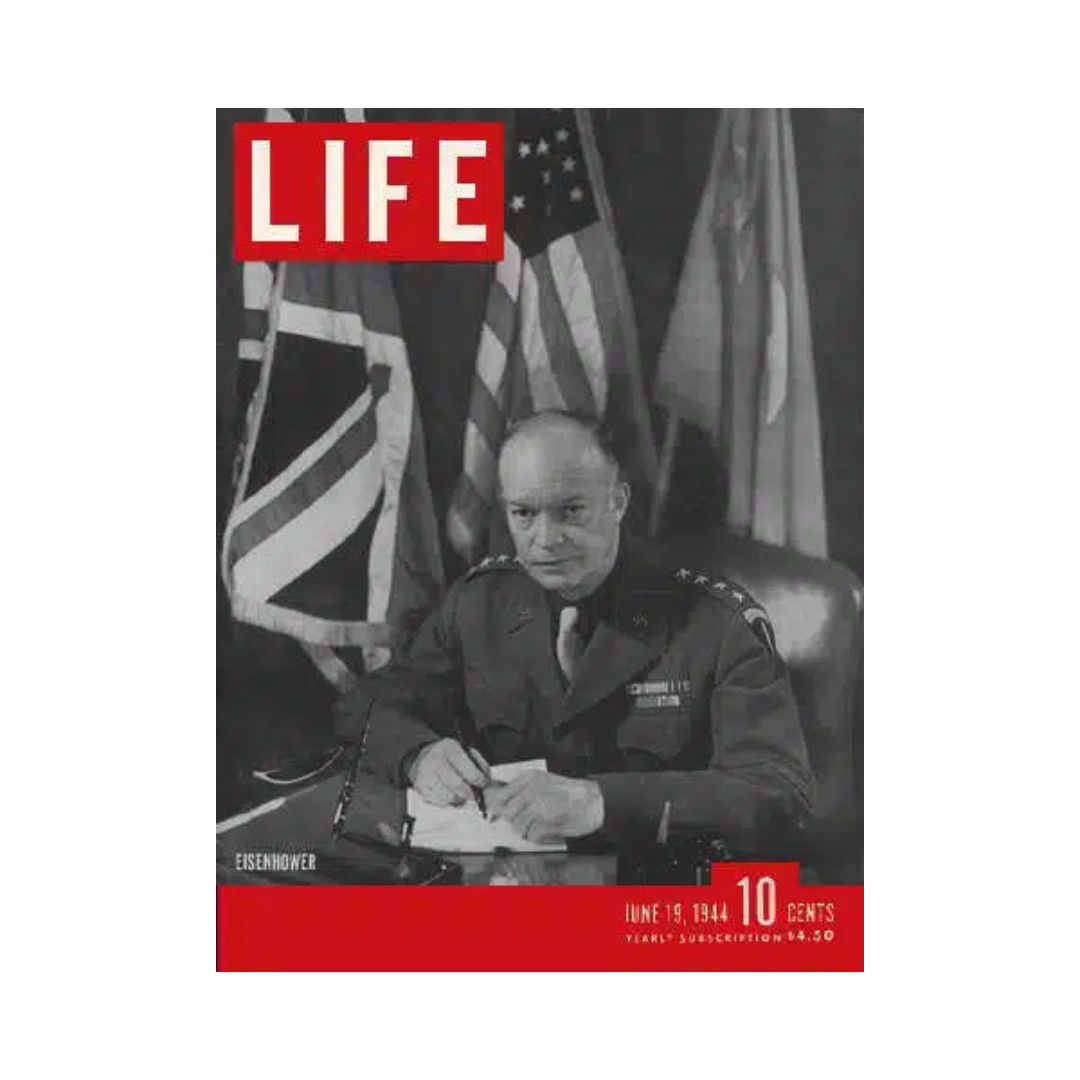

Description
Collector's Note – Why This Issue Matters
Life Magazine's June 19, 1944 issue is one of the most historically significant weekly publications ever printed in the United States. It appeared on newsstands thirteen days after D-Day — June 6, 1944 — making it among the first major illustrated publications to bring the full visual weight of the Normandy landings to the American public. The "Landings in Normandy" coverage, Charles Christian Wertenbaker's firsthand account "The Big Days," and Mary Welsh's "Invasion Surgeon" represent Life at the precise intersection of journalism and history — real-time documentation of an event that would define the century. Wertenbaker was one of Time Inc.'s most experienced war correspondents, and Welsh — later Mary Hemingway — was covering the European theater for Time and Life with a combination of access and literary intelligence that produced some of the most vivid first-person war writing of the period. Collectors who pursue the complete wartime run of vintage Life Magazine issues identify the June 19, 1944 issue as one of the handful of truly irreplaceable entries in the entire 1936–1972 archive.
Dwight Eisenhower's presence in this issue — covered in "The Eisenhowers" feature — places the Supreme Allied Commander at the center of the story exactly as he should be. Eisenhower had planned and commanded Operation Overlord, and in the days following June 6 he was simultaneously managing the consolidation of the beachhead, the breakout into Normandy, and the enormous logistical demands of the largest amphibious operation in history. A Life feature on Eisenhower published in the week after D-Day is a primary document of how the American press was presenting its military leadership at this defining moment. Collectors focused on Dwight D. Eisenhower magazine coverage will find this issue the most historically weighted of his wartime appearances — predating his return as a presidential candidate by nearly a decade and capturing him entirely as the soldier history needed him to be. The simultaneous coverage of Rome's fall — the city had been liberated on June 4, two days before D-Day — gives the issue a quality of compressed historical density that is remarkable even by Life's wartime standards. For collectors building out a 1944 magazine archive, no single issue from that year carries more concentrated historical weight than this one.
About the Publication
Life Magazine was launched on November 23, 1936 by Henry Luce under Time Inc. as a large-format weekly photojournalism magazine built around photography as primary narrative. By the Second World War it had become one of the most widely read publications in American history, with a readership estimated at over 20 million per issue. Its roster of wartime staff photographers and correspondents — Margaret Bourke-White, Robert Capa, W. Eugene Smith, and others — produced some of the most important photojournalism and war writing of the twentieth century, published in real time to a domestic audience hungry for visual evidence of what the war actually looked like. The weekly run from 1936 to 1972 constitutes the magazine's core collectible archive, with the wartime years of 1941 to 1945 representing its most historically significant and most consistently sought-after period.
Key Highlights Inside
- "Landings in Normandy" — D-Day coverage published thirteen days after June 6, 1944, representing one of the first major illustrated treatments of the invasion to reach the American mass audience.
- "The Big Days" by Charles Christian Wertenbaker — a firsthand account of the Normandy landings by one of Time Inc.'s most experienced European war correspondents, present during the invasion.
- "The Eisenhowers" — a feature on Supreme Allied Commander Dwight Eisenhower, published in the immediate aftermath of the operation he planned and commanded, capturing him at the defining moment of his military career.
- "Invasion Surgeon" by Mary Welsh — a firsthand account of field surgery during the Normandy operation by the Life correspondent who would later become Mary Hemingway, representing the magazine's investment in literary as well as visual war documentation.
- Photographic essay on the Taking of Rome — coverage of the June 4 liberation of Rome, published alongside the D-Day material to reflect the dual Allied advances that had occurred within days of each other.
- Notes from Peter Hurd's Sketchbook — Hurd was a prominent American realist painter who served as a war artist; his sketchbook notes add an artistic dimension to the issue's documentary scope.
Condition & Rarity
Condition for this issue is represented by a stock photo rather than a specific copy photograph, which is standard practice for dealers holding multiple copies of a widely sought issue. Life's coated stock holds up better over eight decades than newsprint-based publications, but edge tanning, spine wear, and page brittleness are common findings in copies that have not been stored in controlled conditions. Fine and near-fine copies of this specific issue — bright cover, tight spine, clean interior pages — are meaningfully less common than the issue's large original print run might suggest, precisely because its historical significance has driven active collector demand for generations. The June 19, 1944 issue draws interest simultaneously from WWII military history collectors, Eisenhower collectors, D-Day researchers, and Life archive completionists, making it one of the most multi-directionally sought issues in the magazine's entire run.
Looking for More Issues Like This?
The June 19, 1944 Life is the D-Day issue — the one that brought the visual record of Normandy to the American home front in real time — and it occupies a category of its own within the wartime archive. Collectors focused specifically on Eisenhower's extraordinary career will find his full range of magazine appearances gathered in the Dwight D. Eisenhower magazine collection at OriginalMagazines.com, spanning his wartime command through his presidency. The broader Life Magazine archive covers the full wartime run and beyond, and the 1944 magazine collection documents the full year of the war's decisive turning point across Life and many other titles.