
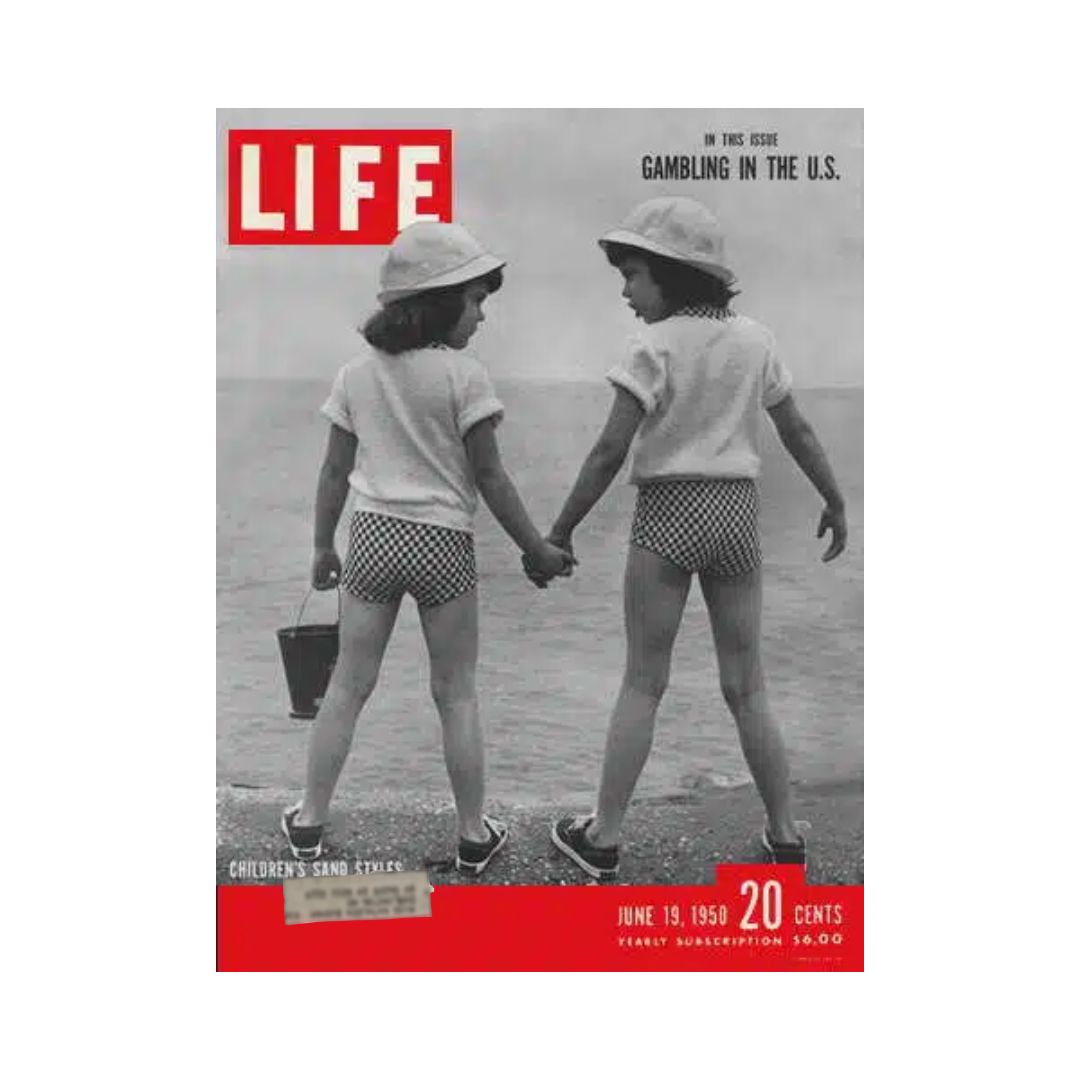

Description
Collector's Note – Why This Issue Matters
The June 19, 1950 issue of Life Magazine, identified as Volume 28, Number 25, features the photographic cover “Children’s Sand Styles.” Life photographer Nina Leen created the image as part of the magazine’s attention to warm-weather clothing and beach culture. The cover presents children’s fashion through a playful seaside setting rather than through a formal studio portrait. Clothing intended for sand, sun, and active outdoor recreation becomes the visual subject of the entire composition. The image reflects the increasing postwar visibility of children as a distinct audience for clothing, recreation, advertising, and consumer products. It also preserves a period when large illustrated magazines helped introduce seasonal styles to families across the United States. The cover is therefore relevant to the histories of childhood, fashion photography, beach recreation, and mid-century magazine design.
The phrase “Children’s Sand Styles” is more precise than the listing’s broader description of children’s beach fashion. It identifies the subject as clothing designed or selected for play near the shore rather than as a complete survey of all children’s swimwear in 1950. Leen’s photograph treats the children as active participants in the beach environment instead of miniature adult fashion models. Their clothing can be considered alongside contemporary ideas about comfort, modesty, mobility, and age-appropriate design. The image also demonstrates Life’s ability to turn an everyday seasonal subject into a memorable national cover. Because the official description does not identify the children, garment manufacturers, prices, or exact location, those details should remain unconfirmed. The issue is best understood as a photographic record of how children’s summer style was presented to a mass American readership.
The complete magazine reaches far beyond fashion and provides a varied record of news, culture, science, sports, travel, and public life shortly before the Korean War began. Its contents include reporting associated with gambling in the United States and contemporary international developments. A short sports item introduces Althea Gibson as a new tennis threat during the period when she was breaking racial barriers within the sport. Other pages examine Dutch princesses at work, fossil evidence connected with human prehistory, novels, travel, crime, and unusual photographic subjects. This variety illustrates how Life placed a light seasonal cover before material addressing serious political, scientific, and social questions. The issue therefore serves both as an appealing example of mid-century fashion photography and as a broader weekly document of American interests in June 1950. Related visual reporting can be explored through other vintage issues of Life Magazine and through additional magazines published in 1950.
About the Publication
Life Magazine was relaunched by Time Inc. in November 1936 as a weekly general-interest publication centered on photojournalism. Publisher Henry Luce promoted a format in which photographs carried much of the narrative rather than merely illustrating lengthy written articles. Its oversized pages allowed portraits, news photographs, and carefully arranged picture sequences to appear with considerable visual impact. Captions, headlines, maps, and concise passages of text supplied context while leaving images at the center of the reading experience. The magazine covered politics, war, diplomacy, science, industry, labor, fashion, entertainment, sports, art, travel, and domestic life. Fashion photography formed an important part of this editorial range, with adults and children appearing in seasonal clothing, accessories, and recreational settings. Life also introduced readers to distant places, scientific discoveries, public personalities, and cultural events they might never witness personally. Its advertisements now provide additional evidence of contemporary products, prices, design, language, and assumptions about family life. By June 1950, the publication had become one of the most influential visual records of postwar American culture. Its weekly format allowed playful lifestyle subjects to appear alongside political conflict, racial change, scientific research, and international news. Surviving issues now function as primary sources for studying both the events photographed and the editorial choices through which those events reached a mass audience.
Key Highlights Inside
- The verified Nina Leen cover is identified as “Children’s Sand Styles.” It presents children’s warm-weather clothing through a beach setting that emphasizes play, movement, and seasonal recreation. Specific garment makers, model identities, prices, and styling instructions should not be assigned without consulting the complete fashion feature.
- The issue is associated with an examination of gambling in the United States. Its presence connects the light beach-fashion cover with a more serious investigation of a widespread American social and commercial activity. The original pages should be consulted for the locations, businesses, individuals, statistics, and editorial conclusions included in the report.
- A short sports feature titled “New Tennis Threat” concerns Althea Gibson. Gibson was emerging as an important competitor while confronting the racial restrictions that had long limited access to leading American tennis events. The item preserves contemporary coverage from before her later Grand Slam victories made her an internationally recognized champion.
- “Princesses at Work” concerns members of the Dutch royal family. The feature demonstrates Life’s continuing interest in European royalty, public duty, and the everyday activities of prominent families. The exact princesses, duties, locations, and photographs represented should be established from the original article.
- The issue includes “Heads of Apes and Bodies of Men” and a related portrait of anatomist Raymond Dart. These pages concern fossils and scientific interpretations of prehistoric human development. Their terminology reflects research and popular-science communication in 1950 and should be read within the historical context of later developments in paleoanthropology.
Condition & Rarity
The listing states that its displayed image is a stock photograph and may not show the exact physical magazine represented by the description. The individual issue should therefore be evaluated from its own condition notes and photographs rather than from the example cover image alone. No precise collector grade is provided in the supplied description. The presence or absence of an address label is also not confirmed. No information is given regarding a plastic sleeve, backing board, page completeness, writing, clipping, or cover attachment. These characteristics should not be inferred from another example of the same publication date. Life’s large format made its covers, corners, edges, and stapled binding particularly vulnerable to bending and wear. A physical inspection should check for short tears, edge rubbing, creasing, loose pages, detached covers, stains, waviness, moisture exposure, fading, and brittle paper. Particular attention should be paid to the children’s fashion pages because illustrations and advertisements were sometimes removed from vintage magazines. The full 128-page sequence should be verified whenever completeness is important. Historical interest in the Nina Leen cover does not independently determine the issue’s rarity, preservation grade, or collector significance.
Looking for More Issues Like This?
Exact-date Life issues can require patience to identify when research is centered on a particular photographer, fashion subject, and publication week. The June 19, 1950 edition is especially relevant to readers studying Nina Leen, children’s clothing, beach culture, and postwar family life. Comparable fashion photography can be explored through the broader collection of vintage Life Magazines. Other issues document swimwear, summer recreation, children’s activities, models, actresses, designers, and changing ideas about leisure. Comparing neighboring editions also reveals how Life placed fashion and entertainment beside politics, sports, science, crime, and international affairs. The collection of original magazines from 1950 provides a wider view of the cultural year represented by this edition. Publications from that year preserve contemporary Cold War concerns, racial change, cinema, radio, advertising, consumer products, sports, and domestic life. Examining several titles together helps place Life’s photographic format beside the approaches used by fashion, literary, news, and entertainment magazines. Closely dated issues remain historically useful even when this precise June edition is not represented because they establish the surrounding visual and cultural chronology. Together, the Life and 1950 collections provide a useful foundation for continued research into American fashion photography and magazine culture at mid-century.