

Description
Collector's Note – Why This Issue Matters
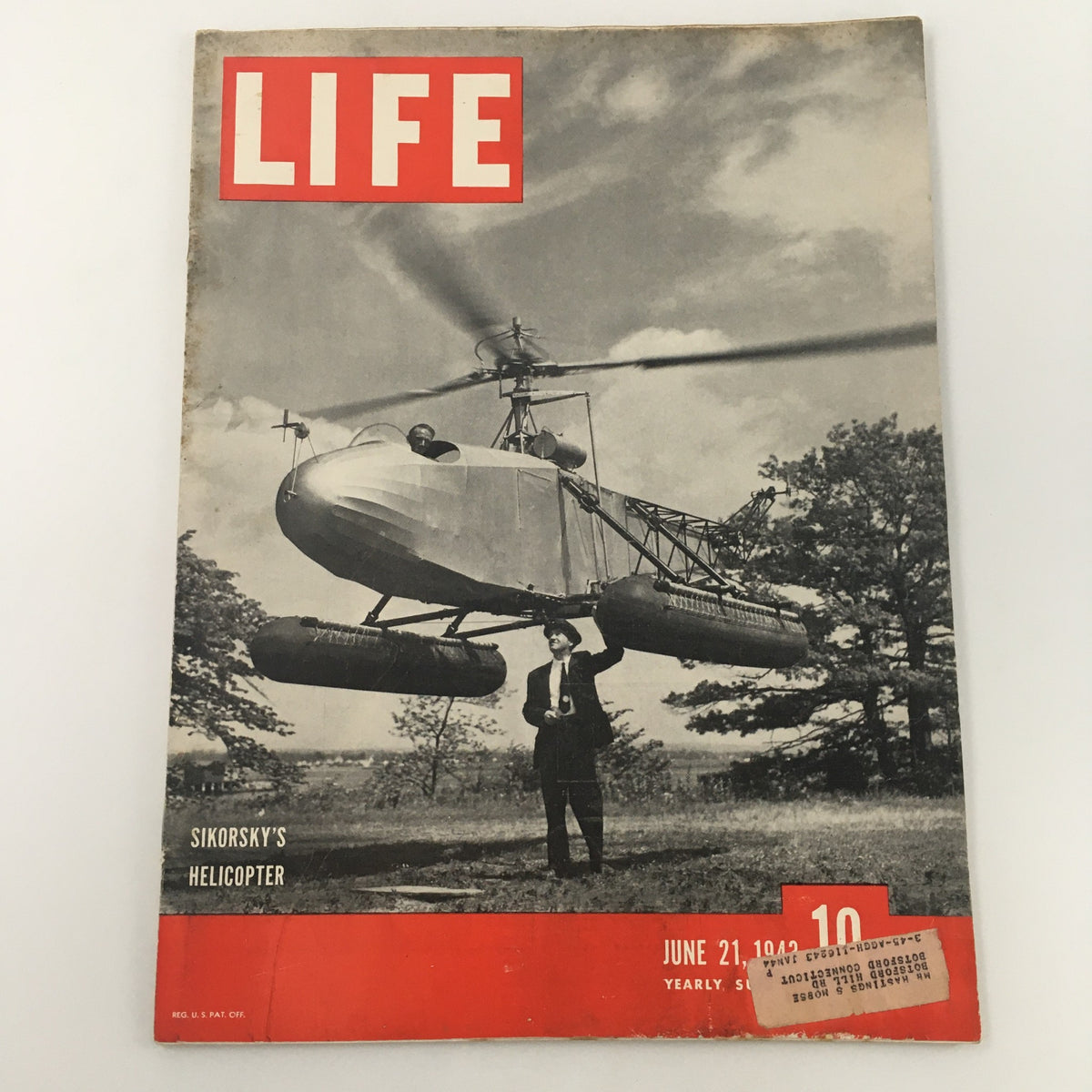
The June 21, 1943 issue of Life Magazine features aviation pioneer Igor Sikorsky and the experimental VS-300 helicopter on its photographic cover. Sikorsky stands on the ground beside the aircraft while test and demonstration pilot Charles “Les” Morris occupies the open control position. Life photographer Frank Scherschel created the image, which presents the helicopter as a functioning machine rather than a speculative drawing of future flight. The exposed framework, rotor system, and compact pilot position reveal how experimental rotary-wing aviation still appeared during the early 1940s. Unlike conventional airplanes, the helicopter promised the ability to rise vertically, hover, move in several directions, and operate without an ordinary runway. Those capabilities were sufficiently unfamiliar that the aircraft itself could serve as a compelling cover subject without elaborate decoration. The issue consequently preserves an important moment when practical helicopter flight was moving from engineering experiment toward broader military and public recognition.
The accompanying article, written by Joseph Kastner and titled “Sikorsky’s Helicopter,” begins on page 80. Its extended title described the aircraft as a flying machine that might someday become an airplane for ordinary people, reflecting the optimistic possibilities attached to vertical flight. By June 1943, Sikorsky and his engineering team had spent several years repeatedly rebuilding and refining the VS-300. The aircraft had helped establish the single-main-rotor and vertical-tail-rotor arrangement that became fundamental to many later helicopters. It had also completed record-setting endurance flights and demonstrations on both land and water before appearing on Life’s cover. Development of the related XR-4 had already led toward the R-4, which entered production for American military use during the Second World War. The magazine therefore appeared at a point when the helicopter’s future applications were becoming more credible even though its full importance in rescue, transportation, observation, and medical evacuation remained ahead.
The wartime publication date gives the issue significance beyond the history of Sikorsky Aircraft alone. In June 1943, the United States and its allies were engaged in campaigns across Europe, North Africa, the Atlantic, and the Pacific, making aviation development a matter of immediate strategic importance. The issue’s interior reporting reflects that environment through coverage of Allied bombing, combat on Attu, military families, emergency communications, and wartime social tensions at home. Placing an experimental helicopter on the cover connected technological invention with a conflict that was rapidly changing the design and purpose of aircraft. At the same time, Life’s presentation encouraged readers to imagine uses extending beyond war, including transportation and civilian mobility. For aviation historians, the issue documents how the helicopter was introduced to a mass American audience before rotary-wing aircraft became familiar sights. Related photojournalism and wartime reporting can be studied through other vintage issues of Life Magazine and through additional magazines published in 1943.
About the Publication
Life Magazine was relaunched by Time Inc. in November 1936 as a weekly general-interest publication built around photojournalism. Publisher Henry Luce promoted an editorial model in which photographs carried much of the narrative rather than functioning only as illustrations for written articles. The magazine’s oversized pages allowed individual images and photographic sequences to appear with considerable visual impact. Detailed captions, short explanatory passages, maps, and headlines guided readers through the events shown in the photographs. Life covered politics, war, science, technology, industry, labor, entertainment, art, sports, fashion, society, and ordinary domestic experience. Its broad audience included readers who might never personally encounter the people, places, machines, or military fronts represented in its pages. During the Second World War, the magazine became an especially influential visual source for Americans following events overseas and changes occurring at home. Photographers documented combat, military training, industrial production, civilian mobilization, and the personal consequences of war. The publication also devoted attention to scientific and mechanical developments whose future importance was not yet fully understood. The June 21, 1943 issue demonstrates this editorial range by combining the Sikorsky helicopter with military news, labor conflict, natural history, art, radio technology, and wartime family life. Surviving issues now serve as primary visual records of both twentieth-century events and the editorial perspective through which those events reached contemporary readers.
Key Highlights Inside
- The verified close-up feature “Sikorsky’s Helicopter” was written by Joseph Kastner and begins on page 80. It examines the experimental aircraft represented by Igor Sikorsky and Les Morris on the cover. Specific technical explanations, predictions, and quotations should be taken from the original article rather than reconstructed from its title alone.
- The cover photograph presents Igor Sikorsky beside the VS-300 while Charles “Les” Morris occupies the controls. Frank Scherschel is credited as the photographer responsible for the image. The exposed structure provides a particularly clear period view of helicopter development before enclosed cabins and familiar production designs became standard.
- The issue includes “Company X on Attu,” a report by Life correspondent Robert Sherrod. The feature belongs to the magazine’s coverage of the American campaign to recover Attu Island from Japanese forces in the Aleutians. Its presence places the helicopter article within an edition deeply shaped by active World War II reporting.
- Domestic wartime coverage includes reporting on the Zoot Suit Riots and an article by Dr. Stephen S. Wise replying to King Ibn Saud. These subjects reflect social, racial, religious, and diplomatic tensions existing alongside military developments. The complete reports should be examined before assigning detailed arguments or conclusions beyond their verified titles and subjects.
- Additional confirmed material includes “Show Business at War,” Navy wives awaiting their husbands at Key West, the shortleaf pine, and a life-raft radio designed to help rescuers locate survivors. The range extends from entertainment and military family life to natural resources and emergency communication technology. This breadth demonstrates Life’s effort to document both the battlefield and the civilian systems supporting the wartime nation.
Condition & Rarity
The June 21, 1943 issue is described as being in good used condition with very minor wear along its edges. A good collector-grade assessment generally indicates that the magazine remains readable and visually presentable while showing evidence of previous handling and long-term storage. Minor marks or small rips may be present according to the supplied condition notes. Each imperfection should be evaluated according to its size, location, and effect on the Sikorsky cover photograph, printed text, binding, or page attachment. Early Life issues were produced in a large format that made exposed corners and edges particularly vulnerable to bending, rubbing, and short tears. An address label appears on the front cover, indicating that the magazine was distributed to a subscriber. Such labels are common on surviving period magazines and should be assessed according to their placement, staining, adhesive condition, and effect on the paper beneath them. The label forms part of the issue’s circulation history but interrupts a portion of the original photographic presentation. A plastic protective covering accompanies the magazine and may help reduce additional dust, fingerprints, abrasion, and direct handling. The protective sleeve does not independently verify page completeness, staple security, spine integrity, or the absence of concealed moisture damage. Collectors examining another surviving example should inspect for loose pages, clipping, writing, stains, waviness, brittleness, detached covers, repairs, and the complete presence of the Sikorsky article before assigning a final grade.
Looking for More Issues Like This?
Exact wartime Life issues devoted to experimental aircraft can take patience to locate, particularly when research is centered on a precise date and aviation milestone. Readers interested in related photographic reporting can explore the broader collection of vintage Life Magazines. Other issues document aircraft designers, military pilots, factories, air campaigns, technological experiments, and the changing experience of civilian life during World War II. Comparing consecutive editions can reveal how quickly the magazine moved among battlefield developments, scientific innovation, domestic mobilization, and cultural reporting. The collection of original magazines from 1943 provides a wider view of the year in which the Sikorsky cover appeared. Publications from that year preserve contemporary aviation, politics, industry, entertainment, fashion, advertising, military service, and public opinion. Examining several titles together helps place Life’s optimistic presentation of the helicopter within the larger technological demands of wartime America. Related issues may also document the development of aircraft whose later importance was not yet apparent to contemporary readers. Although the precise June 21 edition may not always be represented among available material, nearby wartime issues can provide substantial historical and visual context. Together, the Life and 1943 collections offer a useful foundation for continued research into Igor Sikorsky, early helicopter development, and American wartime photojournalism.