


Description
Collector's Note – Why This Issue Matters
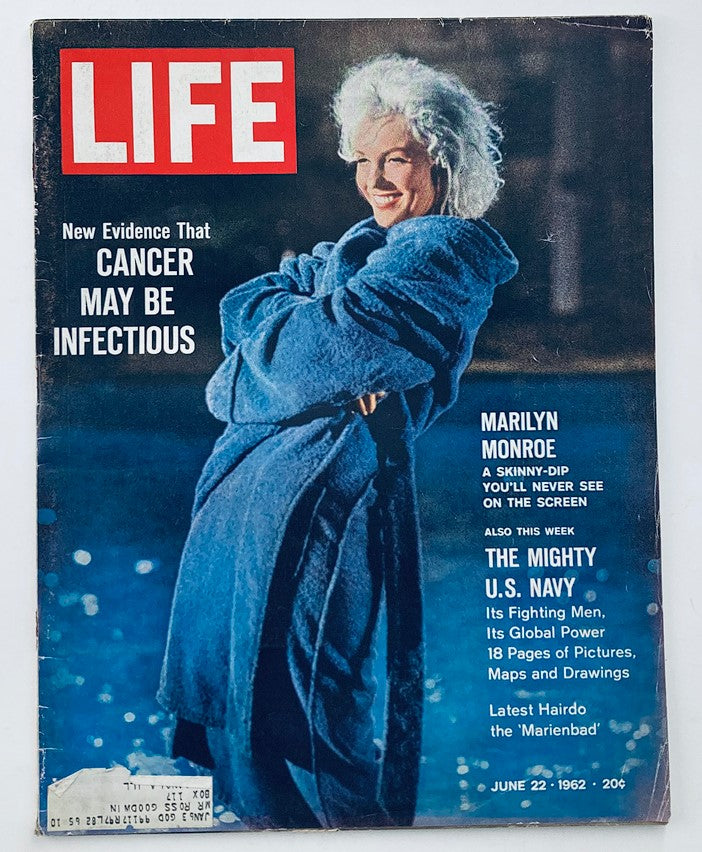
The June 22, 1962 issue of Life Magazine — Volume 52, Number 25 — is one of the most historically charged Marilyn Monroe magazine appearances in existence, and that is a field with extraordinary competition. By June 1962, Monroe was only weeks away from her death on August 4th of that year, and the cultural weight that fact has placed on every piece of primary documentation from her final months is immeasurable. But the significance of this issue does not depend on retrospective tragedy alone. The content referenced here — Monroe's on-screen skinny dip sequence — connects directly to Something's Got to Give, the ill-fated 20th Century Fox production that was being filmed in the spring and early summer of 1962 and that Monroe never completed. The pool scene, in which Monroe famously became the first major Hollywood actress to appear nude on film in a studio production, was photographed extensively by unit photographer Lawrence Schiller on May 23, 1962, just a month before this issue's publication date. Those photographs circulated through multiple major publications almost immediately, and Life's decision to feature them reflected both the images' extraordinary visual impact and the broader cultural fascination with Monroe that had never been more intense than in the final year of her life. For collectors building a serious archive around one of the most documented and most collected figures in twentieth-century popular culture, the Marilyn Monroe magazine collection represents the most concentrated resource for tracking her presence across the full range of publications that covered her throughout her career.
The context surrounding the Something's Got to Give production in the spring and summer of 1962 is essential to understanding why this issue carries the weight it does. Monroe had been fired by Fox in June 1962 — just days before this issue reached newsstands — ostensibly for her chronic absences from the set, which had been fueled by a combination of genuine illness, her dependence on prescription medications, and the psychological fragility that had characterized the final years of her life. The studio's decision to dismiss her, and the photographs and footage that survived from the aborted production, have taken on an almost mythological quality in Monroe scholarship and collecting: they are the last substantial body of professional work she produced, the final documented record of her as a working actress rather than as a public figure navigating the last weeks of her life. A Life Magazine feature built around those images, published in June 1962, is primary documentation of that moment in real time — before her death, before the retrospective narratives solidified, when these images were simply extraordinary photographs of the most famous woman in the world doing something that had never been done before on a Hollywood set. The full range of 1962 magazines from this period documents the year of Monroe's death from multiple angles and across multiple publications, and serious collectors of her legacy treat this body of material as essential primary source territory.
What distinguishes this specific issue from the vast field of Monroe magazine appearances is the combination of timing, content, and publication platform. Life was not a fan magazine or a gossip publication — it was the most widely read and most culturally authoritative photojournalism magazine in the United States, and its decision to run the Something's Got to Give pool photographs gave them a legitimacy and a permanence that placement in a lower-tier publication would not have conferred. A Life cover or feature in this era was a statement of cultural significance, an editorial judgment that a subject deserved to be seen and considered by the broadest possible American readership. Monroe appearing in Life in June 1962 was not a novelty — she had appeared in the magazine multiple times throughout her career — but this particular appearance, with its specific photographic content and its precise placement in the final months of her life, occupies a category of its own within that body of coverage. The Life Magazine archive spans decades of the publication's most significant photojournalism and cultural documentation, and the Monroe issues within that archive are among the most actively sought by collectors working across both the Monroe-specific and the broader mid-century American culture collecting communities.
About the Publication
Life Magazine was founded by Henry Luce in 1936 as the first American magazine built entirely around photojournalism, and over the following three decades it became arguably the most culturally influential periodical in the United States — the publication through which millions of Americans first saw the defining images of their era, from the Second World War and its aftermath through the space race, the civil rights movement, and the full sweep of postwar American cultural life. Its audience was genuinely mass market in a way that almost no other publication could claim: at its peak circulation in the late 1950s and early 1960s, Life reached tens of millions of readers weekly, cutting across class, regional, and educational lines to deliver its distinctive combination of large-format photography, reported features, cultural criticism, and the kind of visual storytelling that the magazine had essentially invented as an editorial form. By Volume 52 in 1962, Life was operating at the height of its mid-century authority, its editorial team including some of the finest photojournalists and writers working in American journalism, and its cover and feature selections carrying genuine cultural weight as statements about what mattered in American life at any given moment. A Monroe feature in this context was not simply celebrity coverage — it was Life making an editorial argument about the significance of what those photographs documented, an argument that the subsequent sixty-plus years have thoroughly validated.
Key Highlights Inside
- Marilyn Monroe's Something's Got to Give pool sequence photography — The images referenced in this issue's featured content derive from Lawrence Schiller's unit photography on the Fox lot in May 1962, documenting Monroe's now-legendary pool scene from the unfinished film. These photographs represented a genuinely historic moment in Hollywood history — the first nude appearance by a major studio actress in an American studio production — and their publication in Life just weeks after they were taken placed them immediately into the permanent record of both Monroe's career and American cinema's evolving relationship with the human body on screen.
- Primary documentation of Monroe's final professional work — Something's Got to Give was never completed, making the photographs and footage from its production the last substantial record of Monroe as a working actress. Coverage of this material in June 1962 captures it before Monroe's death transformed its meaning entirely, preserving the contemporaneous context in which these images were first understood — as remarkable photographs of a living star, not as elegiac documents of a life about to end.
- A Life Magazine editorial statement on Monroe's cultural significance — The decision to feature this material in Life rather than in a more sensationalist publication reflects the magazine's editorial judgment that Monroe occupied a position in American culture that demanded serious photojournalistic engagement. The framing, layout, and accompanying text of the feature would have reflected Life's characteristic approach to celebrity as cultural phenomenon rather than mere gossip — an approach that gives the coverage a depth and permanence that equivalent material in other publications lacks.
- Mid-century Hollywood at a pivotal transition point — The spring and summer of 1962 marked a genuine inflection point in the history of the Hollywood studio system. The collapse of the Something's Got to Give production, combined with the simultaneous crisis surrounding the enormously over-budget Cleopatra, contributed directly to Fox's near-bankruptcy and the broader restructuring of the studio system that would accelerate through the rest of the decade. Coverage from this precise moment documents Hollywood at a hinge point whose full significance was not yet visible to the people living through it.
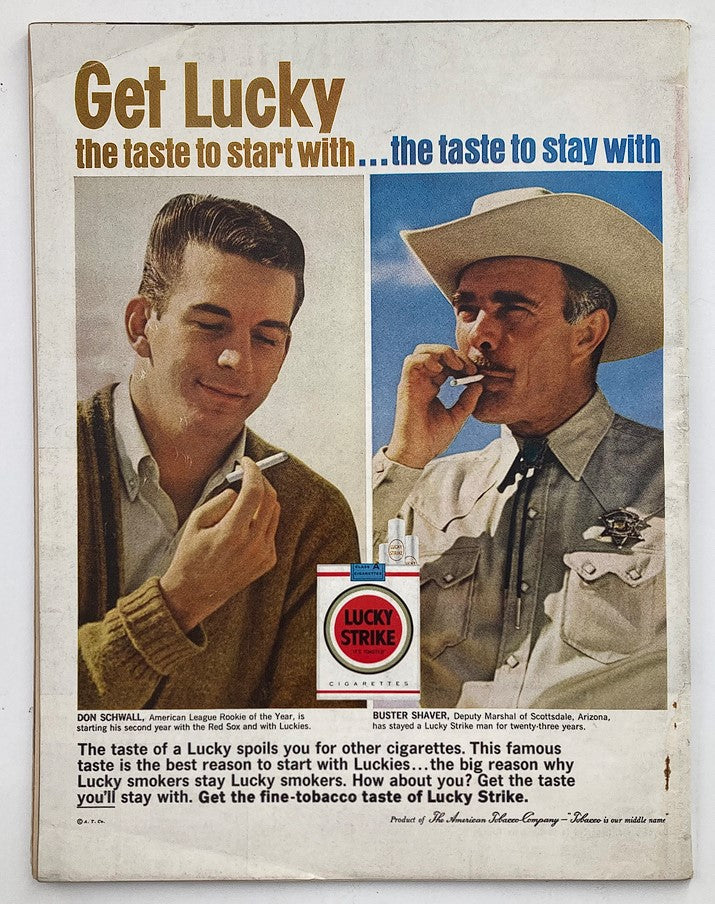
- Period advertising and visual culture from early 1960s America — Life issues from 1962 contain period advertising that is itself a document of early Kennedy-era American consumer culture — the products, the visual language, and the implied social assumptions of the ads all reflecting a specific and historically rich moment in American domestic life that is widely collected and studied independent of the editorial content surrounding it.
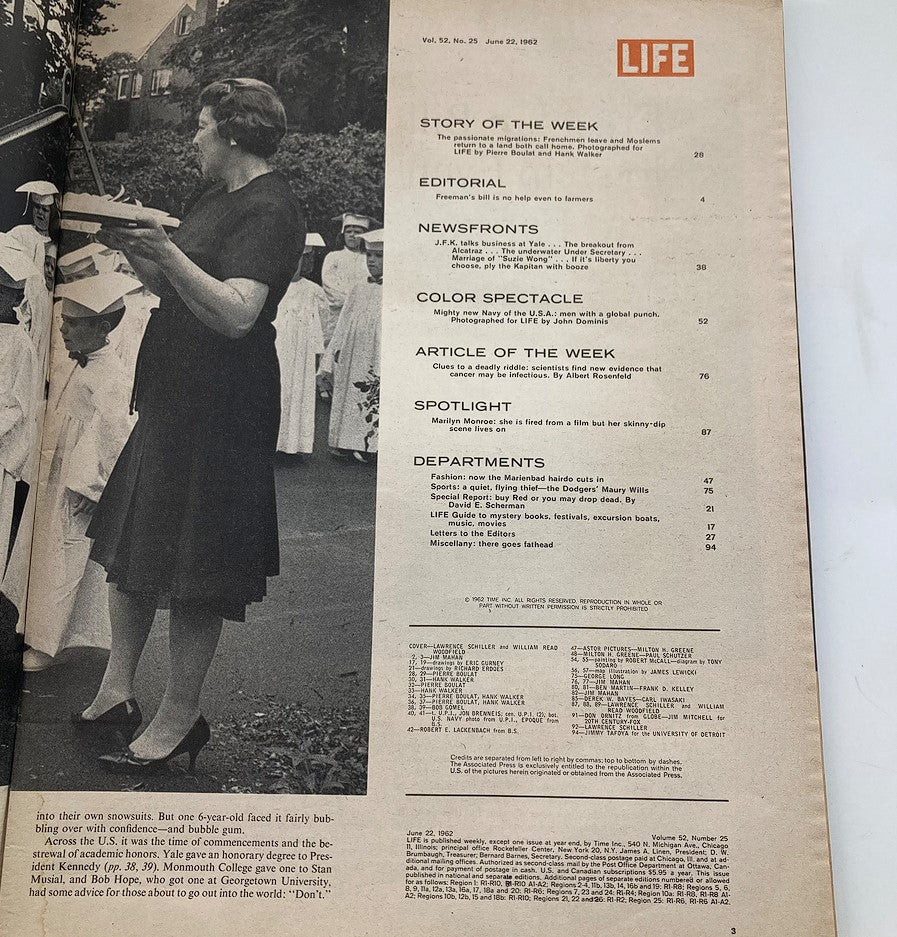
- Note: Specific additional articles, reported features, and the full table of contents beyond the confirmed Monroe-related cover content have not been independently verified for this issue. The highlights above reflect what is documentable from the listing description, the publication's editorial history, and the well-established historical record of the Something's Got to Give production and its photographic documentation.
Condition & Rarity
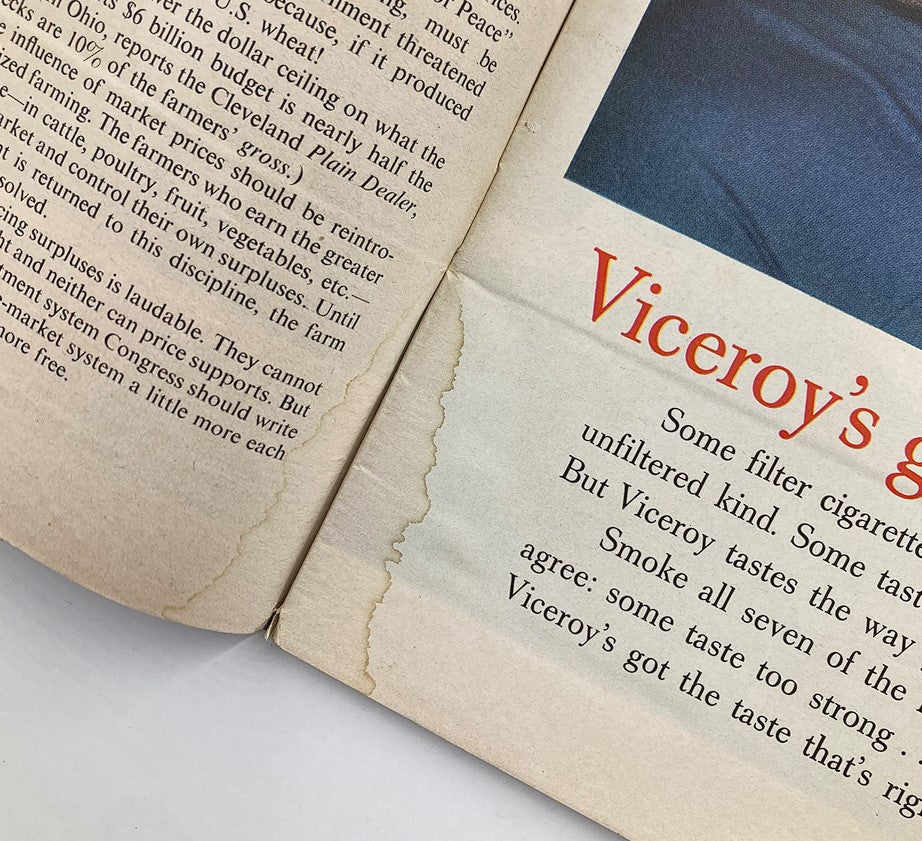
This issue is described as being in collectible condition with minor marks and creases consistent with its age, protected by a plastic covering that has helped stabilize its physical state over more than six decades. For Life Magazine issues from the early 1960s, condition assessment involves several specific considerations that distinguish genuinely well-preserved copies from the much larger pool of casually stored survivors. Life was printed on a relatively heavy, large-format coated stock that gives the magazine excellent physical durability compared to lighter-stock contemporaries, but that same stock is susceptible to specific types of deterioration — particularly corner blunting, cover scuffing from stacking, and the development of tide lines or foxing when stored in variable humidity conditions over long periods. The minor marks and creases noted here are honest condition attributes that are essentially universal in surviving copies of any Life issue from this era — a magazine that reached tens of millions of households weekly and was read, passed around, and stored with no thought given to archival preservation was never going to survive six decades in pristine condition in any significant numbers. The plastic protective covering indicates intentional preservation at some point in the object's history, which correlates with better overall stability than copies that have simply been stacked in attics or basements without protection. The condition note does not mention a mailing label, which is worth examining carefully in any surviving copy — Life was overwhelmingly a subscription publication, and label-free copies command a premium over the label-bearing majority. For a Monroe issue of this specific significance, condition considerations are weighed against historical importance by most serious collectors, and a copy in collectible condition with protective covering and honest minor wear represents a legitimate and accessible entry point into one of the most significant Monroe primary documents in the magazine collecting market.
Looking for More Issues Like This?
Marilyn Monroe issues of Life Magazine from 1962 — and this June issue in particular — occupy a genuinely rarefied position in the collecting market, pursued simultaneously by Monroe specialists, Life photojournalism collectors, and mid-century Hollywood historians, which means strong surviving copies attract serious attention whenever they surface. If this June 22, 1962 issue is no longer available, the Marilyn Monroe magazine collection is the essential starting point for finding other significant coverage of her career and legacy across the full range of publications that documented her life. The Life Magazine archive offers substantial depth for collectors building around the publication itself, spanning decades of its most important photography, cultural documentation, and cover subjects. And for anyone researching the broader sweep of American culture in the year of Monroe's death, the 1962 magazines collection brings together a remarkable range of titles that collectively document that pivotal year from every angle the period press captured.