

Description
Collector's Note – Why This Issue Matters
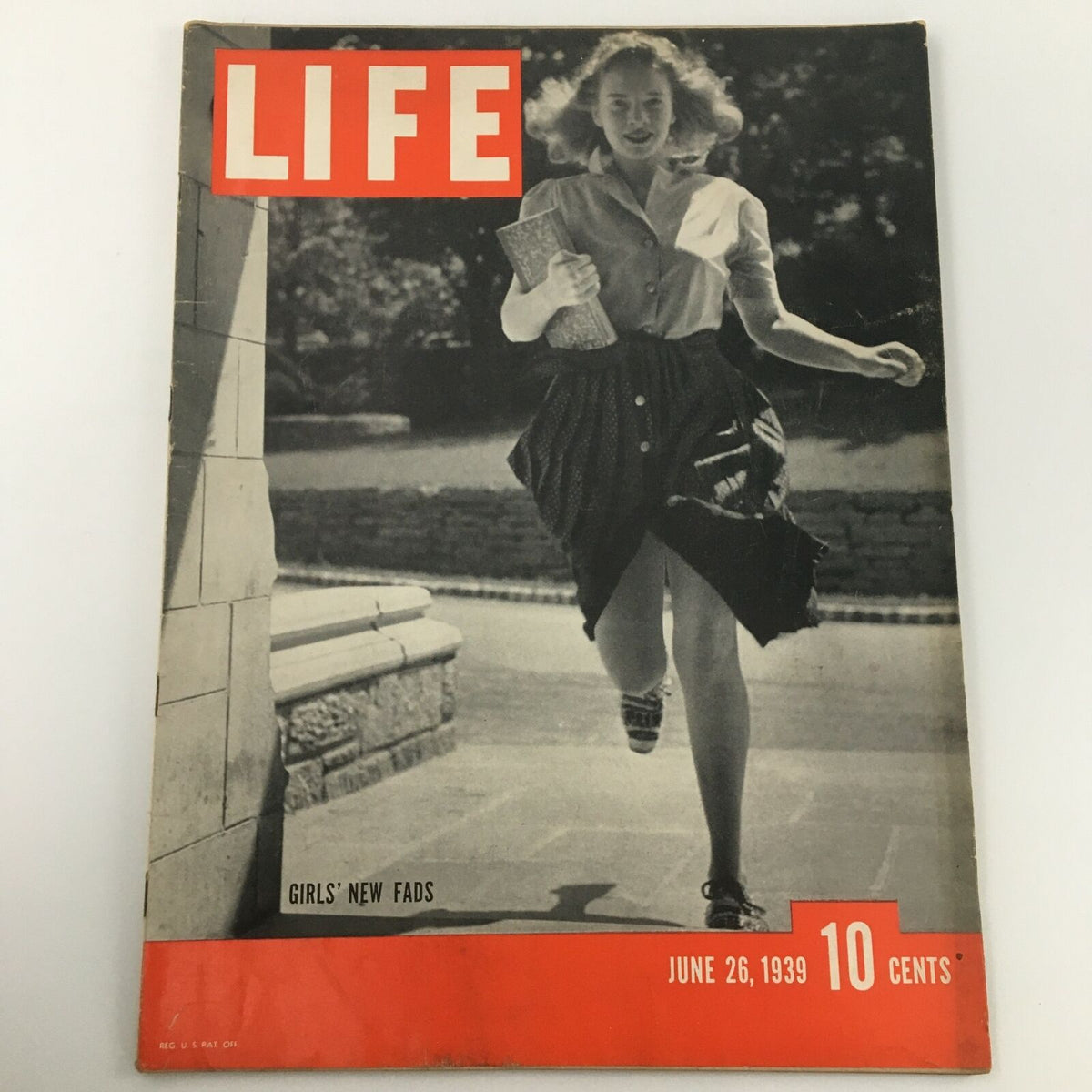
The June 26, 1939 issue of LIFE magazine, cataloged as Volume 6, Number 26, presents “Girls’ New Fads” as its principal cover theme. Walter Sanders’ photograph shows a young woman moving energetically toward the camera while carrying reading material, her skirt caught in motion and her footwear reflecting recognizable youth styles of the late 1930s. Rather than presenting fashion as a formal studio exercise, the cover frames it through movement, personality, and everyday life. That approach was characteristic of LIFE, which frequently transformed ordinary clothing, gestures, leisure activities, and social behavior into visual records of an era. The photograph does not simply document what young women wore; it also conveys the liveliness, independence, and informality that mass-market magazines increasingly associated with modern American youth.
The issue appeared during the final summer before the outbreak of the Second World War in Europe, at a moment when the United States was still emerging from the long economic pressures of the Great Depression. Against that serious background, the cover’s attention to girls’ fashions and changing fads records another side of American life: the development of youth culture, campus customs, consumer style, and informal self-expression. Clothing, shoes, hairstyles, school accessories, reading habits, and leisure activities could become visible markers of belonging among young people, even when the broader national mood remained uncertain. The subject therefore has significance beyond fashion history because it demonstrates how a major national publication interpreted the habits of younger Americans for a mass audience. It also reveals the growing editorial belief that everyday trends could be historically meaningful when documented through photography.
Among original magazines published in 1939, this edition is especially representative of LIFE during its formative years as a weekly picture magazine. The publication had been operating in its photojournalistic format for less than three years, yet its bold red masthead and full-page photographic covers were already becoming familiar features of American newsstand culture. The June 26 cover balances documentary observation with visual charm, preserving a brief and seemingly carefree moment shortly before international events would dominate American illustrated journalism. It also reflects the magazine’s ability to place light social subjects beside serious reporting without treating everyday life as historically insignificant. For collectors studying women’s history, youth culture, education, fashion, photography, or prewar American society, the issue provides a distinctly period-specific point of reference.
About the Publication
LIFE was the influential American weekly picture magazine launched by Time Inc. in November 1936 under publisher Henry Luce. Its audience was broad, encompassing readers interested in national and international news, politics, science, entertainment, sports, society, fashion, travel, industry, and the changing routines of everyday life. The magazine’s editorial identity rested on large photographs, carefully sequenced picture essays, concise captions, reported features, and visually commanding covers designed to attract attention at newsstands. Photographers received unusual prominence, and their images were expected to carry narrative weight rather than merely illustrate written articles. Editors frequently arranged photographs in sequences that allowed readers to experience an event, personality, or social trend through visual progression. During the late 1930s, LIFE helped establish photojournalism as a central part of American mass communication, allowing readers to encounter distant events, famous individuals, domestic customs, new technologies, and contemporary styles through an accessible weekly format. Early issues are particularly useful to historians because they show how modern visual journalism was developing before wartime reporting transformed the magazine’s tone and priorities.
Key Highlights Inside
- The issue is dated June 26, 1939 and is bibliographically identified as Volume 6, Number 26, providing an exact reference for collectors organizing early chronological runs of LIFE. The date also places the magazine within the publication’s third year as a weekly picture magazine.
- The magazine contains 76 pages and was published by Time Inc., reflecting the substantial format that allowed LIFE to combine news photography, social observation, advertising, entertainment, and general-interest reporting within one issue.
- The cover photograph is credited to Walter Sanders and carries the printed feature line “Girls’ New Fads.” The image emphasizes motion, youth, clothing, footwear, reading material, and informal personality rather than presenting a static or highly formal portrait.
- The visible 10-cent newsstand price reflects the magazine’s original position as a broadly distributed mass-market weekly. Its pricing and format were intended to make illustrated current-events journalism accessible to a large national readership.
- The cover theme establishes contemporary girls’ fashions and social trends as a documented subject of the issue. However, the supplied listing does not confirm the precise article title, page range, schools represented, individual participants, or specific fashions and activities discussed in the interior feature.
- The complete table of contents, article bylines, interior photographic credits, advertising sequence, and full arrangement of picture essays should not be attributed without direct examination of the complete issue or a verified archival contents record.
Condition & Rarity
The supplied description grades the magazine in good condition and identifies it as a newsstand edition with no mailing label. For a large-format weekly published in 1939, that assessment generally indicates a complete and presentable periodical that may display ordinary evidence of age, handling, reading, and storage rather than an exceptionally high-grade state. Minor rips, edge wear, creases, and surface marks are noted as possible condition characteristics and should be evaluated according to their size, depth, placement, and effect on the printed imagery. Wear affecting the outer margins may be less visually disruptive than damage crossing the young woman, the red LIFE masthead, the “Girls’ New Fads” caption, or the printed date and price. A no-label cover leaves the original photographic composition and typography unobstructed, which is useful for display and for studying the issue’s original newsstand presentation, although the absence of a mailing label does not by itself determine overall grade. Inspection should include the front and back covers, spine, corners, binding edge, staple or glued areas, center pages, and interior margins for loose leaves, missing pages, detached sections, writing, staining, moisture exposure, brittleness, discoloration, tears, or older repairs. Large early issues of LIFE were frequently read, stacked, folded, clipped for photographs, or stored flat in conditions that placed stress on their oversized covers, making completeness and binding integrity especially important evaluation points. Advertisements and photographic pages should also be checked because individual images were sometimes removed for display or reference. The reported plastic protective covering is a later preservation accessory rather than an original part of the magazine; it can help limit additional dust, rubbing, fingerprints, and edge contact but does not establish the condition beneath it. Long-term preservation is best supported by stable temperature, low humidity, protection from direct sunlight, and an archival-quality enclosure. No verified surviving-copy count, circulation breakdown, or issue-specific scarcity figure has been provided, so collector assessment should rest on the confirmed date, Walter Sanders cover, no-label presentation, physical completeness, visual appeal, and documented wear rather than unsupported rarity claims.
Looking for More Issues Like This?
Early photojournalism issues devoted to youth culture and prewar American fashion can be tough to locate with their covers, advertising, and interior picture essays complete. Readers researching similar social-history subjects can browse other vintage LIFE magazine issues for additional examples of the publication’s influential photographic reporting. The wider selection of magazines from 1939 offers further perspectives on the personalities, fashions, politics, entertainment, technology, and everyday life of the same historic year.