
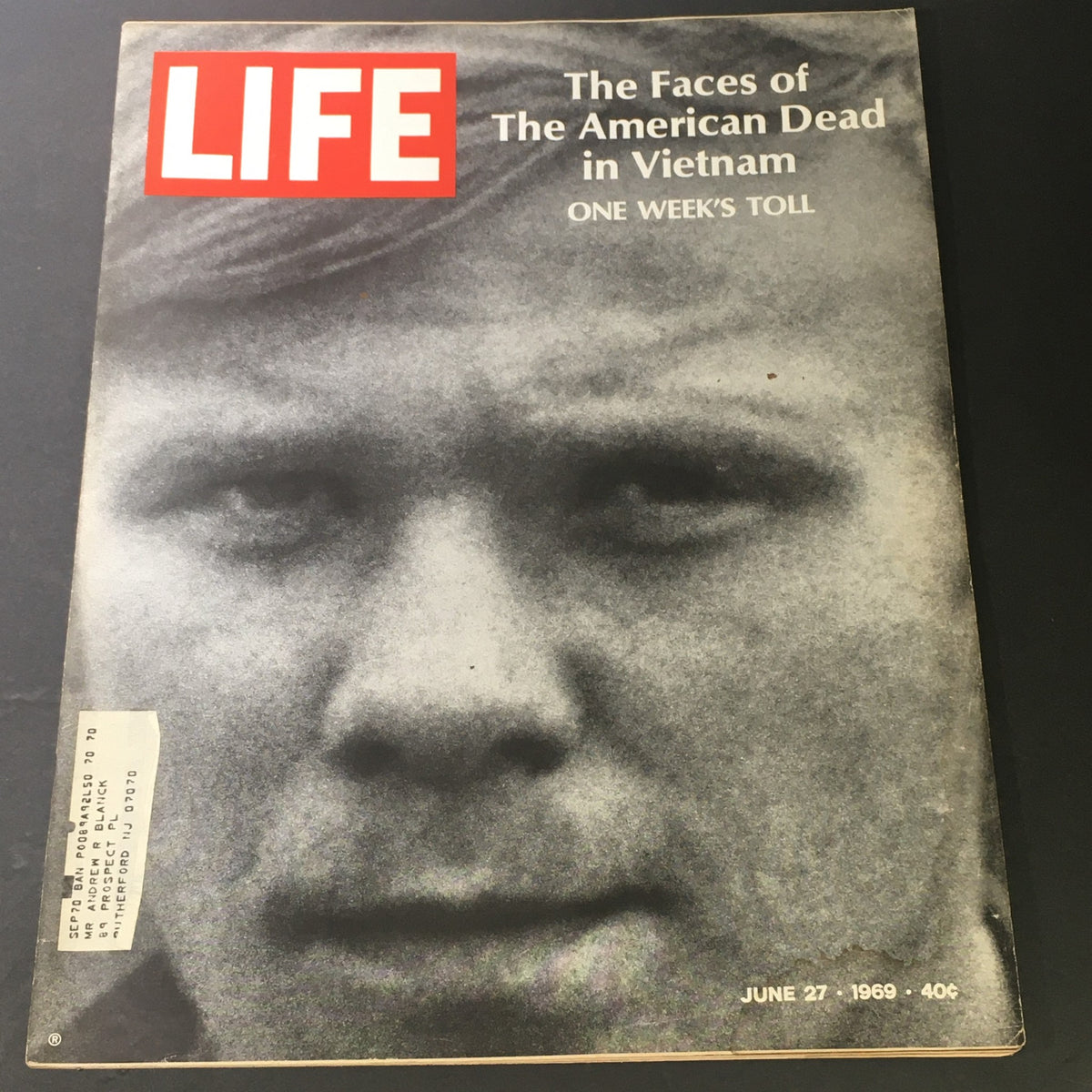


Description
Collector's Note – Why This Issue Matters
The June 27, 1969 issue of Life Magazine — cover story "The Faces of the American Dead in Vietnam" — is one of the most historically significant and morally consequential magazine issues ever published in the United States. The concept was stark and unprecedented in its scale: Life devoted pages to the photographic portraits of every American serviceman killed in Vietnam during a single representative week — the week of May 28 through June 3, 1969 — presenting 242 faces in the unadorned format of a high school yearbook, each identified by name, age, and hometown. The cumulative visual impact was devastating in a way that no combat photograph, no casualty statistic, and no political speech had achieved. These were not abstractions. They were young men — most of them teenagers or barely in their twenties — from every state in the country, every racial and ethnic background, every kind of American town and city. Seeing them all at once, in a single magazine, made the weekly death toll viscerally human in a way that the war's coverage had not previously managed.
The editorial courage required to publish this issue in June 1969 cannot be overstated. The Nixon administration had just taken office in January, promising a plan to end the war that had not yet materialized. The antiwar movement was growing but still contested, and mainstream media institutions were navigating intense pressure from the government, from military supporters, and from their own readership to frame the war in terms that did not undermine morale or the administration's policy. Life's decision to publish 242 portraits in a single issue was a deliberate editorial act — a statement that the human cost of the war deserved to be seen whole, that the abstraction of "casualties" had to be replaced with the specificity of faces and names and hometowns. The issue's impact was immediate and enormous: congressional testimony cited it, antiwar activists reproduced it, and it remains to this day one of the most referenced pieces of Vietnam War journalism in the historical and journalistic literature. For collectors who follow Life's long history of photojournalism that changed the way Americans saw their world, the full scope of the publication's archive is represented in the Life Magazine collection at OriginalMagazines.com.
This issue also arrives at a specific and important moment in the war's political trajectory. President Nixon had announced the first withdrawal of American troops from Vietnam on June 8, 1969 — just nineteen days before this issue's cover date — in a move that was simultaneously a response to public pressure and a reframing of the war's terms. The 242 faces published in this Life issue represent men who died before that announcement, men whose deaths were part of the casualty rate that had made withdrawal politically necessary. The issue is therefore not only a document of grief but a document of political causation — evidence of the human cost that drove policy change. For collectors assembling a comprehensive picture of America in the crucial summer of 1969, the complete 1969 magazine archive at OriginalMagazines.com provides essential surrounding context from one of the most consequential years of the Vietnam era.
About the Publication
Life Magazine was an American general-interest weekly founded by Henry Luce in 1936 and published in its original weekly format until 1972, reaching peak circulations that made it one of the most widely read publications in the world during its prime decades. Built around large-format photojournalism, it defined the visual language of mid-century American culture more than any other single publication. By 1969 it was operating in a period of intense editorial self-examination about the Vietnam War — a conflict it had covered extensively since the early 1960s and whose mounting human cost was forcing a reckoning with the limitations of the optimistic framing that had characterized much of its early war coverage. The "Faces of the American Dead" issue represents the publication at its most morally serious and most willing to use its unmatched photographic platform in service of a truth that was uncomfortable for the administration, for the military, and for a portion of its own readership — a willingness that defines its most historically significant work.
Key Highlights Inside
- The complete photographic presentation of 242 American servicemen killed in Vietnam during the week of May 28 through June 3, 1969 — each identified by name, age, and hometown — constituting one of the most powerful acts of documentary journalism in the history of American magazine publishing and the issue's defining and historically irreplaceable content.
- The cumulative visual argument of the portrait format itself — presenting the week's dead as a community rather than a statistic, making the human cost of the war visible in a way that transformed public understanding of what the casualty figures actually meant in human terms.
- Editorial context published nineteen days after Nixon's announcement of the first troop withdrawal, situating this issue at the precise intersection of maximum public pressure and the beginning of the war's political unwinding — a position that gives it documentary significance beyond its immediate emotional impact.
- The broader editorial content of a June 1969 Life issue — including the advertising and lifestyle features that surrounded the war coverage, capturing the specific texture of ordinary American commercial life continuing alongside the extraordinary grief the cover story documented.
- Note: Specific additional article titles and interior features beyond the Vietnam dead portrait feature are unconfirmed for this issue. The above reflects what can be responsibly attributed based on the cover story, publication format, and date. The portrait feature itself is the issue's defining and most historically documented content.
Condition & Rarity
Surviving copies of this issue are described as carrying an address label on the front cover, in good and used condition with very minor edge wear, possible minor marks or rips, and some water damage — condition details that collectors should evaluate carefully against the photographs before assessing overall grade. The address label affects the visual presentation of the cover and is a relevant factor in grade assessment; label-free newsstand copies of this specific issue are consistently preferred by collectors for whom cover integrity is a primary consideration, though they are harder to locate. The water damage is the most significant condition variable noted in this listing and warrants careful examination in the photographs to determine its extent, placement, and impact on the legibility of the portrait pages — which are, for this particular issue, the primary documentary and historical content. The protective plastic covering reflects deliberate preservation. When evaluating any surviving copy of this issue, collectors should prioritize the completeness and legibility of all 242 portrait pages as the defining condition standard, alongside the integrity of the cover, the spine and binding, and the overall structural soundness — the combination of factors that determines whether a given copy fully delivers on the extraordinary historical significance this issue carries.
Looking for More Issues Like This?
The June 27, 1969 Life "Faces of the American Dead" issue is widely recognized as one of the most historically significant magazine covers and features in the publication's entire run — and in American journalism broadly — making clean surviving copies with minimal condition issues consistently sought after whenever they surface. If this issue has already found its home, the Life Magazine archive at OriginalMagazines.com is the most comprehensive place to continue searching across the publication's many decades of landmark photojournalism. For collectors whose focus is the extraordinary and consequential year of 1969 in American history, the 1969 magazines collection brings together material from across the American press during one of the most turbulent and historically dense years of the Vietnam era.