
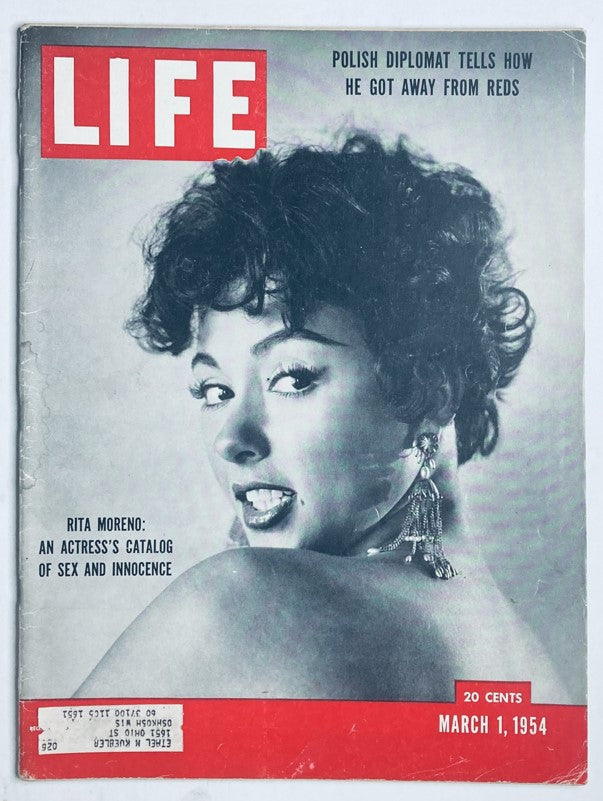


Description
Collector's Note – Why This Issue Matters
March 1, 1954 places this Life Magazine issue at a specific and revealing moment in both American entertainment history and Cold War geopolitics — and the combination of Rita Moreno and a Polish diplomat on the same cover is itself a document of that intersection. Life's editorial instinct in the early 1950s was consistently to find the human story within the political story, and a Polish diplomat appearing alongside a Hollywood actress in the same cover treatment reflects the magazine's characteristic approach to the Cold War: not as an abstract ideological conflict but as a lived reality populated by specific individuals navigating an extraordinarily complicated world. Poland in early 1954 was firmly within the Soviet bloc, and any Polish diplomat appearing in a major American publication during the height of McCarthyism and the Red Scare was an inherently charged subject — a reminder that the Iron Curtain, however real, was crossed by human beings with careers, ambitions, and stories that Life's photojournalistic approach was uniquely equipped to document. For collectors building an archive of Life Magazine issues from the Cold War era, this March 1954 edition represents exactly the kind of unexpected editorial juxtaposition that made Life's covers some of the most historically rich artifacts in twentieth-century American publishing.
Rita Moreno's presence on this cover in March 1954 is a primary document of a career at a genuinely interesting transitional moment. Moreno had arrived in Hollywood in the late 1940s and had spent the early fifties working steadily in studio productions, frequently cast in the "exotic" ethnic roles that the Hollywood system of the period offered to performers of her background — she was Puerto Rican-born and had navigated the specific limitations and opportunities that background presented in an industry still operating under the conventions of the studio era. By March 1954 she was a recognizable face without yet being a major star, and a Life Magazine cover appearance represented a form of mainstream media validation that could meaningfully affect a performer's career trajectory. The roles and recognition that would eventually bring her the EGOT achievement she became the first person to complete were still years away — West Side Story was seven years in the future — which makes this 1954 Life cover a document of Moreno at an early and historically significant stage of a career whose full arc would prove extraordinary. Collectors researching entertainment and cultural magazines from 1954 will find this issue a precisely dated artifact of Moreno's pre-fame visibility and of the specific dynamics of ethnic representation in early-1950s Hollywood culture.
The broader editorial context of a March 1, 1954 Life Magazine adds further documentary layers to an already historically rich issue. The early months of 1954 were an extraordinarily consequential period in American political and social history — the Army-McCarthy hearings were approaching their pivotal spring and summer confrontations, the Supreme Court's Brown v. Board of Education decision was still months away, and the country was navigating the social tensions that would eventually produce the civil rights movement of the following decade. Life was the primary photojournalistic document of American life throughout this period, and its weekly issues collectively constitute one of the most detailed visual records of how the country looked, thought, and presented itself during one of the most charged decades of the twentieth century. A March 1954 issue that placed the specifically charged figure of a Polish diplomat alongside a Puerto Rican actress in the same cover story was doing something editorially ambitious — using the specific to illuminate the general, as Life at its best always did.
About the Publication
Life Magazine was founded by Henry Luce in 1936 as a weekly photojournalism publication and operated continuously in that format until 1972, when it transitioned to special issues before relaunching as a monthly in 1978. At its peak in the postwar decades it was among the most widely circulated magazines in the United States, built on the editorial conviction that photography could document history, convey emotion, and communicate across barriers of education and background in ways that text alone could not. Its staff photographers over the decades included some of the most celebrated photojournalists of the twentieth century, and its pages served as the primary visual record of virtually every major event in American and world affairs from the late 1930s through the early 1970s. By March 1954 Life was operating at the height of its cultural authority — its circulation was enormous, its editorial ambition was fully expressed, and its covers were among the most carefully considered editorial statements in American journalism. The combination of Hollywood celebrity and geopolitical subject matter in this particular issue is entirely consistent with Life's mid-fifties editorial philosophy of treating the full range of American and world experience as equally worthy of its photographic resources and editorial attention.
Key Highlights Inside
- Rita Moreno cover appearance and associated feature — a primary document of the actress's mainstream media visibility in March 1954, seven years before West Side Story and more than two decades before the EGOT achievement that would establish her as one of the most decorated performers in American entertainment history, representing an early and historically significant record of her public profile during the studio-era phase of her career.
- Polish diplomat feature — Cold War-era Life coverage engaging a representative of a Soviet bloc nation at the height of McCarthyism, reflecting the magazine's consistent editorial approach to treating political complexity through the lens of individual human stories rather than purely abstract ideological framing, and constituting a primary source document of how American mass media navigated the specific tensions of the early 1954 geopolitical landscape.
- Photojournalism, news coverage, and editorial content consistent with Life's March 1, 1954 weekly format — the issue would have carried the full range of the magazine's departmental coverage across American and world affairs, science, entertainment, sports, and culture, collectively constituting a comprehensive weekly snapshot of the United States at a moment of significant social and political transition.
- Period advertising reflecting the consumer culture of early 1954 directed at Life's enormous and demographically broad American readership — a category of documentary interest for researchers studying postwar American commercial culture, as the advertising pages of a March 1954 Life capture the brands, products, and aspirational messaging of a specific moment in the American economy's postwar expansion.
- Note: Specific article titles, photography credits, and confirmed secondary editorial content details beyond the cover story subjects have not been individually verified for this issue. The highlights above reflect Life's well-documented editorial format and the verified cover subjects rather than inventoried interior content.
Condition & Rarity
Life Magazine issues from March 1954 are approaching their seventy-second year of existence, and the condition landscape for surviving copies reflects the full physical weight of that age alongside the specific vulnerabilities of Life's large-format staple-bound design. The magazine's oversized pages and staple construction made it more susceptible to cover separation, page loosening, and spine stress than smaller-format publications, and copies from this era that have survived in displayable condition have almost invariably done so through storage circumstances that protected them from the active handling and casual discard that claimed the majority of the original print run. The listing directs collectors to the photos for condition assessment — a standard and appropriate practice for a publication of this age — and the plastic protective sleeve provides ongoing archival protection for what is now a seventy-plus-year-old publication whose paper stock has had ample time to develop the brittleness and tanning that unprotected storage accelerates. The Rita Moreno cover image is the primary visual document and the condition attribute most directly relevant to display value; collectors evaluating surviving examples of this issue should prioritize cover integrity and legibility, the security of the staple binding, and the completeness of the Polish diplomat and Moreno feature pages as the primary condition criteria. A Life from this period in any condition that retains structural integrity and readable content represents a meaningful survival against the odds that have claimed most of its contemporaries.
Looking for More Issues Like This?
A March 1, 1954 Life Magazine with the Rita Moreno and Polish diplomat cover is a historically specific find at the intersection of classic Hollywood history and Cold War documentary journalism — the combination of subjects and timing gives it a collector profile that goes well beyond the standard vintage celebrity magazine, and surviving copies in displayable condition surface infrequently at nearly seventy-two years of age. If this issue is no longer available, the full Life Magazine collection at OriginalMagazines.com is the most comprehensive place to browse surviving issues from across the publication's history and locate other early-fifties editions, notable Hollywood covers, or Cold War-era issues that document the same extraordinary decade. The 1954 magazine collection brings together surviving issues from across that year's major publications for collectors working to document the full breadth of American print culture during one of the most historically consequential years of the postwar era.