

Description
Collector's Note – Why This Issue Matters
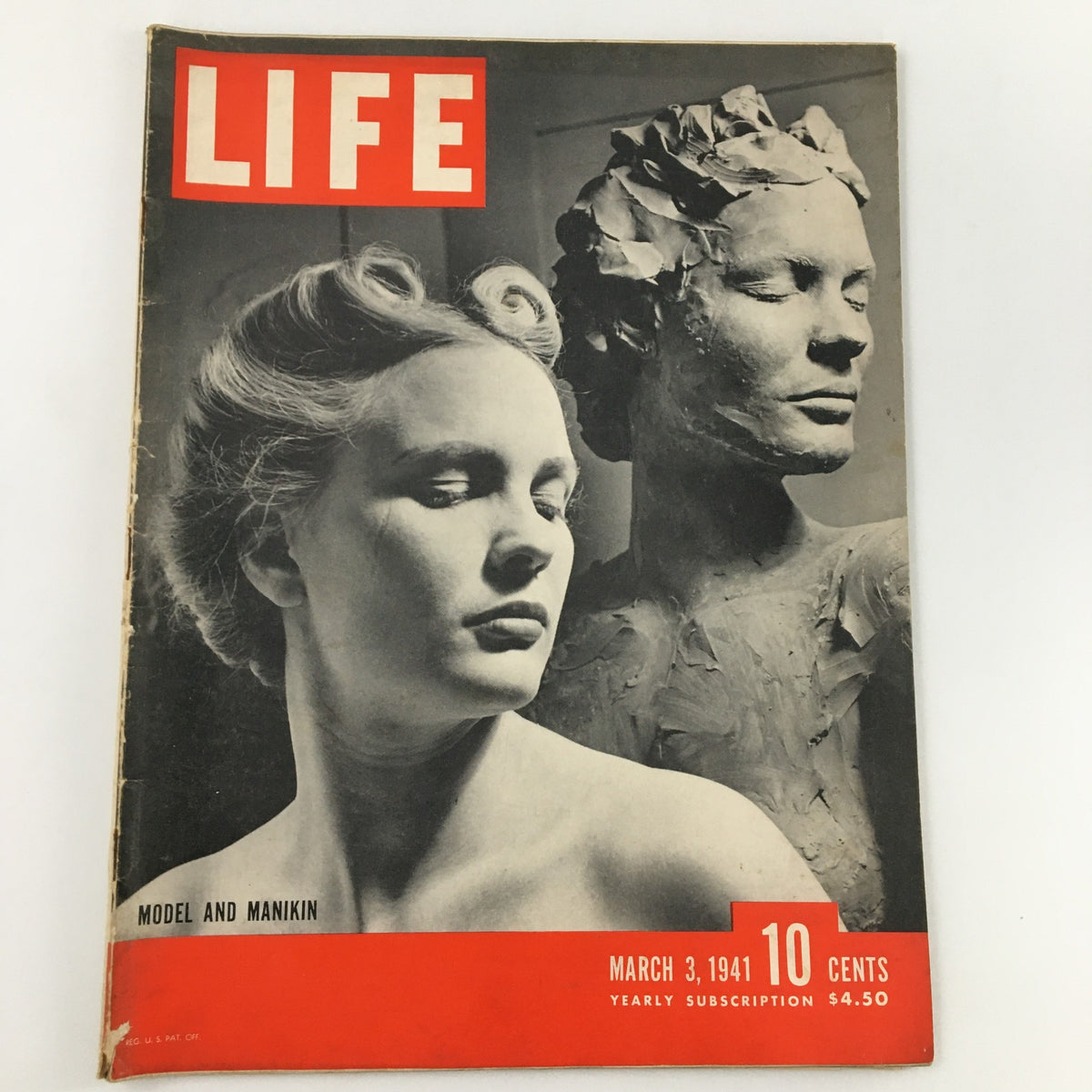
The March 3, 1941 issue of Life magazine, commonly cataloged as Volume 10, Number 9, is remembered for its visually intriguing “Model and Manikin” cover. The photograph places a living fashion model beside a human-shaped display figure, creating a carefully staged comparison between natural expression and manufactured stillness. It is an effective example of the immediately readable visual concepts that worked particularly well on Life covers during the publication's formative years as a picture magazine. Rather than depending on multiple headlines or dense explanatory text, the composition invites viewers to study pose, clothing, facial expression, and physical resemblance. The pairing also creates a subtle visual puzzle, asking the viewer to distinguish personality and movement from imitation and display. That simplicity gives the cover much of its lasting appeal.
The publication date gives the issue a broader historical importance. March 1941 fell during the Second World War, while the United States remained officially outside the conflict that was already transforming Europe, North Africa, and the Atlantic world. American readers encountered reports of international instability alongside domestic photography, entertainment, fashion, consumer advertising, and scenes of ordinary life. Against that background, the model-and-manikin composition represents more than an appealing fashion photograph. It preserves the visual language of American mass media at a moment when modern style and everyday consumer culture existed beside growing anxiety about events overseas. The contrast between the cover's controlled studio setting and the uncertainty of the wider historical moment is part of what makes the issue meaningful today. It shows how weekly magazines could move between serious global affairs and familiar aspects of daily life without treating those subjects as belonging to entirely separate worlds.
The cover also reflects the importance of photography in shaping contemporary ideas about fashion, femininity, presentation, retail display, and modern identity. Manikins were practical fixtures of department stores and shop windows, while professional models translated clothing into aspirational images for magazines, catalogs, and advertisements. By placing the two together, the photograph turns a familiar commercial object into part of a playful study of appearance and imitation. It also demonstrates how carefully controlled posture and styling could make a living person resemble an idealized display form. Among original magazines published in 1941, the issue offers a particularly clear example of how one photographic idea could attract newsstand attention while preserving details of early-1940s visual culture. For collectors, it represents both a dated historical document and an example of the sophisticated cover concepts that helped establish Life as a dominant force in American illustrated journalism.
About the Publication
Life was a large-format American weekly published by Time Inc. and developed under publisher Henry R. Luce as a major vehicle for photographic journalism. Launched in its influential picture-magazine form in 1936, it used photographs not merely as decoration but as the primary structure through which many stories were communicated. Its editorial format combined national and international news, extended photo essays, portraits, politics, war reporting, science, entertainment, fashion, sports, human-interest subjects, and commercial advertising intended for a broad national readership. Pages were frequently arranged so that sequences of photographs, captions, and concise blocks of text guided readers through a subject visually, allowing the images to carry much of the narrative. This format made complicated events more immediate to readers who might otherwise have encountered them only through newspapers or radio reports. By 1941, the magazine had become an important part of American media culture, presenting distant events and recognizable aspects of everyday life within the same weekly publication. Its large page size gave photographs unusual presence and made each issue a substantial physical object as well as a source of information. The March 3 issue belongs to this formative period, when Life was helping establish the picture magazine as one of the most influential forms of twentieth-century mass communication. Surviving issues also preserve period advertising, typography, photographic conventions, and editorial design, making them useful reference sources for historians beyond the specific subjects shown on their covers.
Key Highlights Inside
- The issue is dated March 3, 1941 and is commonly identified in magazine catalogs as Volume 10, Number 9 of Life. These details provide the principal reference points used when distinguishing it from other weekly issues published during the same year.
- The cover is known as “Model and Manikin,” featuring a posed comparison between a fashion model and a human-shaped display figure. The arrangement depends on similarity of pose and appearance while emphasizing the contrast between a living subject and an inanimate retail form.
- The cover concept reflects the close visual relationship between professional fashion modeling and the manikins used to present clothing in department stores and shop windows. It also records the role of carefully staged studio photography in early-1940s magazine design.
- The issue appeared during the Second World War, before the United States formally entered the conflict in December 1941. Its date therefore places it within a period of increasing American attention to overseas events while domestic consumer and cultural life continued to be documented.
- The magazine is identified in the listing as a newsstand example without an address label, leaving the principal cover image unobstructed. This distinction is especially relevant for collectors who study or display the complete photographic composition.
- A complete article-by-article table of contents, the identities of the cover model and photographer, and other specific interior features have not been confirmed from the supplied information. No additional articles, interviews, photo essays, or named contributors should be attributed to the issue without direct examination or authoritative documentation.
Condition & Rarity
The magazine is described in good condition, with small rips, edge wear, creases, marks, and other minor evidence of age and handling. Such flaws are common in large-format weekly magazines from the early 1940s because their broad covers, projecting corners, and relatively flexible paper were vulnerable to bending, rubbing, and short tears during reading, transport, and storage. The issue is identified as a newsstand example without an address label, an attribute that leaves the model-and-manikin cover photograph visually uninterrupted. In collector terminology, the absence of a mailing label can improve presentation, although it does not by itself determine overall grade or rarity. When evaluating a surviving example, collectors should examine whether the small rips remain confined to the margins, whether any creases cross the principal cover image, and whether the reported marks affect only the exterior or continue into the interior pages. Spine condition is also important, particularly around the staples and fold where repeated opening can create splitting or paper loss. Staple firmness, page attachment, completeness, paper flexibility, and the absence of missing advertisements, clipped photographs, or detached pages should all be considered. A plastic protective covering accompanies the magazine, although it is a later preservation accessory rather than an original component of the 1941 publication. Such a sleeve can reduce further exposure to dust and handling, but long-term preservation also depends on dry, stable storage away from direct sunlight and excessive humidity. The listing does not establish a measurable rarity classification, so rarity should not be inferred solely from age or condition. For this issue, the strongest reference points are the recognizable photographic cover, the early wartime publication date, the unlabeled newsstand presentation, and the survival of the complete periodical despite ordinary age-related wear.
Looking for More Issues Like This?
The March 3, 1941 “Model and Manikin” issue can be a tough individual date to locate, particularly when seeking an unlabeled cover with securely attached pages and a clearly preserved photograph. Readers interested in similar examples of photojournalism, fashion imagery, visual humor, and twentieth-century cover photography can explore the broader archive of vintage Life magazines. Comparing nearby issues can also show how the publication balanced wartime developments with fashion, entertainment, science, advertising, and everyday American life.
Additional magazines from 1941 provide valuable context for the news, design, consumer culture, and popular imagery surrounding the same historic year. Together, these periodicals help reveal how publishers documented a society approaching a major turning point while continuing to record the routines, tastes, and visual styles of daily life.