
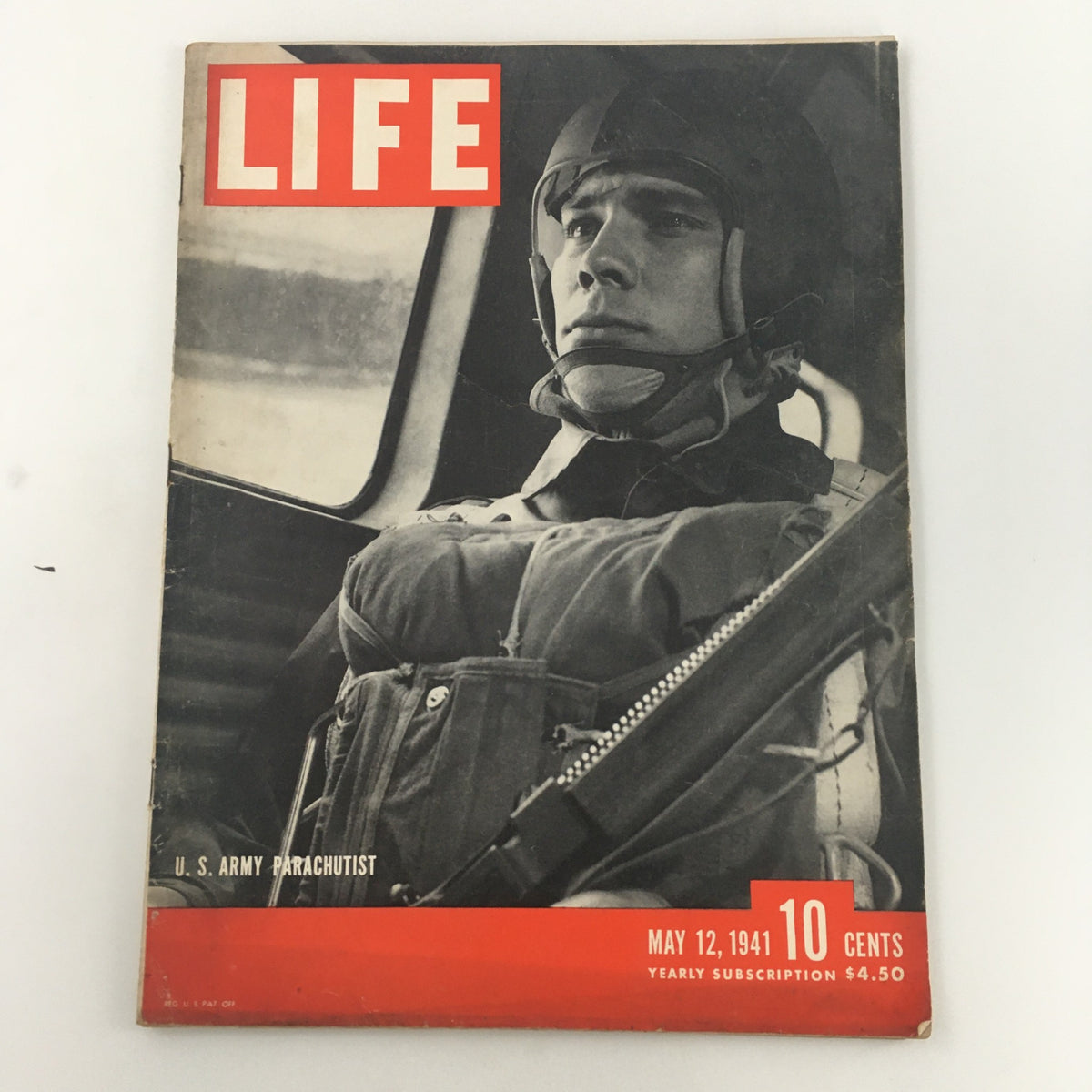


Description
Collector's Note – Why This Issue Matters
The May 12, 1941 issue of Life magazine featuring Bob Feller as a U.S. Army parachutist is a primary document of one of the most dramatic and most personally consequential decisions in the history of American professional sports — and a cover that captures a specific biographical moment that separates Bob Feller from almost every major figure in the game's history. Feller had enlisted in the U.S. Navy on December 9, 1941 — just two days after Pearl Harbor — becoming one of the first American sports figures to volunteer for military service following the attack. But the May 1941 cover predates Pearl Harbor by more than six months, which means this issue is not a post-attack enlistment story but rather an earlier engagement with Feller's relationship to military preparedness and national service in the months before American entry into the war. The specific context of a May 1941 Life feature showing Feller as a parachutist reflects the specific preparedness atmosphere of the period — the draft had been instituted in September 1940, defense industries were mobilizing, and the question of whether America would enter the European war was the dominant political and social question of 1941. Feller was at this moment the most celebrated pitcher in the American League, coming off a 1940 season in which he had led the AL in wins, strikeouts, and innings pitched — and a Life cover showing him as a military parachutist rather than a baseball player made a specific and deliberate statement about the relationship between athletic excellence and national duty in the pre-Pearl Harbor mobilization atmosphere. For collectors who focus on vintage Life magazine issues from the pre-war mobilization era, this May 1941 Bob Feller cover is a primary document of that specific and historically unrepeatable moment.
Bob Feller's military service record gives this May 1941 cover a retrospective significance that no contemporary viewer could have fully anticipated. When Feller enlisted following Pearl Harbor, he was at the absolute peak of his athletic career — twenty-two years old, with the best years of his prime still ahead of him — and he would serve nearly four full years in the Navy, missing what would have been his most productive seasons. By the time he returned to the Cleveland Indians in 1945, he had lost approximately 1,000 innings of pitching — a statistical sacrifice that would have produced, by virtually any reasonable projection, at least 100 additional career victories. He is consistently cited alongside Ted Williams as the player who sacrificed the most to military service of any Hall of Famer in the game's history. A Life cover from May 1941 showing him in military preparedness mode — six months before Pearl Harbor, before the decision to enlist had been made — is therefore a document of the biographical arc that would lead to that sacrifice, produced at the moment when the decision was still ahead of him. Collectors building archives around the magazines of 1941 — the year America moved from mobilization to war — will find this May issue a document of that transition's human dimension with unusual biographical specificity and emotional resonance.
The broader significance of this cover for collectors who understand the intersection of baseball history and American military history extends to the specific cultural function that athlete-as-soldier imagery served in the pre-Pearl Harbor mobilization period. The identification of America's most celebrated athletes with military preparedness and national duty was a deliberate element of the political campaign to shift public opinion toward intervention — and Feller's participation in that imagery, whether as a personal statement of readiness or as part of a broader cultural messaging effort, reflects the specific quality of the pre-war mobilization moment that gave 1941 its characteristic combination of athletic normalcy and existential national crisis.
About the Publication
Life magazine, founded by Henry Luce in 1936 and published weekly, had by May 1941 become the most widely read pictorial journalism publication in the United States — a magazine whose visual documentation of American and world events, whose photojournalism, and whose editorial intelligence had given it a cultural authority and a weekly readership in the tens of millions. Its pre-war mobilization coverage, combining military preparedness imagery with the sports and celebrity coverage that had always been central to its format, was producing some of the most culturally revealing documents of the American pre-war period, and the Bob Feller parachutist cover represents that tradition at one of its most historically specific and most biographically resonant moments.
Key Highlights Inside
- A cover feature on Bob Feller as a U.S. Army parachutist — the Cleveland Indians' most celebrated pitcher, here depicted in military preparedness training six months before Pearl Harbor would prompt his full enlistment, producing one of the most historically specific and most biographically resonant documents in pre-war American sports journalism at the exact biographical moment before the sacrifice that would define his legacy.
- Visual documentation of the pre-Pearl Harbor military preparedness atmosphere — Feller in military training context, reflecting the specific cultural effort to associate athletic excellence with national defense readiness in the months when American entry into the war was the dominant political and social question.
- Coverage reflecting the specific cultural atmosphere of May 1941 America — a country eighteen months into the European war, actively mobilizing its defense industries, navigating the political debate between intervention and isolation, and using its most celebrated cultural figures to communicate the values and urgencies of the mobilization moment to its enormous popular readership.
Note: Specific interior article titles, photographers, bylines, and additional editorial details beyond the cover subject are unconfirmed for this issue from available sources. The highlights above reflect verifiable historical context drawn from the cover subject, publication date, and the well-documented circumstances of Bob Feller's military engagement and Life magazine's pre-war editorial priorities.
Condition & Rarity
This copy carries an address label on the back cover and light writing, along with minor edge wear and potential small marks or rips — a condition profile that collectors should assess carefully against the provided photographs. The back label rather than front label placement is a positive attribute for the cover's presentation, as the Bob Feller parachutist cover image is preserved without label adhesive damage or postal handling marks on its front surface. The light writing is a personal use characteristic that should be assessed in photographs for its extent and location relative to the editorial content. The described good used condition with minor edge wear falls within the expected range for an eighty-plus-year-old large-format magazine. The plastic protective sleeve provides ongoing conservation value. For a May 1941 Life featuring Bob Feller in military preparedness imagery six months before Pearl Harbor — a document of one of baseball's greatest figures at the biographical hinge point before the military service that would define his historical legacy — a copy in good condition with the front cover art intact and readable interior pages represents a meaningful and historically specific acquisition for collectors of baseball history, military history, and pre-war American journalism.
Looking for More Issues Like This?
A May 1941 Life featuring Bob Feller as a military parachutist — produced at the biographical moment before the Pearl Harbor enlistment that would cost him the most statistically productive years of one of baseball's greatest careers — is a historically specific and emotionally resonant find for collectors of both sports memorabilia and wartime American cultural history. If this issue has already found a home, the broader vintage Life magazine collection at OriginalMagazines.com is an excellent resource for other significant sports, military, and pre-war mobilization covers from the publication's remarkable 1940s run. Collectors focused on the mobilization atmosphere, sports culture, and historical landscape of 1941 — the year that ended American neutrality — will find it well worth exploring the full 1941 magazine archive, which brings together publications from one of the most consequential years in modern American history.