



Description
Collector's Note – Why This Issue Matters
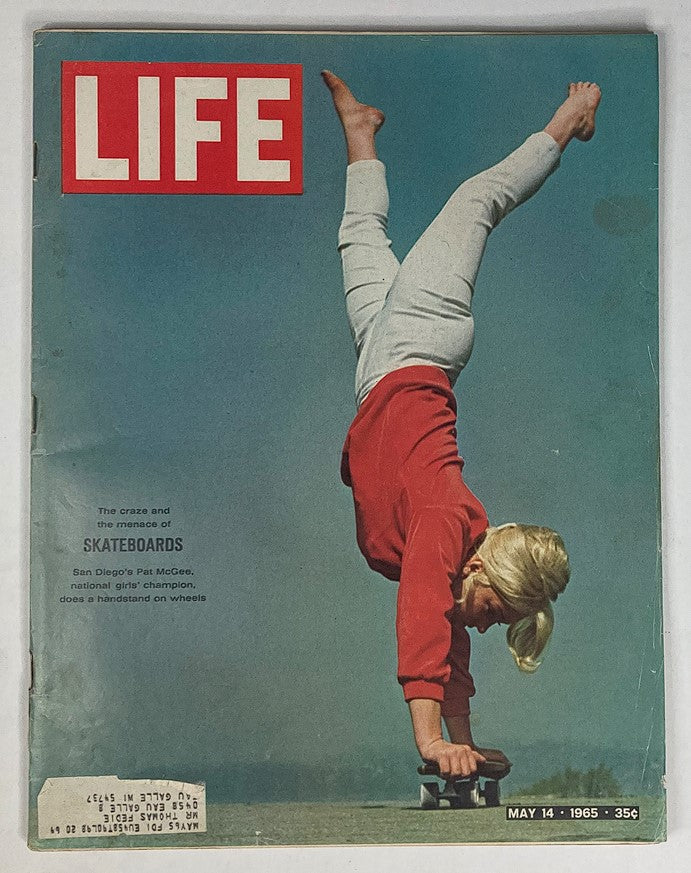
In the spring of 1965, skateboarding was in the middle of its first major cultural moment. What had begun as a California sidewalk pastime — loosely derived from surfing and initially dismissed by parents and civic authorities as a passing fad and a public nuisance — had by the mid-sixties exploded into a genuine youth phenomenon, complete with organized competitions, dedicated publications, and a growing industry of manufacturers scrambling to meet demand from teenagers across the country. The sport had its own heroes, its own aesthetic, and its own relationship to risk and freedom that set it apart from the organized team sports that had dominated American youth culture for generations. When Life magazine turned its lens on the sport for its May 14, 1965 issue, it did something that cemented skateboarding's arrival in the mainstream American consciousness in a way that no amount of local newspaper coverage or niche sporting press could have accomplished. And the face it chose for that moment was not a boy. It was Pat McGee, the national girls skateboard champion, photographed in a feat of balance and athletic control that stopped readers cold at newsstands from coast to coast. For collectors of Life magazine issues from the sports and youth culture beat, this is one of the genuinely irreplaceable issues of the decade.
Pat McGee's appearance on the cover of Life is significant on multiple levels that only become clearer with the passage of time. The photograph — McGee executing a handstand on a moving skateboard — was not a casual or incidental snapshot. It was a technically demanding image of a young woman performing at the absolute frontier of what the sport looked like in 1965, and it ran as the cover of the most widely read magazine in America during one of the publication's peak circulation years. At a time when female athletes were routinely marginalized, relegated to the back pages, or ignored entirely by mainstream sports coverage, McGee's cover was an anomaly in the best possible sense: a major national publication treating a young woman's athletic achievement as the single most compelling visual story of the week. The image has been reproduced and referenced extensively in skateboarding history literature, in museum exhibitions documenting the sport's origins, and in broader scholarly discussions of women in sports media, giving this specific issue a documentary significance that extends well beyond its original publication context and continues to grow as skateboarding's cultural and Olympic profile expands in the twenty-first century.
The mid-sixties were a pivotal and genuinely electric period for youth culture more broadly, and skateboarding was one of the clearest and most visible expressions of a generation asserting its right to define its own aesthetic, its own heroes, and its own relationship to public space and physical risk. This issue of Life captures that energy at a precise and unrepeatable moment in the sport's history — before the first skateboarding boom crashed in the late sixties under pressure from safety advocates and municipal bans, before the urethane wheel revolution of the early seventies transformed the sport's technical possibilities entirely, and before the culture had calcified into the forms and subcultural codes we recognize today. The fact that a young woman stands at the center of this particular historical snapshot adds a dimension that skateboarding's later, heavily male-coded mythology tends to obscure. Volume 58, Issue 19 is therefore not simply a sports collectible or a piece of sixties nostalgia. It is a primary document of a cultural inflection point, and one that rewards closer examination the more context a collector brings to it. Those building a comprehensive archive of 1965 magazines will find few issues from that year that capture the spirit of the era with quite this much immediacy, visual power, and historical layering.
About the Publication
Life magazine, relaunched by Henry Luce in 1936 as a large-format photojournalism weekly, spent the following three-plus decades as the most influential visual news publication in the United States and, by many measures, the world. Its editorial model was built on the absolute primacy of photography — staff photographers were given extraordinary latitude, resources, and creative freedom to pursue images that told stories words alone could not — and its covers were treated as weekly declarations of what mattered most in American life at that precise moment. The magazine reached upwards of 8 million direct subscribers at its peak, with total readership estimated considerably higher through pass-along copies circulating in homes, waiting rooms, barbershops, and public libraries across the country. A single issue could reach tens of millions of pairs of eyes, which is why a Life cover carried a cultural weight in the mid-twentieth century that is difficult to fully convey to anyone who grew up after the weekly's demise. By 1965 the magazine was publishing at the height of its influence and ambition, covering the civil rights movement, the escalating conflict in Vietnam, the space race, and the emerging youth counterculture with a combination of visual boldness and long-form narrative depth that no other publication of the era could match. Its photographers — among them some of the greatest in the history of the medium — were present at virtually every defining moment of the postwar American century. Life ceased weekly publication in 1972, making every issue from the mid-sixties a document from the mature, confident peak of one of American journalism's truly irreplaceable institutions.
Key Highlights Inside
- The cover features Pat McGee, the national girls skateboard champion, photographed performing a handstand on a skateboard — an image that has become one of the most recognized sports photographs of the 1960s and a landmark document in the visual history of both skateboarding culture and women's athletic achievement in mainstream American media.
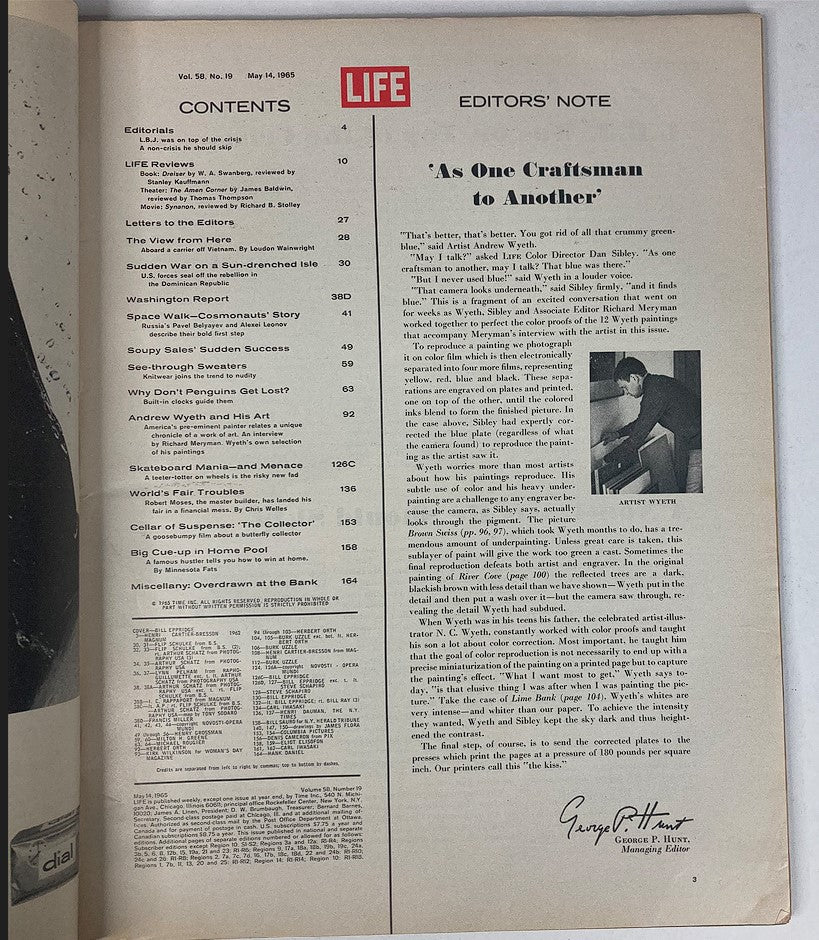
- The issue is precisely identified as Volume 58, Number 19, placing it within Life's publishing chronology at a moment when the magazine was operating at the absolute height of its circulation, editorial ambition, and cultural influence — details that matter to serious Life collectors building complete runs.
- The coverage of McGee and the broader skateboarding phenomenon represents one of the earliest and most prominent treatments of the sport by any major American mainstream publication, giving this issue a foundational and frequently cited place in the documentary history of skateboarding from its first cultural emergence in the early-to-mid sixties.
- The decision to frame a female athlete as the central figure of a major sports cover in 1965 makes this issue genuinely notable within the longer history of women's sports media representation — a context that has given the issue renewed attention from scholars, curators, and collectors in recent decades as interest in that history has grown substantially.
- As a mid-spring 1965 issue, the magazine would have been published against the backdrop of a rapidly and visibly transforming American cultural and political landscape — the Civil Rights Act was less than a year old, U.S. combat troops had just arrived in Vietnam, and the counterculture was beginning its ascent — and its broader editorial contents would have reflected the full, complex range of stories Life was tracking at one of the most consequential moments of the postwar era.
- Note: Specific secondary features and full interior article details beyond the confirmed cover story have not been independently verified for this issue. The above reflects what is documented from the cover, volume and issue identification, and the well-established historical record surrounding Pat McGee and skateboarding's first major cultural moment in 1965.
Condition & Rarity
Surviving copies of this issue in genuinely collectible condition are considerably scarcer than the original print run would suggest, and that gap between original circulation figures and present-day availability is worth understanding for anyone seriously pursuing this issue. Life was produced on lightweight coated and newsprint-grade paper stock that was engineered for a reading life of weeks rather than decades, and the majority of the millions of copies printed in May 1965 did not survive the following sixty years in any condition worth describing. Those that have reached the collector market typically show the characteristic aging patterns of mid-sixties periodicals — some degree of tanning and mild brittleness to the outermost pages, softening at the spine from handling and storage, and occasional light foxing on interior pages — while retaining full structural integrity, complete page counts, and legible, visually intact content throughout. The listing for this issue does not specify the presence of an address label on the cover, which, if confirmed absent, represents a meaningful condition advantage: label-free covers preserve the complete visual impact of the McGee photograph without any interruption or distraction, and are generally preferred by collectors who intend to display the issue. Protective plastic sleeve storage, whether applied at the time of original preservation or retroactively by a later owner, is the accepted standard for maintaining coated-paper periodicals of this era and significantly slows the oxidation, light damage, and humidity effects that degrade unprotected copies over time. Given the exceptional crossover appeal of this particular issue — skateboarding collectors, women's sports historians, Life magazine archivists, sixties youth culture researchers, and general Americana collectors all have legitimate and independent reasons to seek it out — demand has historically and consistently outpaced the supply of well-preserved examples, and that dynamic is unlikely to change as the skateboarding's profile continues to grow in the Olympic era.
Looking for More Issues Like This?
The May 14, 1965 Pat McGee issue is one of those genuinely rare finds where sports history, women's history, youth culture history, and the history of American photojournalism all converge in a single cover image — and copies in solid collectible condition are difficult to locate precisely because so many different kinds of collectors are looking for the same thing. The Life magazine collection at OriginalMagazines.com spans a wide and carefully assembled range of the publication's iconic weekly run, and is the natural and most comprehensive starting point for anyone building a serious archive of twentieth-century American visual journalism. For collectors drawn specifically to the cultural energy, optimism, and turbulence of the mid-sixties, the broader 1965 magazine collection offers a rich and varied cross-section of the year across multiple titles and editorial perspectives — a deeply valuable companion resource for anyone who understands why this specific and extraordinary moment in American history is worth preserving in its original, unmediated print form.